Get Full Government Meeting Transcripts, Videos, & Alerts Forever!
Get email alerts on the Superintendent Search Interviews topic
No spam. Unsubscribe anytime.
Kennewick board holds preliminary superintendent interviews with three finalists; candidates outline safety, family partnership and finance priorities
Summary
The Kennewick School District Board conducted preliminary interviews with three finalists for the superintendent post, who emphasized school safety, partnerships with parents, fiscal caution around one-time funds and approaches to discipline and curriculum alignment.
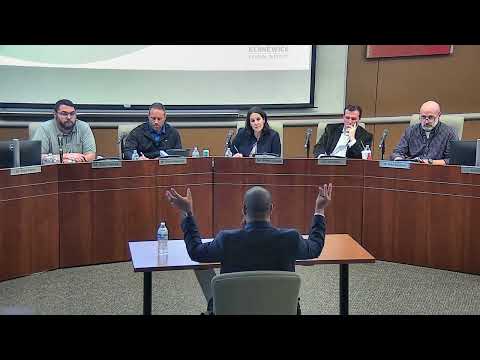
The Kennewick School District Board of Directors conducted preliminary interviews Oct. 12 with three finalists for the district superintendent job, asking each candidate about leadership style, family engagement, finances, school safety, curriculum and student discipline.
The interviews, which the board scheduled in 45–50 minute blocks, featured Damien O'Lois, assistant superintendent of student services in South Bend, Indiana; Bill Fritz, superintendent of Napa School District in Oregon; and Lance (last name not specified in the transcript), superintendent of Lewiston School District in Idaho. Board President Gabe Galbraith opened the session and directed the round-robin questioning.
Why it matters: The board will use candidate answers to compare approaches on pressing local issues — school safety, how to use one-time federal relief funds, and how the district should balance parental input with state requirements. Those issues affect classroom practice, budgets and community trust.
All three candidates said partnership with families is central. "The home is the first classroom, the parent is the first teacher," Damien O'Lois said, describing a triangle of parent, school and student and urging schools to treat parents as "co-teachers." Lance said similarly: "Parents are partners, period," and described requiring parent representation on committees and frequent school presentations to involve families in district decisions. Bill Fritz said the district should be "agnostic" on contested social or political issues and focus on helping students think critically and exposing them to multiple viewpoints.
On safety, candidates stressed layered approaches. Fritz said he is "the safety guy" and described secured entryways, silent alarms, panic buttons, camera systems and coordination with police and emergency services. O'Lois likewise recommended vestibules, panic alarms and annual safety planning with local responders. Lance described close coordination with law enforcement and safety grants and called controlled access points and perimeter security foundational.
Finances and one‑time federal funds were a recurring theme. O'Lois recounted ordering a comprehensive audit after taking a prior post and discovering a forecasted $6 million shortfall; he said he cut roughly $2 million the first year and $2.1 million the next while trying to protect classroom spending. Fritz advised against committing one‑time ESSER funds to recurring costs and described prioritizing capital improvements (HVAC, building envelope) and targeted instructional supports. Lance said the same: "Don't spend one‑time money on residual costs," and described aligning levy and bond messaging to community priorities.
Curriculum and political neutrality: Candidates told the board they would protect academic standards while engaging parents. O'Lois said schools should not "try to subvert" parents' role, and Fritz cited the federal Every Student Succeeds Act (ESSA) and the state's Parents' Bill of Rights initiative in arguing that schools must comply with law while respecting diverse community values. All three said curriculum-selection committees and clear communication are central to keeping instruction aligned to standards.
Discipline and student behavior: Candidates emphasized proactive instruction and supports over solely punitive responses. O'Lois described intervention models such as "promotion in doubt" plans with targeted supports and summer school. Fritz and Lance recommended assessing whether expectations are reasonable, teaching behavioral skills, using restorative approaches and ensuring counseling and mental‑health supports are available. Lance described a Lewiston approach that created a short-term transitional kindergarten program to address readiness and disruptive behavior in small groups; he said the targeted intervention produced measurable classroom improvement.
Next steps: The board did not take any votes in the public session. Following the public interviews, the board indicated it would move into executive session for applicant evaluation.
Quotes in context: All direct quotes in this story are taken from the candidates during the Oct. 12 board interviews. Where candidates tied examples to prior posts, the article attributes those examples to the candidate who gave them.