Get Full Government Meeting Transcripts, Videos, & Alerts Forever!
Get email alerts on the Capital Finance topic
No spam. Unsubscribe anytime.
Municipal advisors outline bond, tax-rate and PSFA options for Deming Public Schools; board to consider election timing
Summary
RBC Capital Markets municipal advisors briefed the Deming Public Schools board on capital funding options — general obligation bonds, education technology notes (ETNs), SB 9/HB 33 mill levies and PSFA/PSCOC rules — and presented election scenarios the board can consider before a likely November ballot placement.
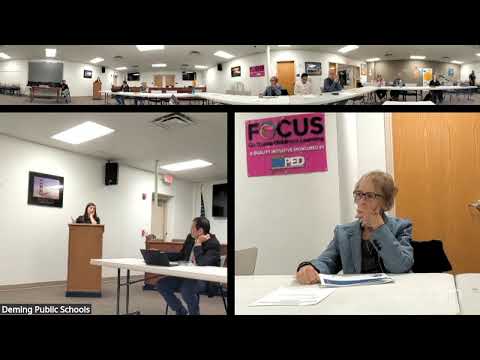
Kaylee, a municipal advisor with RBC Capital Markets, told the Deming Public Schools Board of Education on Jan. 30, 2025, that the district must weigh several debt- and tax-rate options to fund school facilities, technology and possible school replacement work.
The presentation summarized local capital funding sources (general obligation bonds and education technology notes), pay-as-you-go levies (Senate Bill 9 and House Bill 33), and financing routes (public sale, negotiated sale, or financing through the New Mexico Finance Authority). The advisors also ran multiple election scenarios the board could choose for the November 2025 ballot.
Key figures presented by the advisers: - The district’s residential tax rate has been about $8.25, made up of a $5.75 general obligation (GO) debt-service rate plus a $0.50 operational rate and an SB 9 levy. The board’s current plan has been to keep tax rates level unless directed otherwise. - Deming Public Schools has about $22,235,000 of GO bonds outstanding and is approximately 55% bonded to its legal capacity; based on 2024 assessed valuation the district’s legal bonding capacity was cited as roughly $40,000,000. - Municipal advisers projected a potential revenue loss tied to recent tax-structure changes amounting to “up to almost a half a $1,000,000” in a worst-case scenario (advisers said their plan conservatively modeled impacts). - To qualify for PSFA funding at the highest match (the advisers referenced the statute/PSFA rule), districts generally need to levy a $10 residential tax rate; for Deming that would require about a $1.80 increase in the GO debt-service tax rate under the scenarios shown. The advisers said the $1.80 increase would translate to about $60 annually per $100,000 of home market value.
Options presented included: - No tax-rate increase: seek a $9.5 million GO bond election in Nov. 2025 without changing the current $5.75 debt-service rate. - $1.80 tax-rate increase: raise GO debt-service to $7.55 (total residential rate about $10.05) to qualify to ask PSFA for higher matching; advisers showed this could support larger projects, including school replacement. - Larger upfront election (example scenario presented): a $20 million authorization layered under the $1.80 increase; advisers warned larger upfront authorizations would compress future election capacity until the new debt matures. - Blended GO and ETN approach: modest GO increase plus ETN levy to fund technology and infrastructure items (ETNs have a maximum term of five years; ETN authorization may or may not require voter approval depending on district choice).
Advisers noted tradeoffs among financing methods: the New Mexico Finance Authority can reduce issuance costs and provided a disadvantaged program that lowered the district’s 2023 borrowing costs, but NMFA holds funds on a requisition basis rather than delivering proceeds immediately. The advisers also flagged timing constraints: election approval in November is followed by a roughly one-year lag before tax-rate impacts flow through the Public Education Department’s tax-rate setting process.
The presentation included implementation planning items: bond cycling to manage tax-rate impacts, the prospect of early redemption of callable 2014 bonds using surplus cash (advisers estimated a projected surplus of about $1.1 million heading into 2025 collections), and the need for the district to finalize a facilities master plan to prioritize projects before choosing an election amount.
Board members asked questions about bonding-to-capacity norms, the practical effects of PSFA waiver thresholds, the scope of ETN-eligible projects (security systems, infrastructure, technology), and messaging for an off-year election in a community with a high retiree population. Kaylee offered to return for a facilities-focused work session and reminded the board that an election resolution should be approved by July to secure a favorable position on the November ballot.
There was no formal board action recorded on a bond or tax-rate increase at the Jan. 30 work session; advisers recommended follow-up work sessions and outreach to PSFA/PSCOC as next steps.