
Stormwater study and climate vulnerability assessment give Pembroke Park a 10‑year CIP and grant playbook
Get AI-powered insights, summaries, and transcripts
Subscribe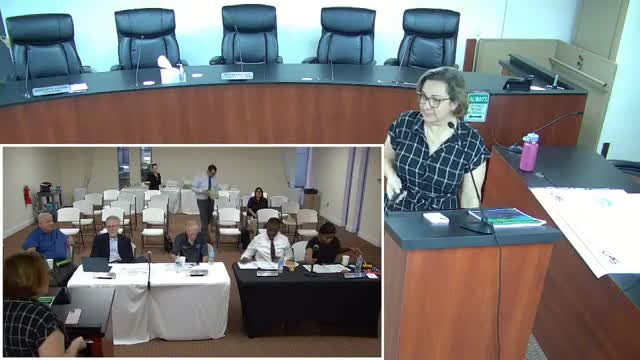
Summary
Consultants presented a stormwater master plan recommending nine CIP projects, maintenance scheduling, and vulnerability assessment results that identify areas and critical assets at highest risk from storm surge, tidal and rainfall flooding. The work positions the town for state Resilient Florida implementation grants.
Tiffany Stanton, a civil engineer with Kimberly Horne, and Giselle Gutierrez, a civil analyst who led the town’s vulnerability assessment, presented linked stormwater studies that lay out a 10‑year capital improvement plan and target areas for climate‑resilience grants.
The stormwater master plan provides a hydraulically calibrated model of the town’s drainage network, recommended performance goals aligned with county and state guidance, and a ranked list of nine projects intended to reduce street and property flooding. “We are recommending that you keep your roads dry in a 10‑year storm event,” Tiffany said, and noted federal, state and local rules that limit discharges and require buildings to be dry in larger events.
The vulnerability assessment (VA) maps current and future flood scenarios — including storm surge, king tides and 100‑year rainfall, as well as compound events — and scores critical assets (pump stations, public buildings, evacuation routes) by exposure and risk. Giselle said the VA used a standardized critical‑asset inventory and modeled 25 scenarios (current and future conditions to 2040/2070) to identify repeated vulnerabilities and focus areas suitable for implementation grants.
Why it matters: the two reports together provide the technical documentation grant reviewers typically require. Tiffany said the consultants built contingency and escalation into cost estimates and kept suggested project sizes in ranges that could be funded in several ways. Giselle told the commission the VA is at FDEP for final review and, once approved, the town will be positioned to apply for Resilient Florida implementation grants; that grant cycle opens July 1–September 1.
Major technical recommendations and findings: - Nine prioritized projects (Park Road North, south Park Road segments, two 31st Street projects, west‑side exfiltration projects, 52nd/36th Court drainage, and others). Each project bundles conveyance (trunk lines), inlets and, where suitable, exfiltration trenches or swales. Exfiltration trenches were recommended in higher‑elevation, green‑space west areas where groundwater and soils are permissive; they were not recommended for low‑lying areas with high groundwater or contaminated soils near the Superfund site. - A maintenance program tied to GIS so crews can record catch basin cleaning and pipe flushing. Tiffany recommended annual pipe flushing and catch‑basin inspections, street sweeping to keep debris out of drains, and regular pump station maintenance including scheduled starter and motor replacement cost allowances in the CIP. - Project sizing for grant readiness: consultants recommended keeping individual CIP projects roughly around $1 million to match typical annual budgeting and grant packaging, and included a 25% contingency at this concept stage.
Interactions with Superfund and development: commissioners and consultants discussed a nearby Superfund site and the potential for federal remediation or construction to disturb contaminated soils and buried infrastructure. Tiffany and staff advised coordinating pre‑construction meetings with the Superfund project team so town drainage or sewer projects are not later dug up and reexcavated.
Funding and next steps: the consultants encouraged the town to use the master plan and VA when assembling applications for Resilient Florida, state, and federal grants. Kimberly Horne noted an in‑house grant writing capability and offered technical support for cost‑benefit analyses and benefit‑cost ratios that grant programs commonly require.
Ending: the consultants left the town with a ranked CIP, a maintenance plan that can be integrated into GIS, and a vulnerability assessment that staff said will be used in emergency‑planning and grant applications. No formal action was taken at the workshop; FDEP review of the VA was pending at the time of the presentation.