
After hours of testimony, board finds no sale-to-intoxicated-person violation at 2,000 Liquors
Get AI-powered insights, summaries, and transcripts
Subscribe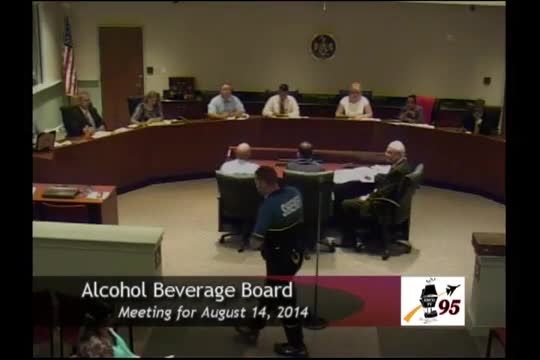
Summary
The St. Mary’s County Alcohol Beverage Board on Aug. 14 concluded a contested hearing on whether 2,000 Liquors sold alcohol to a visibly intoxicated person on April 23, 2014, and voted that the administrative record did not prove such a sale.
The St. Mary’s County Alcohol Beverage Board on Aug. 14, 2014 concluded a contested violation hearing about an April 23 incident at 2,000 Liquors, finding the licensee not proven to have sold alcohol to a visibly intoxicated person.
The hearing centered on testimony from St. Mary’s County deputies and other law‑enforcement witnesses who described contacts that day with Joanne Dimuzio at Nicollet Park and later at Lancaster Park. Deputy Timothy Snyder told the board he first found Dimuzio “about 12:30 … off the path, into the wood line” and described her as unable to walk without help, with “bloodshot eyes, slurred speech” and a “pungent smell of beer.” Snyder said he later observed Dimuzio enter 2,000 Liquors with another person and leave carrying a wet black bag that “you could tell it was a 6 pack.”
Corporal James Stone and DFC (Deputy First Class) Beishline also testified they found open and partly consumed cans in a wood line at Lancaster Park after following the pair. Beishline described removing Dimuzio from the woodline and said he “immediately checked the strong odor of an alcoholic beverage coming about her body and breath.” Deputies said two cans from the alleged six‑pack had been opened and about half a can remained in each of two discarded cans they collected.
Licensee representatives and the store’s on‑duty manager testified they had no recollection of a problematic sale that afternoon and said staff do refuse sales when customers appear intoxicated. The store’s owner testified he received notice of the administrative violation more than two months after the April 23 incident and said he had no contemporaneous contact with officers that would have allowed the business to preserve video. The store said it does keep video but that recordings are routinely overwritten and would not necessarily reach back two months.
Board members repeatedly pressed the evidentiary gap between what deputies observed outside the store and what, if anything, occurred inside during the roughly two to three minutes the licensee said the customer was in the store. Board attorney and participants also discussed that a district court charge arising from the same incident was later dismissed; the deputies testified they were not aware of that disposition at the time of the hearing.
After hearing testimony and receiving exhibits, a motion to find the licensee guilty of selling alcohol to an intoxicated person was made and did not carry. A subsequent motion that the violation did not occur carried on a majority vote; the board therefore did not proceed to a penalty phase.
The board’s action was administrative only: it resolved whether the record established the licensee sold or furnished alcohol to a visibly intoxicated person on April 23, 2014. The board did not make any criminal finding; deputies noted the district court outcome was dismissal of the criminal charge that had been filed in the separate judicial process.
The record before the Alcohol Beverage Board includes extended oral testimony from deputies Snyder and Beishline and from Corporal Stone; statements from the store’s owner and manager; and the board’s review of the incident timeline, photographs officers said they took at the scene, and other exhibits introduced into evidence.
Board members and county enforcement staff said afterward they plan to continue compliance outreach and targeted enforcement in areas with repeated public‑consumption and open‑container complaints. Deputy Snyder and DFC Beishline both told the board they encounter multiple alcohol‑related citations during routine patrols and that officers across the county conduct follow‑up investigations when circumstances warrant.
Votes at a glance: Motion to find violation occurred — failed; Motion that violation did not occur — carried. The board therefore recorded a formal finding that the violation was not proven on the administrative record presented that day.
The board closed the hearing and moved on to other licensing business.