Get Full Government Meeting Transcripts, Videos, & Alerts Forever!
Get email alerts on the Finance topic
No spam. Unsubscribe anytime.
Alaska revenue forecast shows lower unrestricted receipts as oil price and production outlooks fall
Summary
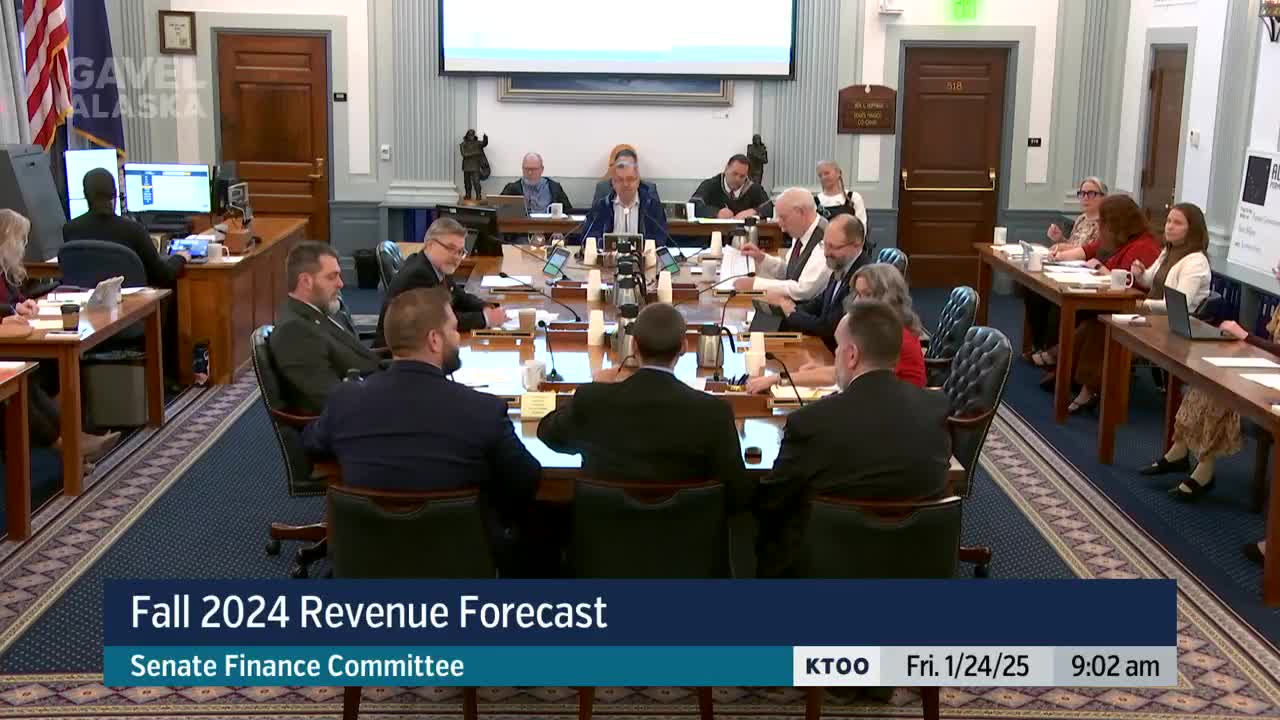
The Department of Revenue presented its fall 2024 revenue forecast to the Senate Finance Committee on Jan. 24, projecting lower unrestricted general fund receipts driven primarily by reduced oil-price and production assumptions and detailing Permanent Fund transfer assumptions and revenue sensitivities.
Juneau — The Alaska Department of Revenue on Jan. 24 told the Senate Finance Committee it expects total state revenue to fall modestly in the near term and that unrestricted revenue available for legislative appropriations will be weaker than earlier projections, driven largely by lower oil-price and production assumptions.
Dan Stickel, chief economist for the Department of Revenue, presented the fall 2024 revenue forecast and told the committee that the state received $16.3 billion in total revenue in fiscal 2024 and the department is forecasting $16.8 billion for fiscal 2025 and $15.7 billion for fiscal 2026. "The fall forecast was released on December 12th, concurrent with the governor's budget release," Stickel said, summarizing the department's published Revenue Sources Book and its assumptions.
The forecast assumes an Alaska North Slope oil price of $73.86 per barrel for fiscal 2025 and $70 per barrel for fiscal 2026, down roughly $4 per barrel from the spring outlook. Stickel said updated futures-market data and some actual price data informed the change. He noted the department used actual investment returns through October and assumed a 7.9% return for the Permanent Fund for the remainder of fiscal 2025 and a 7.65% annual long-term return thereafter.
Those price and production adjustments translated into a roughly $220 million reduction in unrestricted general fund revenue for fiscal 2025 and about $232 million for fiscal 2026, Stickel said. He also gave a sensitivity rule of thumb: at the center of the forecast, each $1 per barrel change in oil price corresponds to about $35 million of unrestricted general fund revenue, with the per-dollar sensitivity rising at higher price levels and falling at lower prices.
The department separated total revenue into the categories used for budgeting: unrestricted general fund, designated general fund, other restricted revenue, and federal receipts. Permanent Fund investment earnings and transfers remain the largest single contributor to unrestricted revenue; Stickel said the percent-of-market-value (POMV) transfer is expected to contribute more than half of unrestricted revenue in coming years and will steadily increase under the long-term return assumption.
Commissioner Adam Crum, who also represents the governor on the Permanent Fund Corporation trustees, said liquidity and the fund's asset mix are ongoing concerns. "The liquidity risk of the 5% draw is a constant point of discussion among the trustees and staff," Crum said, describing trustee briefings and consultant analyses that have shaped the department's view. He and Stickel noted that combining the Permanent Fund's two-account structure would require a constitutional amendment and that trustees have discussed that option.
Committee members pressed the department for near-term sensitivity analyses and multi-year (three- to five-year) projections that aggregate revenue and expenditure assumptions. Co-chair Stedman emphasized short- to mid-term cash risks to the Constitutional Budget Reserve (CBR) and asked the department to provide readily usable three- and five-year scenarios. Stickel said the department already produces sensitivity appendices in the Revenue Sources Book and offered to provide additional aggregated analyses to the committee and the Office of Management and Budget.
Senators also questioned the interaction between large capital expenditures for new North Slope developments and state tax receipts. Stickel and Crum described how the state's complex production tax — a net-profits tax with a gross minimum floor plus per-barrel credits for qualifying production — can make aggregate, per-barrel tax revenue difficult to estimate while major projects carry forward large capital costs that reduce near-term state receipts even as production rises later. "When a company is making investments in the state, there's three possible situations," Stickel said, describing cases in which investments either reduce current tax liabilities, produce carryforward losses, or interact with the minimum tax floor.
Nonpetroleum revenues — corporate income tax, mining license, fisheries taxes and excises — are forecast to contribute a little under $600 million annually to unrestricted revenue in fiscal 2025–2026. Stickel cautioned that corporate income tax collections remain one of the more volatile nonpetroleum sources, and the department's forecast assumes continued recovery from COVID-era losses and improving corporate profitability.
Committee members repeatedly asked about the CBR and the department's view of a safe floor. Commissioner Crum said the department, the Office of Management and Budget and the Attorney General's office maintain a working agreement on an "absolute floor" for daily cash purposes in the range of $4 billion to $500 million. He reiterated the department's willingness to produce consolidated short- and medium-term scenarios that show the combined effect of forecasts and proposed expenditures.
Stickel also reviewed transportation and cost assumptions that affect net revenues, including Trans Alaska Pipeline (TAPS) tariffs and tanker costs, which together averaged about $10.53 per barrel in fiscal 2024 and are projected to be slightly lower on a per-barrel basis if throughput increases. He outlined differences in royalty and tax treatment depending on land ownership (state, federal/National Petroleum Reserve–Alaska, ANWR, or private/Alaska Native Corporation land) and reminded the committee that royalties on federal NPRA production are shared with the state for use in impacted communities.
The committee did not take formal votes. The Department of Revenue offered to provide additional, aggregated 3- to 5-year sensitivity scenarios and project-level cash-flow examples (including a Willow project analysis posted on the department website) to help lawmakers assess near-term budget risk. The committee's next scheduled meeting is Jan. 27, when the Office of Management and Budget will present the governor's proposed FY26 budget.
Ending