Get Full Government Meeting Transcripts, Videos, & Alerts Forever!
Get email alerts on the Alaska Department Of Fish And Game Overview topic
No spam. Unsubscribe anytime.
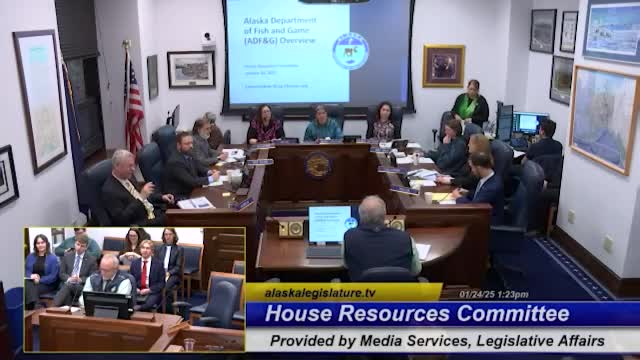
Commissioner outlines priorities, staffing and climate threats at House Resources overview of Fish and Game
Summary
Doug Vincent‑Lang, commissioner of the Alaska Department of Fish and Game, told the House Resources Committee that the agency is balancing statutory duties, staffing gaps and climate‑driven changes to salmon and big‑game populations while recruiting a subsistence director and seeking funds for vessel and aircraft maintenance.
At a Friday meeting of the Alaska House Resources Committee in Capitol Room 124, Doug Vincent‑Lang, commissioner of the Alaska Department of Fish and Game, gave a department overview that focused on statutory authority, staffing, budget structure and climate‑related threats to fish and wildlife.
The presentation explained the department’s mission and legal duties and why those responsibilities matter to both rural subsistence users and urban recreational and commercial interests. "Fish and game resources feeds our culture and feeds our families," Vincent‑Lang said, adding that Alaska’s constitutional sustained‑yield clause and state statutes guide management.
Vincent‑Lang summarized the agency’s organization and finances: he said the department’s overall operating budget is about $250 million and described several major program divisions (commercial fisheries, sport fish, wildlife conservation, subsistence, habitat and administration). He told the committee the department employs about 828 permanent full‑time staff and roughly 590–600 part‑time staff, and runs large seasonal and lab programs that support management, stock assessment and permitting.
The commissioner described the Fish and Game Fund and other dedicated federal matching programs the department uses to leverage federal grants for research and conservation. He cited the department’s genetic and stock‑identification work, ongoing mariculture permitting changes, and investments in artificial intelligence for photo census analysis as examples of recent technical work.
Vincent‑Lang outlined several near‑term priorities and pressures: recruiting a subsistence director (a position funded by the Legislature and actively being recruited), addressing deferred maintenance on vessels and aircraft, and improving recruitment and retention across the agency. He also said the department plans a modest budget request for capital work that would include additional stock‑composition sampling in Gulf of Alaska catches to better target bycatch and interception reductions.
On subsistence and salmon, Vincent‑Lang described a multiyear agreement tied to Yukon River Chinook that reduced main‑stem harvests to avoid a Canadian endangered‑species listing and to preserve international treaty obligations. He said Canada is prepared to pursue hatchery approaches while U.S. communities and stakeholders remain divided, and that the international Yukon panel will meet the week after the committee hearing to discuss restoration options including potential hatcheries and bycatch reductions. "I can't change the temperature of the Yukon," he said, explaining that warmer ocean and river conditions appear to be reducing adult size and survival.
Committee members asked about climate impacts on terrestrial species. Vincent‑Lang said changes in vegetation and icing events have reduced calf and adult survival for some herds and have contributed to declines in some sheep populations. He noted a recent controversial predator management action on the Mulchatna herd had, after two years, shown improved calf survival. He also said some herds are constrained by federal land management because predator‑management tools are limited off state lands.
The commissioner reiterated the department’s unique Title 16 permitting authority over activities affecting anadromous waters: "I have the ability to really stop a project if fish and game resource sustainability is not there," he said, while also emphasizing that the department prefers to work with industry to design mitigations rather than to prohibit projects outright.
Vincent‑Lang highlighted the board process for regulatory change — the Alaska Board of Fisheries and Board of Game — and said those boards and the public proposal system are an important avenue for constituent input. He said the department is continuing to expand marine‑science work to better understand why many salmon die before reaching Canadian waters and to examine ocean‑phase mortality and bycatch impacts.
Before closing, he said the department will issue commissioner's‑office regulations to allow limited cultural harvest opportunities (for cultural camps) while Yukon Chinook rebuilding continues, to avoid eroding cultural practices during the recovery period.
The committee did not take formal action on any bills at the hearing; members asked questions and the department described follow‑up items, including recruitment progress for the subsistence director and planned capital sampling for stock composition in Gulf of Alaska fisheries. The committee scheduled department overviews from the Department of Natural Resources and the Department of Environmental Conservation on subsequent days.
Vincent‑Lang and committee members agreed to continue engagement on subsistence, bycatch, and agency maintenance and staffing requests during the session.