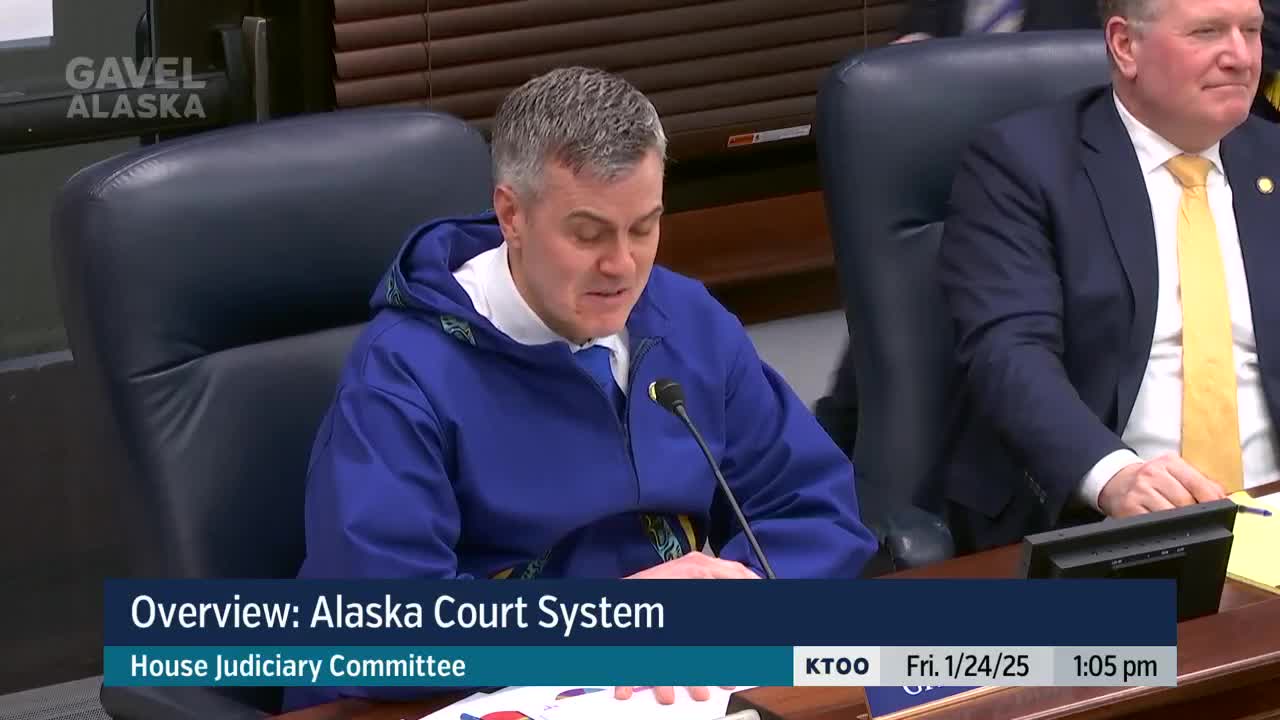
Alaska court system outlines structure, backlog progress and therapeutic courts to House Judiciary Committee
Loading...
Summary
Nancy Mead, general counsel for the Alaska Court System, told the House Judiciary Committee on Jan. 20 that the state’s unified court system is making progress reducing criminal-case backlogs, described median times to disposition for various charges and summarized the use and limits of therapeutic courts.
Nancy Mead, general counsel for the Alaska Court System, told the House Judiciary Committee on Jan. 20 that Alaska operates a single, unified court system and that the courts are making measurable progress reducing criminal-case backlogs since the COVID era.
Mead briefed the committee on court structure, filings and operations, the current backlog and steps the system has taken to shorten case timelines. “The court system in Alaska is a unified court system,” Mead said, adding that administration is centralized in Anchorage under the Alaska Constitution’s judiciary provisions.
Mead told lawmakers the court system includes four judicial districts with presiding judges, 38 magistrate judges, 15 superior court locations and district court judges in seven locations. She said the system has roughly 784 positions total and that the court is about 1.5% of the state government workforce. The court does not retain filing fees or fines; Mead said that all money collected is turned over to the state general fund.
Why it matters: Committee members pressed the courts on why some criminal cases take years to resolve, how therapeutic courts operate, and whether rising caseloads in fast-growing areas such as Palmer are straining local resources. The presentation framed near-term staffing and facility requests — and set the context for future hearings the committee plans on court budgets and therapeutic courts.
Most important facts first
Backlog and timing: Mead said the system is “making tremendous progress” on criminal-case backlog. She reported that as of Jan. 1, 2025 the number of pending criminal cases was about 25% lower than on Jan. 1, 2024 and roughly comparable to Jan. 1, 2019. She also gave median times to disposition for typical case classes: median times were about six months for class C felonies, 10 months for class B felonies and 13 months for class A felonies. For unclassified felonies (the most serious charges) she said the median time to disposition is about three years. For misdemeanors, Mead reported median times of about six months for class A misdemeanors and four months for class B misdemeanors.
Mead explained that most criminal matters are resolved without jury trials: she said felony trial rates are about 2.4% and many filers are dismissed by prosecutors — she cited roughly a 39.5% dismissal rate among felony filings last year. Mead also described the court’s “clearance rate” — cases closed versus cases filed — and reported a statewide clearance rate around 107% in the most recent year, meaning the system closed more cases than it opened.
Causes of delay: Mead listed common causes of continuances that lengthen cases: substitution or turnover of defense counsel (including public defender conflicts and transfers to the Office of Public Advocacy), late discovery or large electronic discovery volumes (for example, cellphone data), motions filed close to trial that require hearings, treatment timelines for defendants, witness or victim unavailability, and courtroom or jury-room capacity constraints (she said Palmer has had weeks where jury deliberation room availability limited scheduling). She emphasized courts grant continuances for good cause and said judges will assign retired or pro tem judges when calendars double-book to provide trial capacity when parties are ready.
Electronic filing and operations: Mead said most criminal filings are now electronic and that civil filings are electronic in most but not all locations; she estimated full electronic filing for all case types within about a year. She said electronic files improve access for judges, staff and the public and reduce the need to physically move paper files.
Magistrates, access and facilities: Committee members raised access in growing communities such as Palmer and Wasilla. Mead said magistrates are assigned by caseload and that the Fourth Judicial District (which includes many rural locations) and Anchorage have higher magistrate staffing. She said Palmer’s courthouse is strained and that the court has requested capital funding to expand the facility; the court expects further requests for judgeships once facilities are available.
Therapeutic courts: Mead described Alaska’s therapeutic (problem-solving) courts — programs that combine supervised treatment with judicial oversight for defendants who plead guilty and enter an intensive, team-based program. She said therapeutic courts serve people with substance use and behavioral-health needs, run roughly 12–18 months in many models, and use a team (judge, prosecutor, defense, probation, treatment providers and community supports) to apply incentives and sanctions.
Mead said therapeutic-court capacity varies by location and that most such courts are not operating at full enrollment: she gave the Coordinated Resource Project (a mental-health court) a capacity of 50 with 36 enrolled and Anchorage’s felony drug/DUI court capacity at 60 with 47 enrolled. She said some courts — for example a Palmer family therapeutic court — are at capacity. On outcomes, Mead said graduates have substantially lower recidivism; she summarized recent data as about a 20% recidivism rate for graduates and noted statewide recidivism measures reported to her “somewhere between, like, 56–62%,” underscoring different baselines in those comparisons.
Rural limitations: Mead said therapeutic courts require local treatment providers, housing and employment supports; where those resources do not exist (she cited a previous Bethel program that closed after a provider left), the court cannot operate the program locally and affected individuals must relocate to participate.
Victim restitution and revenues: Mead described restitution collection work performed by the court system and said the system collected more than $1.5 million last year via about 2,000 payments, often through garnishment of permanent fund dividends; recipients include the Violent Crimes Compensation Board, state agencies (for example, DHSS), insurers and businesses.
Staffing and vacancies: Mead said the court currently has an approximately 11% non-judge staff vacancy rate and noted four vacant judgeships at the moment; she said the court uses retired or pro tem judges to cover peaks and that recruiting for some rural positions is difficult. The court has requested a single position with federal receipt authority in the current budget cycle; Mead said the court is not broadly requesting new staff positions this year beyond that and possible future judgeships tied to facilities.
Committee follow-ups and next steps: Committee members asked for updated court rules for the committee room, enrollment numbers for therapeutic courts, recidivism tracking data, and further detail on Palmer backlog specifics and facility needs. Chair Gray closed the meeting by scheduling future items: a Department of Law presentation on Jan. 29 and the committee’s first bill hearing on Friday, Jan. 31 — House Bill 48, the Civil Legal Services Fund, at 2:13 p.m.
Ending note: The presentation was informational; Mead and committee members identified data and facility questions the committee will pursue in follow-up hearings on court budgets, therapeutic courts and Palmer courthouse capacity.