Get Full Government Meeting Transcripts, Videos, & Alerts Forever!
Get email alerts on the Education Funding Bsa Indexing topic
No spam. Unsubscribe anytime.
House committee hears bill to index Alaskas base student allocation to inflation
Summary
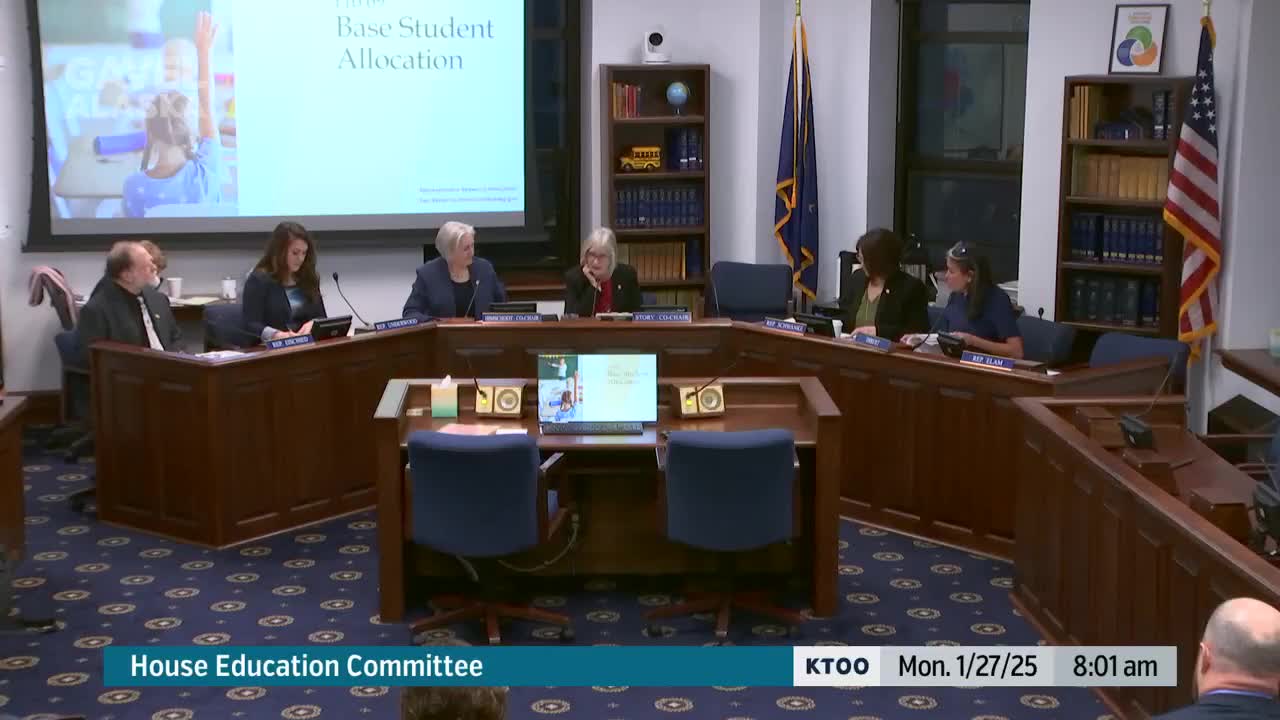
Rep. Rebecca Hemschute, sponsor of House Bill 69, told the House Education Committee on Jan. 27 that the bill would inflation-proof and raise Alaskas base student allocation so districts could meet rising operating costs and avoid repeated "one-time" funding patches.
Rep. Rebecca Hemschute, sponsor of House Bill 69, told the House Education Committee on Jan. 27 that the bill would inflation-proof and raise Alaskas base student allocation (BSA) so districts could meet rising operating costs and avoid repeated "one-time" funding patches.
The bill would amend AS 14.17.470 to apply a multi-year consumer-price-index adjustment to the BSA, beginning July 1, 2025, and would add a series of flat-dollar increases in the first three years. "We have a crisis, and the crisis is right here and right now," Rep. Hemschute said, summarizing why she brought the measure forward.
Why it matters: Committee members and invited testifiers said predictable, ongoing increases to the BSA would let local boards plan for contracts and staffing, reduce the reliance on one-time federal or state infusions and help districts retain and recruit teachers. Testimony came from municipal leaders, business representatives, superintendents from multiple regions, and parents who described cuts to classrooms, extracurriculars and maintenance when funding lags.
Bill specifics and sponsors explanation
Rep. Rebecca Hemschute (bill sponsor) and her staff, Claire Fordyce, outlined the bills structure. Under the draft language presented, the July 1, 2025 BSA increase would use the average Alaska CPI for calendar years 202123 and add a $1,000 flat increase; July 1, 2026 would use the 202224 average CPI and add $404; July 1, 2027 would use the 202325 average CPI and add $404. Thereafter the BSA would increase annually by the average percent change of the first three of the preceding four calendar years according to the Alaska CPI. The sponsor said the three-year averaging smooths spikes and provides an 18-month data lag tied to calendar-year CPI reporting.
Local impacts and invited testimony
Jenna Wright, president and CEO of the Anchorage Economic Development Corporation, said businesses see a direct link between school quality and workforce recruitment: "Today's students are tomorrow's workforce and the future of Alaska's economy depends on their success." Wright noted Anchorage has lost about 17,500 working-age adults in the last decade and that employers increasingly consider school quality when recruiting.
Andy DeGraw, chief operations officer for the Fairbanks North Star Borough School District, told the committee Fairbanks faces a preliminary FY26 general-fund gap of about $31 million (roughly 15.5% of the district's general fund). DeGraw emphasized transportation is a mounting pressure: revenues for transportation have fallen while costs rose, producing an annual district transportation gap he estimated at about $4 million that now must be subsidized from instructional funds.
Nils Andreasen, executive director of the Alaska Municipal League, described municipal strain when state funding lags: deferred maintenance backlogs statewide exceed the hundreds of millions, local contributions have grown, and municipalities face tradeoffs between schools and services like roads and public safety.
Ben Malott, president of the Alaska Federation of Natives, said AFN delegates passed a resolution urging the state to raise and inflation-index the BSA and to fully fund school meal programs.
Superintendents, parents and local boards testified to program cuts and staffing shortfalls
Dr. Madeleine Aguilar, superintendent of the Cusbuck School District (REAA No. 5), described a remote district where average spending per pupil is about $63,000 compared with a statewide average she cited near $21,000, and where 96% of students are economically disadvantaged. Aguilar said the district has combined grades in 70% of elementary classrooms, reduced classified positions by about 23% and now relies on international hires for roughly 68% of teachers.
Catherine Tatsuta, Ketchikan Gateway Borough School District board member, said Ketchikans district has about 2,000 students, that 35% of students were food insecure in the last 30 days and 10% were unhoused, and that continued flat funding is forcing the district to consider school consolidations and closures that would split siblings, lengthen bus rides and create community stress.
Clayton Holland, superintendent of the Kenai Peninsula Borough School District and president of the Alaska Superintendents Association, said Kenai faces a roughly $17 million FY26 deficit, a fund balance down to about $300,000, a hiring freeze and potential reductions that could eliminate roughly 85 teaching positions and cut extracurriculars, distance-education and gifted programs.
Parents who testified described the local consequences. Stacy Dixon, a parent whose children attend the Anchorage School Districts highly gifted program, said insufficient, unpredictable funding strained programs and prompted families to consider private schools or homeschooling. Adrienne Michael, PTA fundraising chair at Bear Valley Elementary, described PTAs covering many routine needs but said parent fundraising cannot replace predictable state funding for teachers, psychologists and major repairs.
Policy and process questions from committee members
Committee members asked how CPI-linking would behave during volatile inflation years; Rep. Hemschute said the three-year average is designed to dampen spikes and provide stability. Representatives also asked for more data on how one-time federal infusions (for example, ESSER grants) changed districtss short-term budgets and whether detailed statewide totals could be provided to show cumulative impacts.
Several members pressed transportation funding design: Fairbanks' testimony explained that transportation is now funded as a per-student allocation based on a historical baseline, which shrinks when enrollment falls even though geographic costs to transport students do not fall.
Next steps
The committee set an amendment deadline for Jan. 31 at 3 p.m. and scheduled public testimony on HB 69 for Jan. 29 (morning and an evening session) with a 7 p.m. sign-in cutoff for callers. Staff and presenters agreed to post slide materials and provide follow-up data on prior studies and federal one-time funding totals.
Ending
Testifiers from districts across Alaska told the committee that predictable, inflation-sensitive increases to the BSA would reduce reliance on one-time funding, help districts keep certified teachers in classrooms, and preserve programs and maintenance. No committee vote or formal action on HB 69 was recorded at the Jan. 27 meeting; the committee instead set deadlines and public testimony dates as it continues its review.