Get Full Government Meeting Transcripts, Videos, & Alerts Forever!
Get email alerts on the Natural Gas Supply Glenfarn topic
No spam. Unsubscribe anytime.
NSTAR outlines Cook Inlet shortfall, signs exclusivity deal with Glenfarn as stopgap
Summary
NSTAR Natural Gas told the Senate Resources Committee it has spent more than $4 million evaluating supply options for the rail-belt and has signed an exclusivity agreement with developer Glenfarn to pursue an LNG import project while continuing negotiations with Cook Inlet producers and expanding local storage.
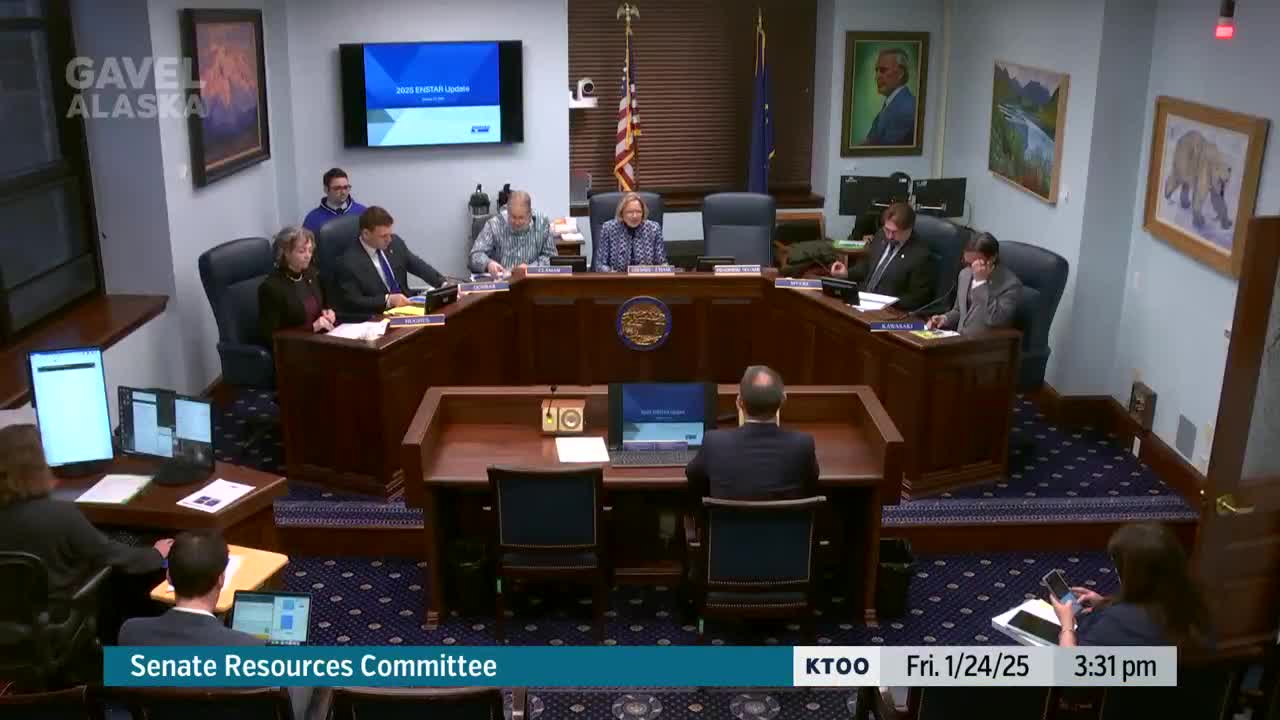
John Sims, president of NSTAR Natural Gas, told the Senate Resources Committee on Jan. 24 that the company has spent over $4,500,000 in the last 24 months evaluating options to secure long‑term gas for utilities on Alaska's rail belt and has entered an exclusivity agreement with developer Glenfarn to pursue an LNG import project.
"There's no one else that holds the same obligation and the same duty to serve," Sims said, describing the statutory duty utilities face to provide reasonably continuous service. He framed the Glenfarn agreement as an early-stage step toward a joint development agreement and possible final investment decision in the coming years, while stressing the project remains at an initial stage and many details must be negotiated.
The nut graf: Utilities face differing contract expirations and immediate winter needs that in part motivated the search for additional supply. Homer Electric currently will be served on an interruptible basis beginning April 1, 2025; other utilities face later contract expirations (MEA and Chugach in 2028, NSTAR with Hillcorp in 2033). Sims told the committee that local production in the Cook Inlet is tight and that importing LNG could help meet near‑term gaps if a viable, reliable project can be developed.
Sims summarized NSTAR’s two‑year evaluation process: a June 2023 BRG (Berkeley Research Group) phase‑1 status report, more than 30 confidentiality agreements with potential developers, and an internal scoring rubric that prioritized schedule, operational reliability and delivered cost. He said the company continues negotiations with Cook Inlet producers and submitted a Cook Inlet procurement contract to the Regulatory Commission of Alaska on Dec. 31, 2024.
That contract, Sims said, is priced at $12.30 per unit with royalty relief and $13.69 without; it is slated to start in 2026 and includes an annual cap of 1.5 percent on price movement. He emphasized the contract’s price projections are sensitive to inflation and that the Department of Natural Resources must rule on royalty relief.
Sims described storage and deliverability work at CINGZA (Cook Inlet Natural Gas Storage Alaska). CINGZA was expanded by about 2 billion cubic feet of capacity through added compression and two new wells (wells 6 and 7), bringing the facility to seven wells total and an estimated additional winter deliverability of roughly 65 million cubic feet per day. The expansion was initially budgeted at $72 million and is tracking near $67–68 million, Sims said.
Sims told senators the utilities gave special weight to proposals that could leverage existing AKLNG export‑site permits, saying modifying existing permits could be faster and less costly than permitting a new site from scratch. He also raised operational concerns about floating regasification units in Cook Inlet, citing ice and tidal challenges that could force such a vessel to vacate the area seasonally.
Committee members pressed Sims on several issues, including the public disclosure of the Glenfarn name after a Jan. 8 social‑media post; the potential conflict of Glenfarn working on multiple Alaska projects; and whether the Glenfarn import proposal would be independent of the AKLNG project. Sims said Glenfarn represented to NSTAR that the import proposal would be an independent project with separate financing and that NSTAR required independence to avoid political or commercial entanglement with other projects.
Sims also said a second, more detailed utilities report planned after June 2023 was delayed because NSTAR had signed many confidentiality agreements that limited disclosure and because some pricing and commercial details are commercially sensitive during negotiations. He reiterated that any costs passed to customers would require Regulatory Commission approval before NSTAR could charge customers.
The presentation closed with committee members and Sims noting persistent concern about Cook Inlet production: "I have significant concerns about the Cook Inlet," Sims said, citing tight supply, producer challenges and execution risk on other projects. He said utilities continue daily collaboration to minimize service interruptions and seek additional storage and supply options.
Ending: Sims said the Glenfarn exclusivity agreement begins a process that could take months to resolve and years to reach FID. He urged careful, staged work and regulatory review; senators asked to be kept informed as negotiations and filings to the commission proceed.