Get Full Government Meeting Transcripts, Videos, & Alerts Forever!
Get email alerts on the Education.school Finance topic
No spam. Unsubscribe anytime.
Fairbanks school leaders warn of multimillion-dollar deficit, propose BSA increase to avoid further cuts
Summary
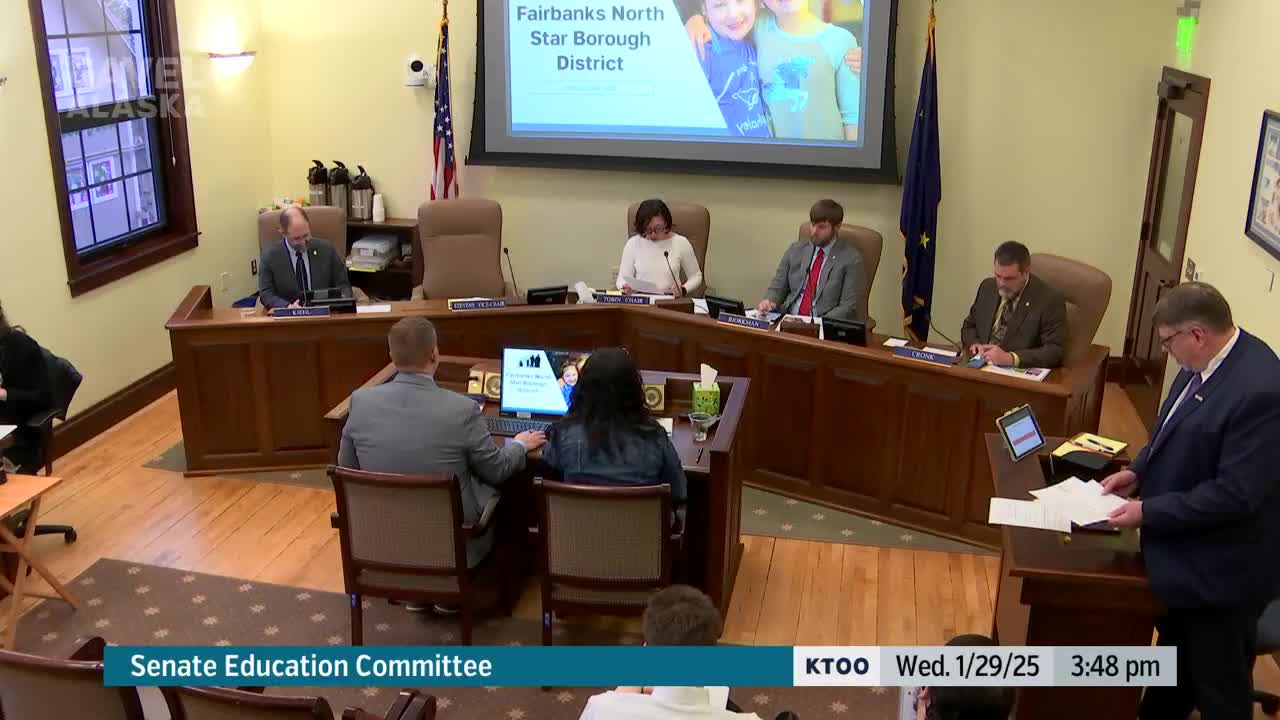
Fairbanks North Star Borough School District leaders told the Senate Education Committee on Jan. 29 that the district faces a significant budget shortfall and enrollment decline that could force more school consolidations and program cuts.
Superintendent Dr. Luke Meinert and Fairbanks North Star Borough School District Board President Melissa Burnett told the Senate Education Committee on Jan. 29 that the district is confronting a deep budget shortfall and enrollment declines that threaten programs and neighborhood schools.
Burnett and Meinert said the district currently enrolls about 11,805 students — 5,601 in elementary grades and 6,204 in secondary grades — and that enrollment has dropped by roughly 650 students this year. Burnett noted that about 25 percent of students are military-connected, citing Fort Wainwright and Eielson Air Force Base ties.
The presenters outlined several budget scenarios. They said the district is working from a $16 million shortfall if one-time outside-BSA funding provided last year is continued, and that a preliminary calculation without those assumptions produces a larger $31 million shortfall, which they described as roughly 15 percent of the district’s general fund. The district said potential savings from five proposed school consolidations would be approximately $7 million, which would still leave an identified gap of roughly $6 million for their Feb. 17 budgeting deadline.
Burnett listed cuts already made in recent years: four school closures, elimination of many elementary music and art programs, elimination of extended learning programs, a 20 percent reduction in administration since 2019, depletion of activity funds and the loss of more than 250 jobs. The district said it subsidizes transportation and nutrition services from general funds, and that transportation funding has not increased since 2015.
Meinert and Burnett urged the legislature to shift targeted funding into the Base Student Allocation (BSA) or otherwise provide sustainable support. They asked for a $1,400-per-student increase to the BSA this year, saying that amount would prevent additional class-size increases, allow required tutoring under the Alaska Reads Act to be fully implemented, and address liabilities such as outdated technology and deferred curriculum purchases.
Committee members pressed for clarifications on fund balance and budget processes. The presenters said the district’s unobligated fund balance available to address deficits was described in testimony as "$750,000,0.0" in the record; later clarification requests were promised to the committee. Burnett described the district’s general fund reserve as insufficient relative to recommended targets and said the board had worked to rebuild reserves from near zero in recent years.
District officials warned that continued state funding uncertainty has consumed administrators’ time and limited the district’s ability to recruit for positions early in the budget cycle. Meinert said months of district staff time have been spent on scenario planning and that the fiscal uncertainty has taken staff time away from student achievement work.
Members of the Fairbanks community who testified during the committee’s public comment period reiterated concerns about school closures, class-size increases, cuts to programs and the broader community impact of losing neighborhood schools. Several called on legislators to raise the BSA, fully fund transportation and sustain Alaska Reads Act implementation to protect neighborhood schools and student supports.