Get Full Government Meeting Transcripts, Videos, & Alerts Forever!
Get email alerts on the Education.teacher Shortage topic
No spam. Unsubscribe anytime.
Anchorage educators warn of staffing crisis, cite high turnover and recruitment costs
Summary
Corey Aist, president of the Anchorage Education Association, told the Senate Education Committee that Alaska faces an education emergency driven by teacher churn, high caseloads and recruitment expenses. AEA survey results and district figures were presented as evidence of worsening student outcomes and reduced classroom stability.
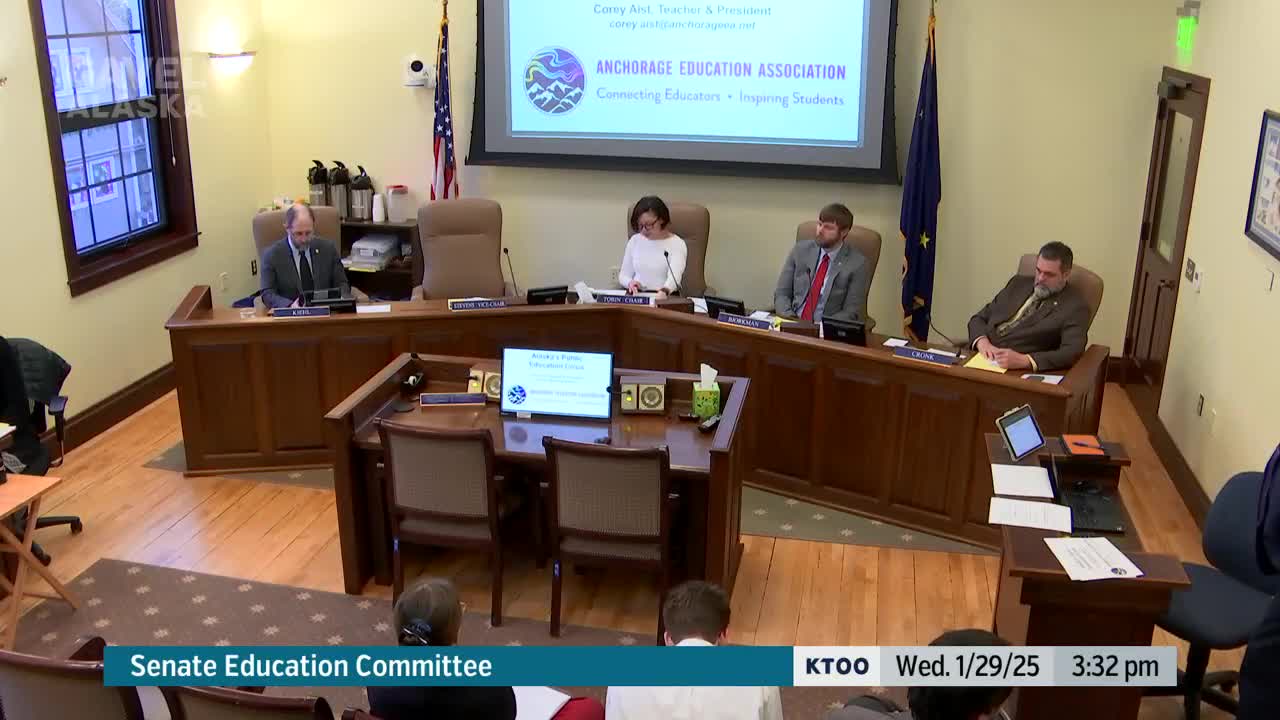
Corey Aist, president of the Anchorage Education Association, told the Senate Education Committee on Jan. 29 that Alaska is facing an education emergency driven by high teacher turnover, large class sizes and unsustainably high special-education caseloads.
Aist, speaking remotely, said Anchorage Public Schools — which he said serves about 42,000 students — is at the “top of this teacher shortage crisis.” He told senators that the district estimates it spends more than $10 million a year on recruitment and related costs to fill vacancies, and that the district provided an estimate that it costs over $27,000 to navigate a single resignation.
The AEA president described a churn of certificated staff in recent years and said the union’s survey of members found nearly 1,100 responses from the roughly 3,000-member pool. He said the survey showed more than two-thirds of respondents reporting they felt “overwhelmed” or unable to continue at their current workload, and that early-career teachers are leaving at high rates: Aist reported that 48 percent of resignations last year were teachers in their first five years and that 42 percent were in their first three years.
Aist connected staffing instability to student outcomes, saying new teachers need time to learn curriculum and policies and that frequent turnover harms student relationships and school culture. He also said the departure of veteran staff has led to lost programs and weakened supports that help attendance and engagement.
Committee members asked about the AEA survey methodology. Aist said the union used SurveyMonkey, sent the survey to all Anchorage Education Association members (about 3,000), and received roughly 1,100 responses; he said the presentation extrapolated those responses to the larger membership but that he could provide raw data on request.
Aist urged legislators to fund measures that help districts retain educators and to prioritize having a certificated teacher in every classroom. He singled out funding for the Alaska Reads Act and supplements for nationally board-certified teachers as examples of targeted investments that, if funded, would help student success.
The committee did not take any formal votes on funding or legislation during Aist’s presentation. The senator chairing the meeting, Senator Tobin, and other members present asked clarifying questions on the survey and recruitment estimates.
Aist concluded by saying his goal was to advocate for students and communities and that stopping the outflow of educators will require funding and supports to keep certificated teachers in Alaska classrooms.