Get Full Government Meeting Transcripts, Videos, & Alerts Forever!
Get email alerts on the Rural Aviation Pfas topic
No spam. Unsubscribe anytime.
DOT outlines rural aviation needs, PFAS transition and civil-rights planning for airports
Summary
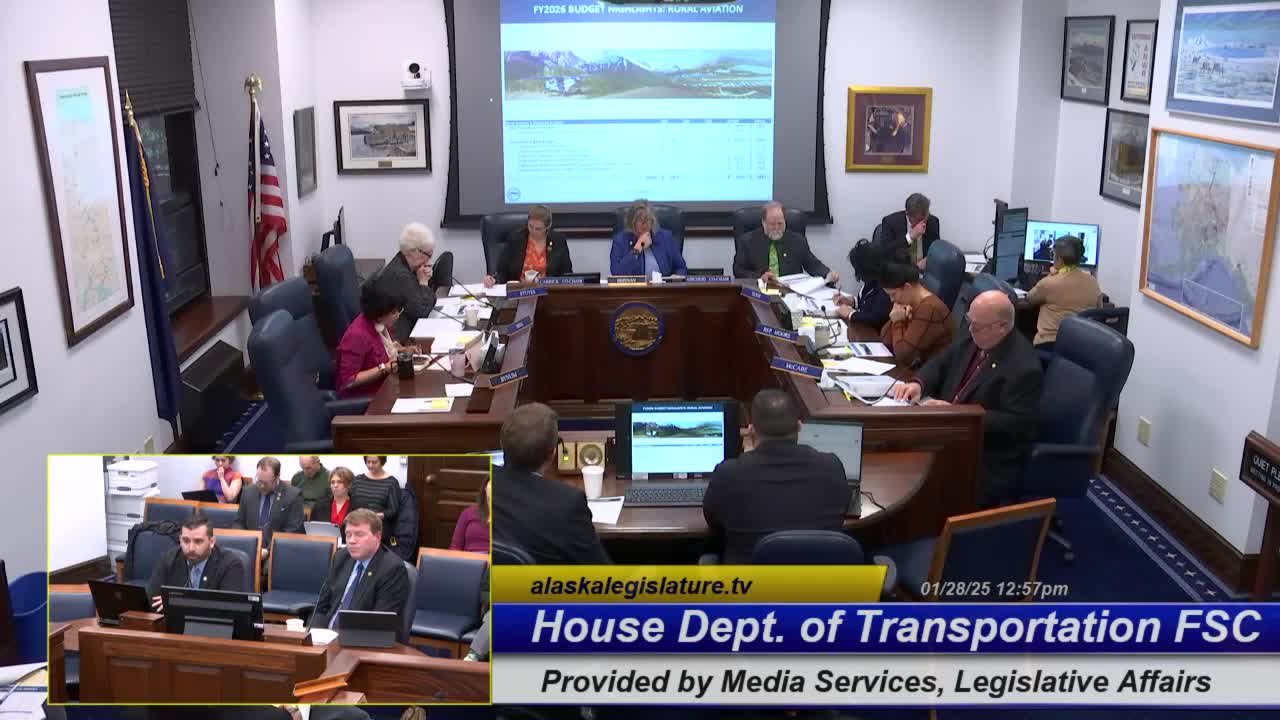
At the Jan. 28 subcommittee briefing, DOT described capacity and maintenance needs in rural aviation, ongoing PFAS foam transition at airports, civil-rights plan development required by the FAA, and requests for contractor and software funding.
Dom Pinone, DOT director of program management and administration, told the House Finance Subcommittee on Jan. 28 that DOT operates a large rural aviation network and cited specific operating pressures in rural airports. The department said it operates roughly 235 rural airport locations and that many rural runways are maintained by contract because local contracting is often the most effective approach.
Pinone described requests in the FY26 operating package tied to rural aviation: increases to rural airport maintenance contractor funding (presentation cited $374,000), software licensing and database work for the Alaska Aviation System Plan and inspection programs, and employee-housing increments for airport employees. The transcript shows the presentation listed $72,000 of UGF for employee housing at one airport and an additional line of $111,000 of UGF; the transcript did not clearly specify which airports correspond to each amount (not specified).
PFAS (per- and polyfluoroalkyl substances) transition work at airports was discussed. Anderson and Pinone said DOT is actively managing the shift to fluorine-free firefighting foams, starting with international airports, and that cleaning equipment and vehicles previously exposed to PFAS is work-intensive. The department said a contract for cleaning vehicles at international airports was under way and that bottled water provision remained in places where groundwater impacts from legacy firefighting training required mitigation. DOT indicated capital funds will be needed for larger water-system fixes.
Committee members asked about civil-rights reviews the department has undertaken at certain airports. Pinone said FAA-required civil-rights plans have been developed for primary airports and that DOT expects to produce on the order of 20'30 plans (presentation cited an FAA-driven requirement to prepare plans for primary airports). The plans address a range of reporting requirements, including provisions such as handicap accessibility.
Members pressed for more specific deferred-maintenance breakdowns for roads, facilities and airports; DOT said it maintains lists and will provide those breakdowns to the committee. The department noted airport lighting, weather-observation systems and employee housing as notable maintenance and capital needs.