Get Full Government Meeting Transcripts, Videos, & Alerts Forever!
Get email alerts on the Energy topic
No spam. Unsubscribe anytime.
Mayors and legislators warn Cook Inlet gas shortfall could threaten Southcentral energy security
Summary
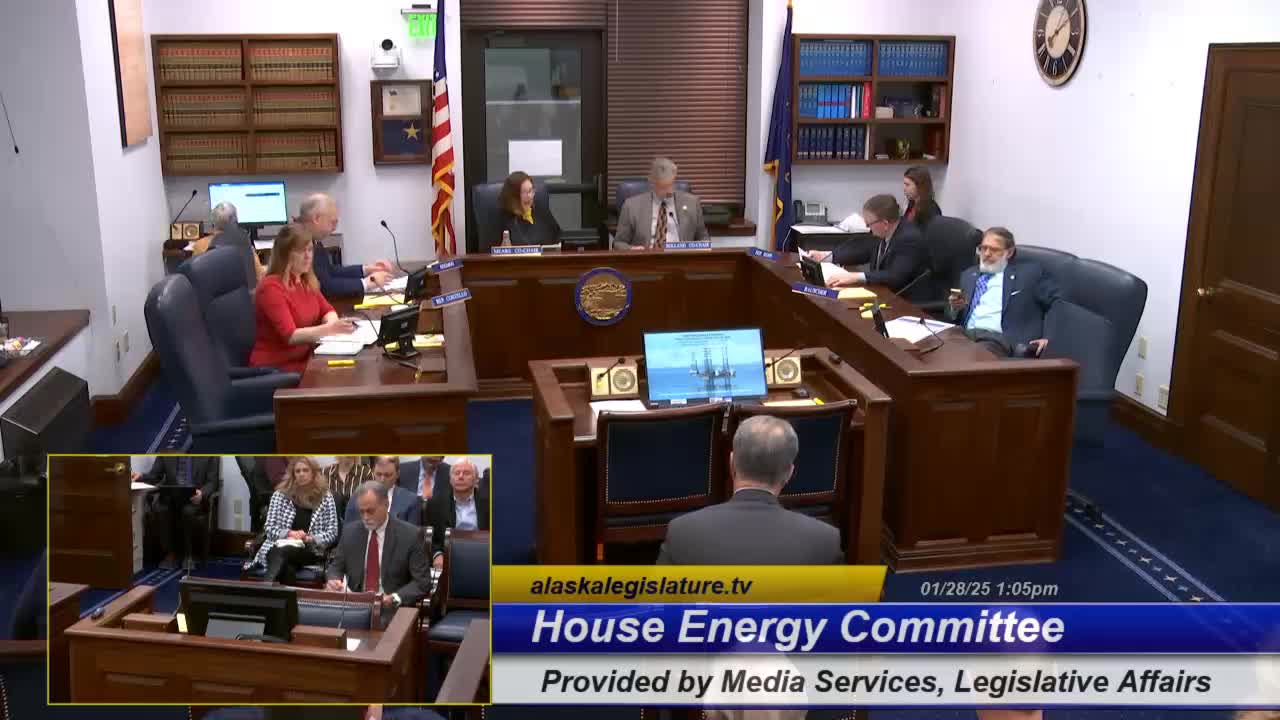
Anchorage Mayor Suzanne LaFrance and members of the South Central Mayors’ Energy Coalition told the Alaska House Energy Committee on Jan. 28 that declining Cook Inlet natural gas production and long project timetables create a real risk of near‑term shortages for heating and power in Southcentral Alaska.
Anchorage Mayor Suzanne LaFrance and members of the South Central Mayors’ Energy Coalition told the Alaska House Energy Committee on Tuesday, Jan. 28, that declining natural gas production in Cook Inlet and long timelines for new projects create a real risk of shortages for space heating and electricity across Southcentral Alaska.
The coalition’s presentation, led by former Senate president and current Kenai Peninsula Borough mayor Peter Michicky, reviewed local production trends, project timelines and possible near- and longer-term responses, including boosting local production, adding storage, importing liquefied natural gas and expanding renewables supported by transmission upgrades. Michicky and LaFrance both pressed lawmakers to support utilities and expedite options that can be implemented while longer projects advance.
Why it matters: the rail-belt population and much of the state’s commerce depend on reliable winter heating and power. Committee members and mayors said a supply shortfall would affect households, schools and businesses and could slow investment in the region.
Michicky told lawmakers the technical picture is stark: historically dense Cook Inlet fields have depleted and newer reservoirs are harder and more expensive to produce. He cited federal estimates for technically recoverable resources and emphasized the distinction between "technically recoverable" and "economically recoverable." He warned that many proposed projects remain stalled because they lack firm utility purchase commitments and investment anchors.
"Support the utilities," Michicky said. "Your job is to make sure they're being responsible and you're looking out for every constituent ratepayer." He also said, "There's nothing evil about LNG imports," describing imports as a possible short-term option to avoid supply gaps while local or long-term projects progress.
LaFrance described municipal actions and near‑term projects Anchorage is pursuing to increase local resilience: expanded transmission investments to reduce bottlenecks on the rail-belt grid; support for Bradley Lake and the Dixon diversion to expand hydro capacity; a pumped-storage study at Eklutna Lake; and a proposed landfill waste-to-energy project that the municipality estimates could add up to about 30 megawatts of generation and reduce landfill emissions. "Declining production of natural gas in Cook Inlet worries us. It worries us tremendously," LaFrance told the committee.
Committee members asked for specifics on timelines and the role of state policy. Michicky said some major options — including a large gas line or North Slope monetization — have possible first-gas timetables in the early 2030s, and that the region faces tighter supply by the late 2020s if no gap-filler is implemented. He described two import approaches: onshore regasification facilities and a faster, lower‑upfront option using a floating storage and regasification unit (FSRU) and existing onshore connections; he said the latter can be cheaper to deploy in the near term.
Lawmakers also discussed storage and existing infrastructure. Michicky said the state and private parties are pursuing storage expansions (he referenced a third‑party storage permitting effort of 50 billion cubic feet and an expansion of existing storage to 13 billion cubic feet, which together he said would yield about 63 billion cubic feet in capacity). Committee members asked whether imports would suppress local production; Michicky and others replied that local production remains a near‑term priority and that import options could be phased down as local projects or longer-term solutions come online.
Questions touched on the role of the Regulatory Commission of Alaska (RCA) and rate design, royalties and fiscal tradeoffs. Michicky and LaFrance said utilities need legislative and regulatory support but cautioned that placing too much of a cost burden on ratepayers could suppress economic activity. Michicky noted the political difficulty of “picking winners” and urged that lawmakers provide reliable information and a clear path so the private sector can mobilize.
No formal votes or committee actions were recorded during the presentations and Q&A. The committee scheduled follow-up presentations on transmission and reliability for upcoming meetings.
Looking ahead: presenters and committee members said the most likely short-term gap mitigations are increased storage, short‑term LNG import arrangements or incremental increases in local production where feasible, paired with conservation and efficiency measures. Longer-term solutions discussed by the coalition include transmission upgrades, new hydro and renewable projects, and potential monetization of North Slope gas — each of which would require multi-year permitting, financing and utility commitments.
Sources and direct quotes in this report come from remarks on the record to the Alaska House Energy Committee on Jan. 28, 2025, as delivered by Mayor Peter Michicky and Mayor Suzanne LaFrance.