Get Full Government Meeting Transcripts, Videos, & Alerts Forever!
Get email alerts on the Statewide Transportation Improvement Program topic
No spam. Unsubscribe anytime.
DOT says federal findings forced rapid STIP rewrite; committee hears progress on fixes and project risks
Summary
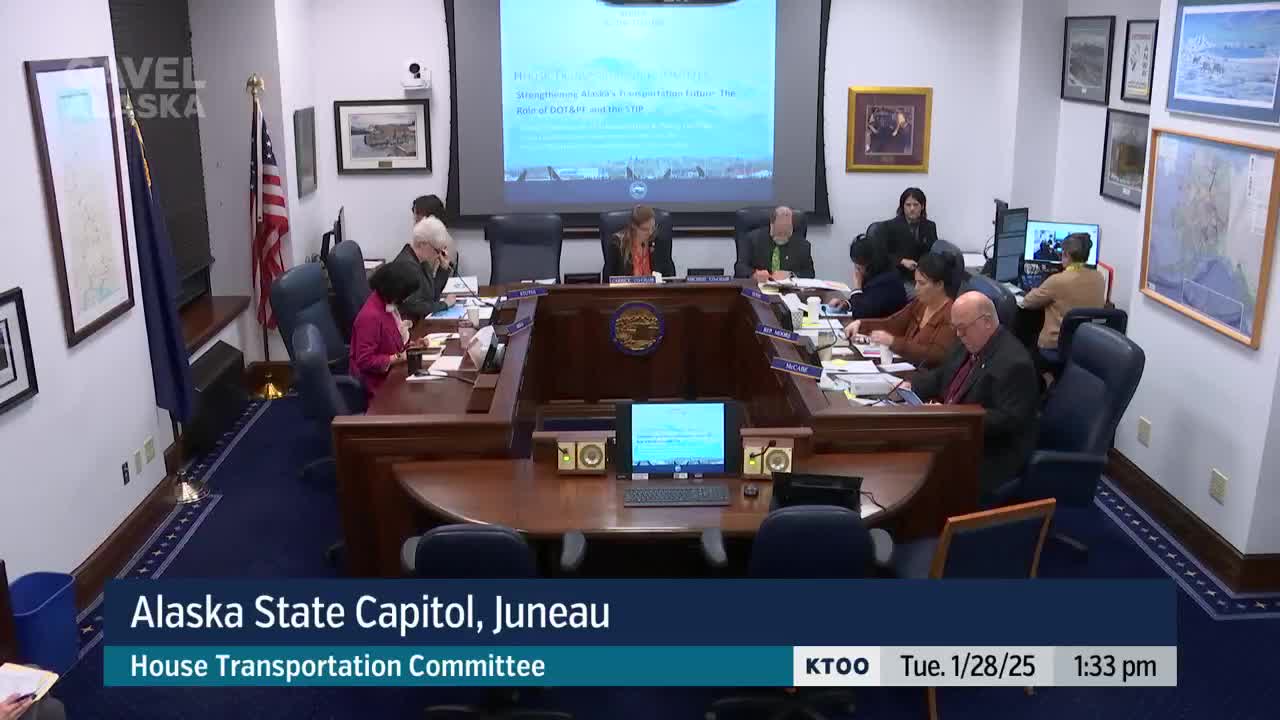
Catherine Keith, deputy commissioner at the Department of Transportation and Public Facilities, told the House Transportation Committee on Jan. 28 that federal reviewers required a rapid rewrite of Alaska's Statewide Transportation Improvement Program that produced major changes to project programming, reporting and public outreach.
Catherine Keith, deputy commissioner at the Department of Transportation and Public Facilities, told the House Transportation Committee on Jan. 28 that federal reviewers issued planning findings that required a rapid rework of Alaska's Statewide Transportation Improvement Program.
“The Federal Highways and Federal Transit Administration gave us 16 days to basically recreate our entire program,” Keith said, describing the February 2024 findings and the department's rush to avoid a funding gap.
The nut of the hearing: the STIP process grew more complex after federal reviewers required different project programming, stricter fiscal-constraint tables and new formatting. That combination — plus a transition to new digital tools — produced a larger, more detailed STIP and a spike in administrative work, department officials said.
Dom Pinone, director of program management and administration at DOT, described a longstanding overprogramming issue that helped trigger the intervention. “When we shined a light on the process, it brought to light this $3,400,000,000 of shadow projects that were now in our STIP,” Pinone said. He explained that prior practice allowed the department to program beyond the revenue expected in order to maintain schedule flexibility; federal reviewers pressed for a stricter fiscal constraint demonstration.
Committee members repeatedly asked about coordination with metropolitan planning organizations (MPOs). Keith and Pinone said DOT has held regular meetings with all three MPOs and has recorded more than 70 meetings since April to address coordination. They acknowledged disagreement about what projects belong in the statewide STIP versus MPO transportation improvement programs (TIPs), and said a cooperative document to align expectations has been approved by MPO technical and policy boards.
Keith and Pinone summarized several specific effects and fixes raised during the hearing:
- Public engagement rose sharply: DOT reported receiving more than 13,100 public comments during the STIP process and expanded an online comment portal and GIS tools to make projects easier to review.
- Document size and detail increased: a DOT slide shown to the committee stated the STIP grew from under 500 pages to about 3,000 pages after federal findings and additional attachments (TIPs, tribal TIP, metropolitan plans) were included. DOT said much of the growth reflects required attachments and detailed fiscal-constraint tables.
- Project sequencing and programming changed: DOT removed programs and individual projects from the statewide STIP and required that projects in MPO urban areas be programmed in the MPO TIPs to satisfy federal rules. DOT said roughly 45 projects and programs were reprogrammed during that process.
- Overprogramming and software issues: Pinone said legacy processes and a new software implementation revealed large “shadow” programming that put the STIP out of fiscal constraint, prompting a department intervention and a tighter review of project readiness and estimates.
Committee members pressed DOT on staffing and capacity. Keith said the department has a cross‑functional team — planners, data scientists, GIS analysts and program staff — and that the project-delivery bottlenecks tend to be at regional engineering and delivery staff, where vacancies affect timelines.
Tribal consultation and outreach were discussed. Keith told the committee DOT has created a formal tribal consultation plan for the STIP and expanded tribal outreach methods; the department also published some outreach materials in Yupik, she said.
Committee members and DOT discussed several specific projects raised in public comment and federal findings. Keith said the Richardson Highway bridge project at milepost 346 was initially flagged in review but federal staff later reversed that finding and the bridge is now moving toward construction. She also described the Safer Seward Highway corridor project, noting disagreement with AMATS about termini and scope; DOT said it will adjust termini in the next amendment to avoid further delay while continuing work on the safety corridor.
DOT told the committee it has submitted amendment drafts to federal partners and that Federal Highway Administration and FTA were reviewing material ahead of an amendment 2 public comment period. Pinone said DOT was working with federal reviewers to resolve formatting and fiscal-constraint questions before releasing amendment 2 for the public.
No formal committee votes or motions were recorded during the hearing. Committee cochair Representative Carrick recessed the hearing with the expectation that DOT would return later in the week to continue questions and present on rural aviation.
Ending: The committee paused the hearing after roughly 50 minutes of questions and asked DOT to return for a follow-up session; representatives noted construction season planning depends on timely completion of the STIP amendment and DOT said most construction projects the department expects to obligate this season are proceeding under existing authorities.