Get Full Government Meeting Transcripts, Videos, & Alerts Forever!
Get email alerts on the Alaska Municipal League Federal Grant Pause topic
No spam. Unsubscribe anytime.
Alaska Municipal League warns federal grant pause could stall local projects; outlines roles of municipal government
Summary
Nils Andreassen, executive director of the Alaska Municipal League, described the classification and authorities of Alaska’s local governments and warned that a recent federal pause on Inflation Reduction Act and IIJA-related grants has created immediate uncertainty for municipalities and grantees.
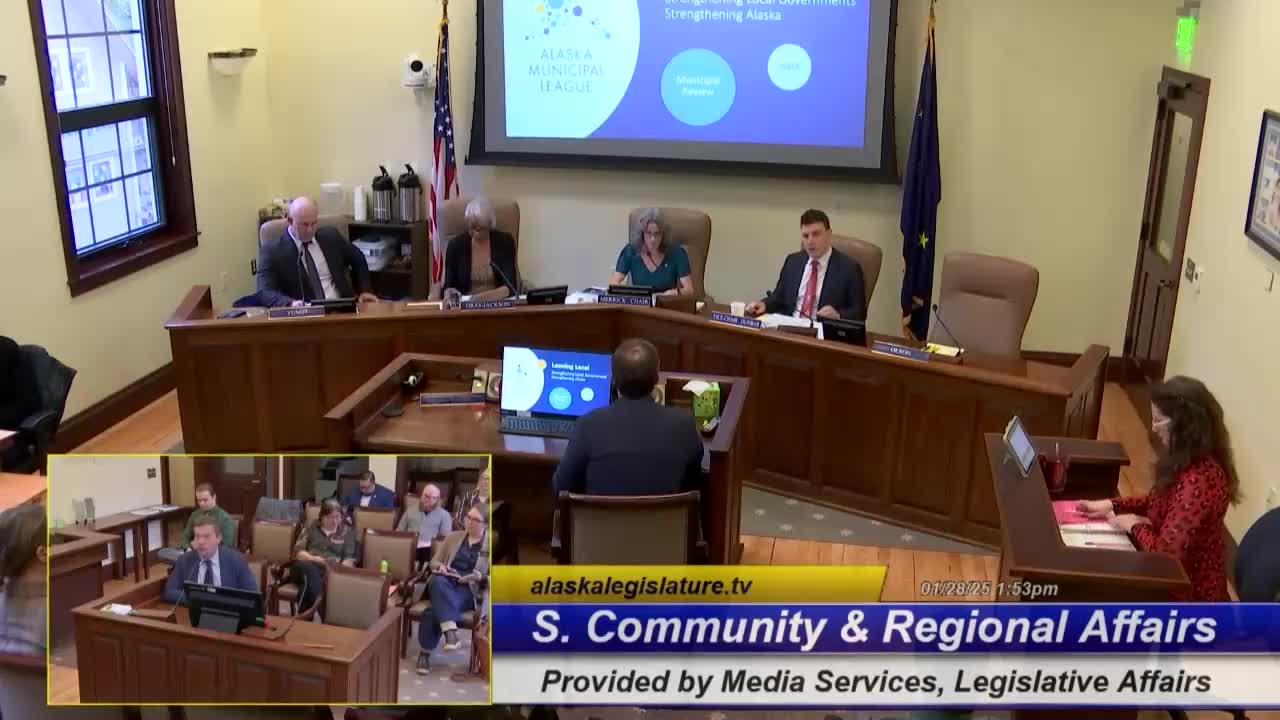
Nils Andreassen, executive director of the Alaska Municipal League, told the Senate Community and Regional Affairs Committee on Jan. 28 that a recent Office of Management and Budget pause on certain Inflation Reduction Act and Infrastructure Investment and Jobs Act awards has created “a great deal of uncertainty” for Alaska communities and project partners.
Andreassen said the pause initially affected grants and loans tied to IRA and IIJA programs, then was narrowed in guidance and — as of the hearing — temporarily reprieved until the following Monday. “There’s a great deal of uncertainty, for those who had hired and whose fund source was federal,” he said, and added that he had seen “stop work orders, pause work orders go out.” He urged members and grantees to seek clarification from federal agencies and said AML is tracking impacts statewide.
After describing the immediate grant‑pause concerns, Andreassen gave a broad briefing on municipal authorities and distinctions important to state policy makers. He told the committee that local governments in Alaska operate under the Alaska Constitution’s principle of “maximum local self‑government” and that Title 29 of the Alaska Statutes sets statutory authorities. He reviewed the practical differences between home‑rule and general‑law municipalities: home‑rule jurisdictions have broader authority unless state statute preempts that authority, while general‑law entities may only exercise powers expressly authorized by statute.
Andreassen outlined the three duties that boroughs must carry out under state law — funding public education, planning and land‑use regulation, and taxation to support the first two — and explained that those responsibilities, and how they are funded, vary widely across Alaska’s communities. AML’s briefing noted there are about 165 cities and boroughs in Alaska and that municipal governments, school districts and other local subdivisions together account for a large share of public employment and local services.
He summarized local government responsibilities that affect state partnership decisions: public safety (local police departments, village public safety officer programs and municipal jails), school facilities (local governments own or maintain a majority of Alaska school buildings), utilities and port/harbor infrastructure, and revenue dependence on state programs such as revenue sharing, power‑cost equalization and school bond reimbursement programs.
On revenue sharing and fiscal pressure, Andreassen told the committee that state support has eroded over the past decades and that reductions in purchasing power have constrained local budgets and governance capacity; he cited historical program figures to illustrate scale and long‑term trends. He also flagged employer retirement costs and pension liabilities as a major local fiscal pressure, and noted workforce recruitment and retention are pressing challenges for many municipalities.
Committee members asked questions about whether small communities could rely on the state to assume services; Andreassen and committee members emphasized local decisions vary by community and that some services can fall to the state in the unorganized borough. He said AML will continue to track the federal grant pause and follow up with members and federal agencies as clarifications arrive. No committee action was taken at the hearing.