Get Full Government Meeting Transcripts, Videos, & Alerts Forever!
Get email alerts on the State Budget Transportation topic
No spam. Unsubscribe anytime.
Alaska DOT presents FY26 operating budget overview, highlights pay, capital linkages and targeted increments
Summary
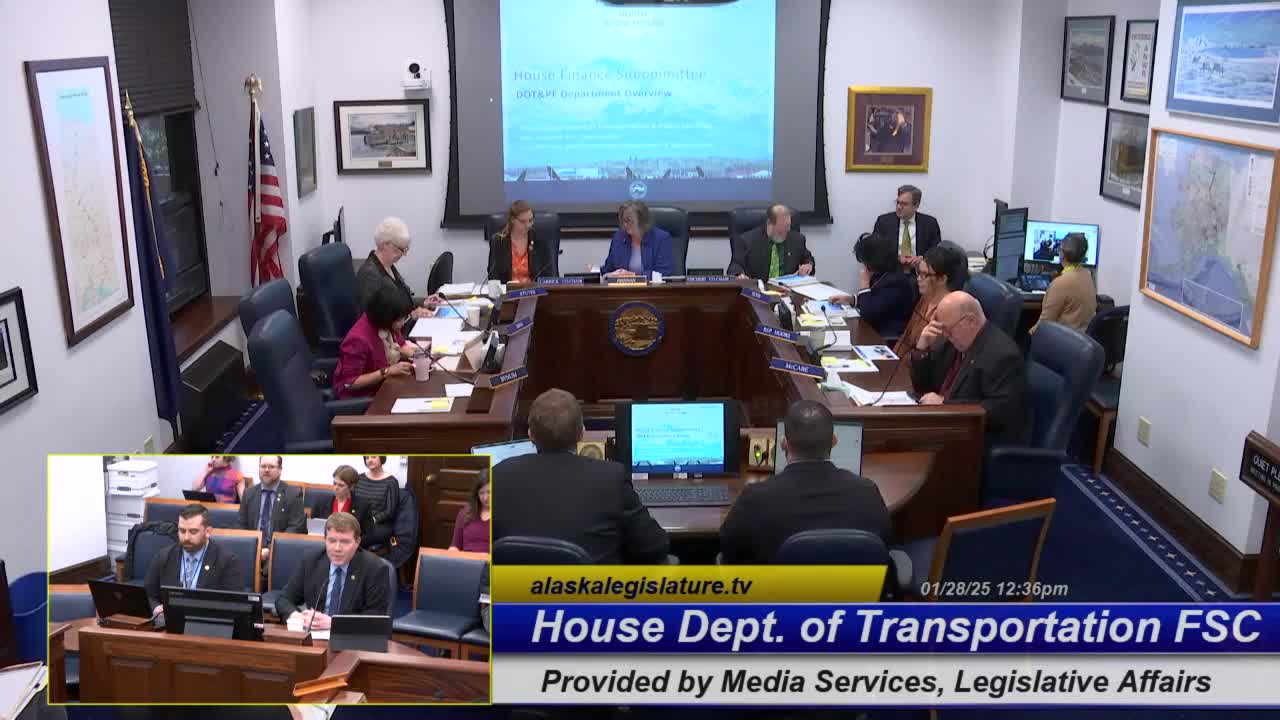
At a Jan. 28 House Finance Subcommittee meeting, Alaska Department of Transportation and Public Facilities officials summarized the department's FY26 operating budget request, noting personnel costs as the largest share of the operating budget and outlining several targeted one-time and base increments.
The Alaska Department of Transportation and Public Facilities (DOT) presented an overview of its FY26 operating budget to the House Finance Subcommittee at a Jan. 28 meeting chaired by Representative Hannon. Commissioner Ryan Anderson said DOT will focus the subcommittee's review on the numbers section of the operating budget and noted that the department's mission is to "keep Alaska moving."
The presentation said personnel costs account for the largest share of DOT's operating budget. DOT officials stated personal services represent about 61% of the operating budget, approximately $488,000,000, and that roughly $200,000,000 of payroll is funded from capital project receipts. The department also described major funding sources, including motor fuel tax receipts of about $37,000,000 that support highway maintenance and operation.
Commissioner Anderson and Dom Pinone, director of program management and administration, highlighted inflation and materials-cost pressures captured by the Federal Highway Administration's National Highway Construction Cost Index, which the presentation said rose roughly 61% since the pandemic and is a driver of project cost escalation and schedule changes. Anderson said cost escalation on capital projects can trigger revised estimates and require amendments that reduce the number of projects that can be delivered.
DOT listed several targeted requests and increments in the operating budget presentation. The department reported current-year spending on cleanup of vacated homeless encampments of roughly $300,000 in Anchorage and roughly $130,000 in Fairbanks; the transcript did not clearly specify the requested FY26 UGF increment for encampment cleanup (not specified). DOT also requested one-time and base increments including funding for roadside safety hardware and guardrail repairs in the northern region, and training funds to prepare Dalton Highway crews to respond to potential liquefied natural gas transport events. The Dalton Highway was identified as a priority for maintenance contracting because it is a 414-mile corridor with elevated vacancy rates at some maintenance camps (some camps reported vacancy rates above 50%).
The department emphasized the link between operating and capital budgets: many DOT staff who design and deliver capital projects are paid from capital program receipts. DOT also described vacancy pressures across classifications, the department's 3,400-plus positions statewide, and a reliance on contractors for some rural airport and maintenance services.
Representative questions focused on vacancy rates, the effect of construction-cost escalation on fiscal constraints, and requests for further breakdowns of deferred maintenance by roads versus facilities. Chair Hannon asked that any follow-up questions from individual members be routed through the subcommittee chair so responses can be shared with the full membership.
The subcommittee scheduled follow-up hearings to drill down on divisions and individual programs; DOT officials said they expect additional, more detailed briefings in future meetings.