Get Full Government Meeting Transcripts, Videos, & Alerts Forever!
Get email alerts on the Division Community Regional Affairs topic
No spam. Unsubscribe anytime.
State division outlines local-government services, $1B grants portfolio and data tools
Summary
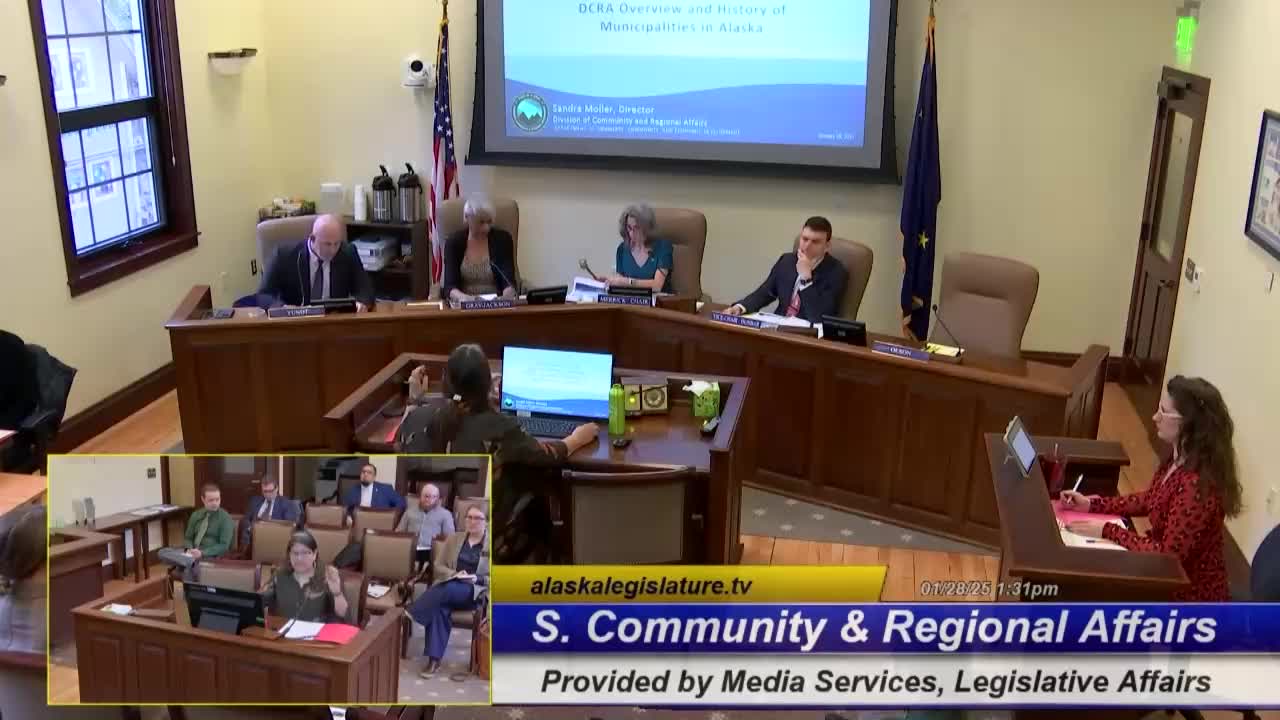
Sandra Moeller, director of the Division of Community and Regional Affairs, gave the Senate Community and Regional Affairs Committee an overview of the division’s programs, data resources, grant portfolio and technical assistance services, including plans to modernize grant management and expand broadband funding distribution.
Sandra Moeller, director of the Division of Community and Regional Affairs in the Department of Commerce, Community and Economic Development, told the Senate Community and Regional Affairs Committee on Jan. 28 that her office focuses on helping local governments with governance, data and grant administration.
Moore said the division’s work rests on the Alaska Constitution’s statement on local self-government (Art. X, Sec. 14) and that the agency aims to “provide help if they ask us” rather than dictate local solutions. The presentation outlined the division’s three program groups: mapping/analytics and data resources; local government assistance; and grants and funding administration.
Moeller said the division employs about 57 people. She described a six-person “Mapping, Analytics and Data Resources” team that maintains an online community database (population, elected officials and other community profiles), GIS services and community story maps used by planners and project teams. She said the local government assistance group has about 20 staff in seven field offices across the state and provides hands‑on support for elections, utility management and training programs such as RUBA (the EPA-funded Rural Utility Business Advisor program). The grants and funding section has roughly 12 staff, she said, and oversees a portfolio of 22 programs worth more than $1,000,000,000; Moeller added the division expects an additional roughly $1,000,000,000 in new programs next fiscal year, largely for broadband and digital equity work.
Moeller described program details and technical assistance the division provides: utility best-practice training and management support tied to RUBA and DEC technical assistance; community resilience work including National Flood Insurance Program (NFIP) support; and the Office of the State Assessor’s collection of municipal tax data (real and personal property, bed and marijuana taxes when reported). She said the division produces twice-yearly retail fuel price reports from a survey of roughly 100 communities and maintains a photo library and community plan archive that planners use for projects.
On grants, Moeller outlined the life cycle the division follows from award through negotiation and delivery, and said that some legislatively designated grants require added negotiation and documentation before funds are disbursed. She said the division is modernizing its eGrants/portfolio tools to improve transparency for grantees and that a public-facing grant portal shows status for awarded programs.
Moeller highlighted several consumer-facing and economic programs the division manages: the Made in Alaska program (membership reportedly about $25 per year and more than 1,000 members), a presence for Alaska-made products at Ted Stevens Anchorage International Airport Concourse B, and a product-preference purchasing program intended to bias some state buying toward Alaska-made goods. She also described Serve Alaska (the state service commission that manages AmeriCorps-like grants), saying about $300,000 or less in state funds can leverage roughly $4,000,000 in federal and local match for service programs.
Moeller briefly noted the Local Boundary Commission work and said a proposed borough is in final stages of reconsideration before potential local elections; she did not provide the borough name in the presentation. She invited committee members to consult the division’s online community database and dashboards for more detail.
The committee did not take any formal action; Moeller answered procedural questions and the committee moved on after her presentation.