Get Full Government Meeting Transcripts, Videos, & Alerts Forever!
Get email alerts on the Retirement Benefits topic
No spam. Unsubscribe anytime.
Alaska retirement office describes staffing fixes, cyber-related payroll backlog and employer delinquencies
Summary
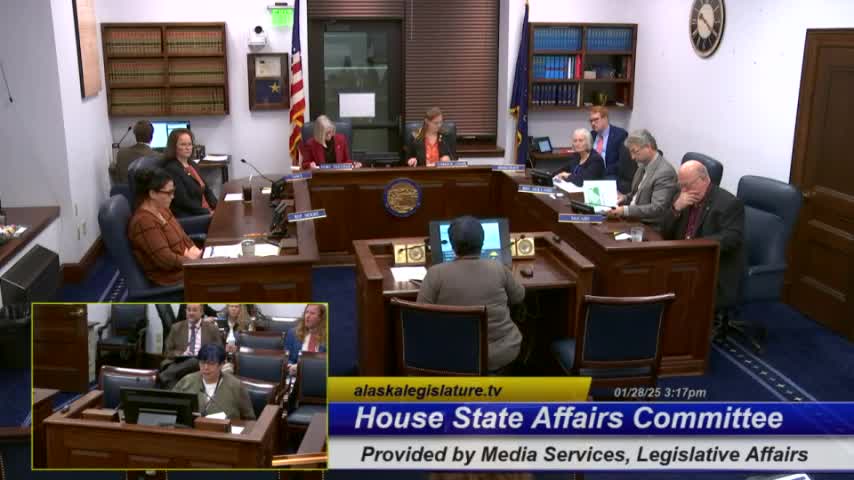
Kathy Lee, director of the Division of Retirement and Benefits (DRB), told the Alaska House State Affairs Committee on Jan. 28 that the office has returned most retiree processing to its normal timeline after a staffing and organizational breakdown left many newly retired public employees waiting months for first checks.
Kathy Lee, director of the Division of Retirement and Benefits (DRB), told the Alaska House State Affairs Committee on Jan. 28 that the office has returned most retiree processing to its normal timeline after a staffing and organizational breakdown left many newly retired public employees waiting months for first checks.
The backstory: DRB’s normal processing time is four to six weeks from a retiree’s effective date, Lee said; that window stretched to as much as 14 weeks for many people during the summer 2024 spike tied to a predictable July retirement surge for teachers and other school‑year employees. “We process a large number between 75 to 80% of our retirement before our monthly cutoff for benefit payments,” Lee said, adding that the unit handles about 100 retirements in a typical month and that a July load can be four to five times the regular work.
Why it fell behind: Lee told lawmakers a 2022 reorganization moved counseling staff out of the pension processing section and into member education. That reduced the pool of experienced employees the processing team historically relied on during predictable July surges. The chief pension officer post was vacant for roughly 18 months, and at one point the retirement processing unit was about 47% vacant, Lee said. She described an all‑hands response in mid‑2024 that used overtime, temporary reassignment of staff and other emergency steps; by August the division said it had returned to the four‑to‑six‑week timeline for cases with complete documentation.
Hiring and retention steps: The division has used targeted incentives to recruit and retain staff. Lee said the program offers a $4,000 hiring bonus (half paid at hire, half after two years) and a comparable retention incentive for existing employees, which she credited as one of several measures that improved applicant flow. She described other recruitment changes including adjustments to minimum qualifications and elimination of barriers like mandatory cover letters.
IT intrusion and payroll reporting backlog: Lee also told the committee that a cyber intrusion identified Nov. 4 required DRB to migrate applications to the state cloud and that the employer reporting tool known as eReporting could not migrate without vendor updates because it relied on an older Java version. DRB said it has been accepting employer contributions with a manual workaround while the vendor reprogrammed and re‑tested eReporting. Lee said about 1,600 employer payrolls (multiple employees per payroll) remain backlogged and will be scheduled into reporting in order — a process she cautioned will take time to complete.
Compensation for missed DC contributions: For affected defined‑contribution accounts, Lee said the division will follow IRS correction rules to make participants financially whole for missed contributions and earnings; the division is coordinating with tax counsel and Department of Law to choose the appropriate correction method and will notify participants when the calculations are complete.
Delinquent employers and long‑standing receivables: Committee members pressed Lee about roughly $11.1 million in delinquent employer payroll reports attributed to many small villages and municipal entities, with some liabilities dating back to the early 2000s. Lee said state law allows interception of other state funds to collect unpaid contributions, but many small communities lack interceptable funds, and she said legislative action likely would be required to resolve the largest, oldest balances.
Invited testimony: Amy Galloway, a Fairbanks retired teacher who retired in July after 25 years, described the practical and emotional toll of the summer delays. Galloway said she received an early notice warning of possible 12–14 week delays and later learned that timeline could mean checks as late as November. She credited DRB staff and legislators for subsequent fixes, and she thanked a retirement counselor, Stan Love, by name. “The state thought it was legitimately acceptable to expect me and all the other public servants to live without a paycheck for 3 to 4 months,” Galloway said, adding that the experience left many retirees stressed and demoralized.
Other notes from the meeting: Lee said DRB reversed the reorganization in June 2024 to restore counseling staff support to the pension processing section, instituted cross‑training for fall 2025, and promoted an internal candidate into the chief pension officer role. The division also announced Chris Novell as the new chief financial officer; Novell was introduced to the committee during the meeting.
What the committee heard as next steps: Lee told lawmakers eReporting had completed testing and was scheduled to go live the Monday after the Jan. 28 meeting, with a staggered employer rollout to avoid system overload. She said the division will notify participants about the method and amount of any corrective payments for missed DC contributions after backlog processing is complete. Committee members asked for written follow‑up on outstanding counts (for example, how many incomplete retirements remain) and on total bonus spending; Lee said she would provide that information.
No formal committee vote or policy action occurred at the hearing; the session was an informational briefing and a public testimony opportunity.