Get Full Government Meeting Transcripts, Videos, & Alerts Forever!
Get email alerts on the Behavioral Health topic
No spam. Unsubscribe anytime.
Health department presents youth behavioral‑health road map, DOJ letter and plans for certified behavioral‑health clinics
Summary
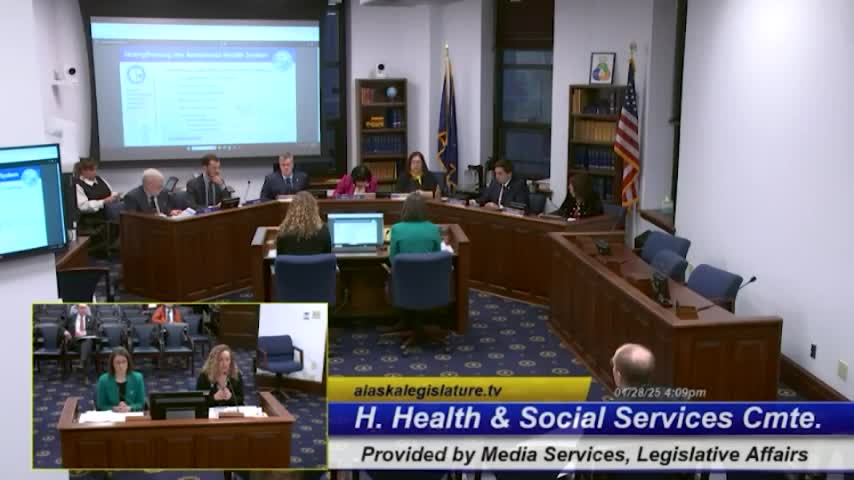
On Jan. 28, 2025, Alaska’s Department of Health presented a youth behavioral‑health road map to the House Health and Social Services Committee, said it had signed a Jan. 16 letter of agreement with the U.S. Department of Justice and announced participation in a federal cohort to develop certified community behavioral‑health clinics.
Commissioner Heidi Hedberg and Deputy Commissioner Emily Ritchie told the House Health and Social Services Committee on Jan. 28, 2025, that the Department of Health has produced a youth behavioral‑health road map and is pursuing multiple steps to expand community‑based services for children and youth.
Hedberg said the youth behavioral‑health road map contains 47 recommendations; she told the committee there is active work on 21 of those recommendations. The roadmap lays out a continuum of care from prevention and early intervention through outpatient, subacute and residential services, with cross‑cutting needs in data integration, provider supports and care coordination.
Hedberg also said the department signed a Jan. 16 letter of agreement with the U.S. Department of Justice. The agreement pauses litigation for approximately three years while Alaska implements changes and provides updates to DOJ; Hedberg said the agreement does not mean the work is finished and that DOJ will continue monitoring implementation.
Deputy Commissioner Emily Ritchie described concrete system changes tied to behavioral health: the department has renewed the Section 1115 behavioral‑health waiver through March 2024–effectively extending that demonstration — and is focused on building out crisis services using contractor analysis (Milliman) to identify gaps and priorities. Ritchie said the department completed a claims‑payment transition for behavioral‑health claims on Nov. 1, 2024, and is working to stabilize post‑transition issues with providers.
The department also reported that it will participate in a federal cohort to establish certified community behavioral health clinics (CCBHCs). Ritchie said Alaska has four clinics that could qualify; when asked about locations she referenced Juneau, Anchorage and Mat‑Su and said the department would follow up with specifics. The department said CCBHC certification would require state standards and certification rules so Medicaid could implement an enhanced payment model for those clinics.
Lawmakers pressed for measures of progress and asked for examples of recent successes. Officials cited work to stabilize claims payment, to improve provider supports and to develop specialized services for individuals with complex needs (including new specialized family habilitation homes and adjusted staffing flexibilities).
Ending: Department officials asked legislators for continued collaboration as they implement the road map and regulatory groundwork for clinic certification and crisis services; they said they will provide additional follow‑up information and specific implementation timelines on request.