Get Full Government Meeting Transcripts, Videos, & Alerts Forever!
Get email alerts on the Minors In Psychiatric Hospitals topic
No spam. Unsubscribe anytime.
Bill to expand family access and reporting for minors in psychiatric hospitals draws supportive testimony
Summary
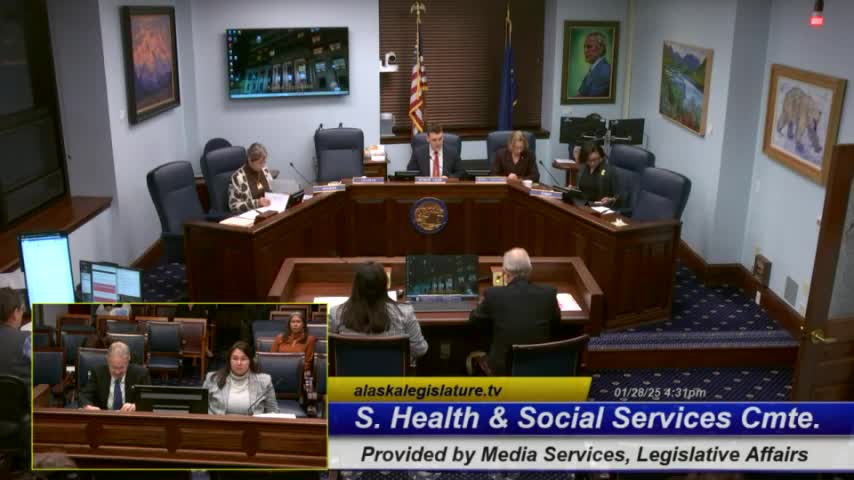
Senator Matt Clayman introduced Senate Bill 44 during the Jan. 28, 2025 hearing, saying the bill is designed to enhance rights, transparency and oversight for minors admitted to psychiatric hospitals.
Senator Matt Clayman introduced Senate Bill 44 during the Jan. 28, 2025 hearing, saying the bill is designed to enhance rights, transparency and oversight for minors admitted to psychiatric hospitals.
"Senate Bill 44 enhances and protects the rights of these young patients who undergo evaluation or inpatient treatment at these psychiatric hospitals," Clayman said in his sponsor remarks, and he described four principal provisions: guaranteed regular confidential video communication with a parent or guardian, twice-yearly inspections with patient interviews, 24-hour notice to parents and the Department of Health after each use of seclusion or restraint, and an annual public report on minors in psychiatric hospitals.
Committee staff provided a sectional analysis: the bill adds a right for a minor to access at least one hour of confidential communication per week with a parent or guardian unless prohibited by law or court order; requires a Department of Health annual report and data collection by the Department of Family and Community Services; gives licensing inspectors authority to enter and conduct unannounced inspections; requires interviews with at least 50% of patients present at inspections; and requires written notification within one business day after each seclusion or restraint incident involving a minor. The bill sets an effective date of July 1, 2025.
Invited testimony included Amanda Metivier, co-founder and board member of Facing Foster Care in Alaska, who described the bill as addressing "long standing issues for children in residential psychiatric treatment facilities," highlighting restricted communication and common uses of chemical restraint. Carolyn Brown, a Fairbanks parent who described her family's experience with her son's psychiatric treatment and residential care, told the committee that "regular contact has been critical to his treatment and his overall well-being," and supported the bill's provisions for parental notification of seclusion or restraint.
Committee members questioned definitions and implementation details. Senator Sarah Tobin asked whether the bill's reference to an "overseeing physician" might exclude other clinicians who supervise care; Senator Clayman said the drafting could be adjusted to allow deliberation on whether mid-level clinicians should have similar authority. Senator Hughes asked about a phrase that could be read as limiting contacts to "not more than four occasions"; the sponsor and chair said the intent was to set a minimum of one hour per week, not to impose a strict maximum.
Senators also questioned practical aspects of inspections and notifications. Clayman said the 50% interview threshold was modeled on other states and appeared feasible; the committee agreed to consult providers. Members asked whether video recordings should be required for seclusion or restraint; the sponsor said he would consult providers because continuous cameras may be contraindicated in some psychiatric settings.
The committee received the invited testimony and announced it will take public testimony on SB 44 at its Jan. 30 meeting. No vote was taken at this hearing.