Get Full Government Meeting Transcripts, Videos, & Alerts Forever!
Get email alerts on the Overdose And Suicide Prevention topic
No spam. Unsubscribe anytime.
Alaska forms opioid fatality review committee, directs settlement funds to communities and elevates suicide prevention work
Summary
The Department of Health told legislators on Jan. 28 that it has established an opioid fatality review committee, begun distributing National Opioid Settlement funds to community organizations and is coordinating overdose and suicide prevention across agencies; the committee will meet every other month and issue at least an annual report.
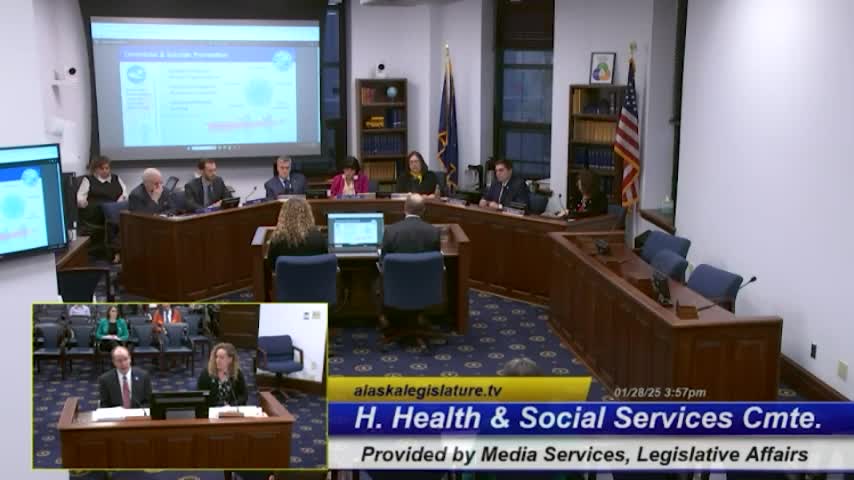
Dr. Robert Lawrence, chief medical officer at the Alaska Department of Health, told the House Health and Social Services Committee on Jan. 28, 2025, that the department has established an opioid fatality review committee to examine overdose deaths and issue community‑focused recommendations.
"That committee has now been established. They're meeting for the first time this month," Dr. Lawrence told lawmakers, and he said the committee will review clinical records and case reviews to produce “actionable recommendations for change” and will work to get those recommendations into communities. He said the committee will meet every other month and plans to produce at least an annual report summarizing recommendations.
Dr. Lawrence described the department’s response to overdose as a multi‑strand approach — interdiction, prevention, harm reduction, treatment and recovery — coordinated across state agencies including the Departments of Corrections, Public Safety and Family and Community Services and with the Mental Health Trust Authority.
On funding, the department said National Opioid Settlement funds have started to flow into Alaska and that the first iteration of those funds has been distributed to 18 community organizations and one statewide intermediary organization; the department said over 80% of the first grants were directed back to communities. Dr. Lawrence noted the settlement fund was previously described (in the briefing) as approximately $58 million but said he could not confirm the current balance and offered to follow up with detailed figures.
Lawmakers asked about links between youth mental health and social media, the role of law and school policy, and whether suicide‑prevention work should extend beyond schools. Dr. Lawrence and other department leaders noted the state is pursuing suicide‑prevention planning (including work on the 988 crisis line) alongside opioid response efforts.
Ending: The department said it will provide further detail on the opioid settlement fund balance and distribution process and that communities receiving the initial grants will help distribute smaller awards to organizations that did not apply directly.