Get Full Government Meeting Transcripts, Videos, & Alerts Forever!
Get email alerts on the Medicaid Behavioral Health Parity topic
No spam. Unsubscribe anytime.
Senate committee hears introduction to bill aimed at Medicaid behavioral-health parity
Summary
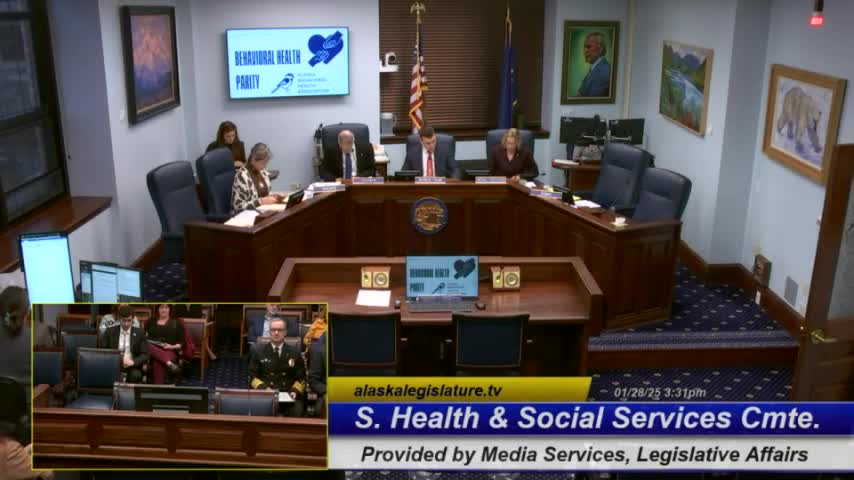
Senate Health & Social Services Committee Chair Senator Dunbar introduced Senate Bill 45 on Jan. 28, 2025, saying the measure would require the State to analyze whether Medicaid covers behavioral health the same as physical health and to report back to the Legislature.
Senate Health & Social Services Committee Chair Senator Dunbar introduced Senate Bill 45 on Jan. 28, 2025, saying the measure would require the State to analyze whether Medicaid covers behavioral health the same as physical health and to report back to the Legislature.
The bill would add a new subsection to Alaska Medicaid statute that, according to Ariel Wigan, committee aide and chief of staff to Chair Dunbar, "states that the State must provide equal coverage and access to treatment for behavioral health issues" and would require the Department of Health to follow federal behavioral health parity statutes listed in the bill.
Supporters from the Alaska Behavioral Health Association and provider groups told the committee that administrative rules and documentation requirements make it harder for Alaskans to obtain community-based behavioral health care. Lance Johnson, chief operating officer of the Alaska Behavioral Health Association, said parity legislation would not remove oversight but would require the department to analyze how it regulates behavioral health compared with medical care and to publish findings.
John Solomon, CEO of the Alaska Behavioral Health Association, described parity as ensuring "that behavioral health treatment has the same access and coverage as medical and surgical treatments," and emphasized that many behavioral-health services occur outside hospital settings. He and other witnesses noted that some service rules and documentation requirements predate Medicaid billing and create delays that can stretch initial access to care from days into months.
Assembly Chair Christopher Constant and other invited witnesses described how time-limited authorizations and 90-day treatment-plan requirements can disrupt continuity of care. Dustin Larna, CEO of Residential Youth Care in Ketchikan, and providers argued that lengthy intake and documentation processes can push people to emergency rooms and contribute to workforce strain when agencies hire multiple administrative staff to meet Medicaid reporting needs.
The bill would: (1) require the state Medicaid program to align with federal parity standards and investigate parity complaints; (2) require an annual legislative report, due March 1, describing how medical necessity is applied for behavioral and physical health; (3) require a one-time plain-language online report describing the department's transition to parity and a market review; and (4) allow sections 1'4 to take effect only after federal approval of necessary State Medicaid Plan amendments.
Committee members and the director of the Division of Behavioral Health discussed implementation details, including how federal parity rules were written for managed care systems while Alaska currently operates fee-for-service Medicaid. Director Tracy Dompling said the department and the association should prioritize which regulatory changes to pursue and that a statutory requirement would maintain continuity across administrations. The director also noted the department is undertaking rate rebasing and that forthcoming provider data would inform that work.
Senator Dunbar said the committee would not move SB 45 at this hearing and encouraged continued work between the Alaska Behavioral Health Association and the Department of Health to refine implementation and possible drafting changes.
Votes at the hearing: No formal motions or votes were recorded on SB 45; the bill was introduced and received invited testimony and was set aside for further consideration.