Get Full Government Meeting Transcripts, Videos, & Alerts Forever!
Get email alerts on the Medicaid topic
No spam. Unsubscribe anytime.
Alaska health department outlines Medicaid rate review, 1115 demonstration work and claims payment changes
Summary
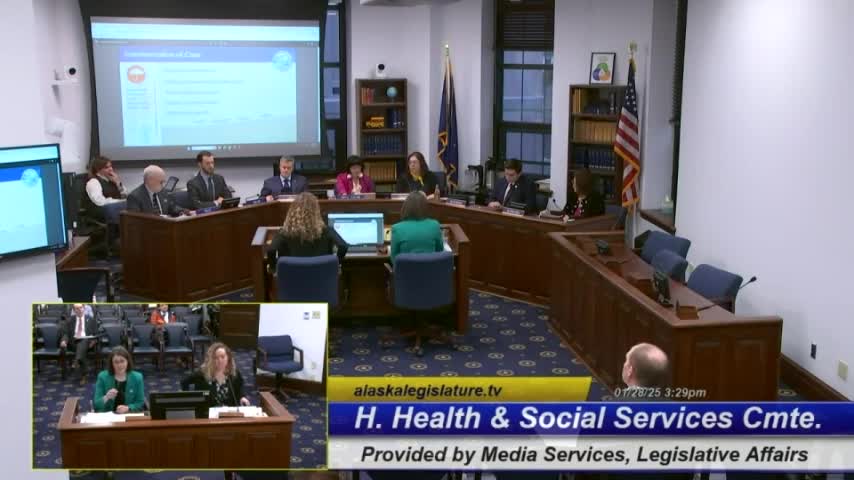
Alaska’s Department of Health told the House Health and Social Services Committee on Jan. 28, 2025, that it is conducting a multiyear review of Medicaid rate methodologies, pursuing Section 1115 demonstration projects and finishing a claims‑payment transition begun last year.
Alaska’s Department of Health told the House Health and Social Services Committee on Jan. 28, 2025, that it is conducting a multiyear review of Medicaid rate methodologies, pursuing Section 1115 demonstration projects and finishing a claims-payment transition begun last year.
Deputy Commissioner Emily Ritchie said the department’s “Medicaid methodology rate review” is intended to test whether current rate structures, levels and policies are producing the outcomes the state wants for population health and service delivery. She told lawmakers that phase one focuses on behavioral health services, long-term care services and supports, federally qualified health centers and both emergent and non‑emergent medical transportation, and that the department expects “final recommendations for those 4 areas of focus” in July 2025.
Why it matters: Alaska Medicaid is a major payer in the state. Changes the department makes to rate methodology and to what services Medicaid covers can affect provider revenue, access to care and long‑term state spending.
Ritchie described 1115 demonstration waivers — federal approvals that let states test delivery and payment approaches for up to five years — as a separate but related track. “It’s essentially a 5‑year demonstration waiver that is structured to include a hypothesis, a very clear research objective, significant reporting and public input,” she said, summarizing the federal framework the state must follow when it proposes an 1115 project.
On provider payments, Ritchie said the department completed a high‑risk transition of most behavioral‑health claims into the state’s centralized Medicaid claims system on Nov. 1, 2024. “That claims transition occurred November 1, 2024,” she told the committee, and the department said it remains in a post‑transition stabilization period while staff work outstanding issues with individual providers.
Lawmakers pressed department officials about delayed payments and provider cash flow. Ritchie said the department is sharing information as it becomes available and working directly with providers who continue to experience problems: “We are trying to share information as it becomes available,” she said, adding that the department balances speed with the need to gather provider data and allow stakeholder feedback.
The department also highlighted other Medicaid‑related fiscal work. Emily Ritchie said the Division of Health Care Services recouped $139,000,000 in federal offsets in fiscal 2024 through tribal reclaiming and reported $168,000,000 in pharmacy rebates, which the division credited with reducing general‑fund pressure.
Operational and modernization steps described to the committee included a proposed provider‑enrollment portal in the governor’s capital budget, short‑term fixes to reduce manual processing, and a planned patient‑facing mobile app to carry a Medicaid ID card (the department said it aims to have the ID card available to enrollees in August 2025). The department described a modular approach to Medicaid IT modernization — moving functions off the mainframe one module at a time rather than doing a single large replacement.
What's next: department officials said they expect final recommendations for phase‑one rate methodologies in July 2025, plan further work to design and evaluate 1115 waiver opportunities with a contractor, and will continue post‑transition work on behavioral‑health claim payment issues.
Speakers quoted or cited: Deputy Commissioner Emily Ritchie; Commissioner Heidi Hedberg; Chair Mina of the House Health and Social Services Committee.
Ending: Committee members asked the department for continued updates on provider payment issues and on the July 2025 timeline for the rate review recommendations. The committee scheduled further budget and subcommittee review as the department’s recommendations and procurements proceed.