Get Full Government Meeting Transcripts, Videos, & Alerts Forever!
Get email alerts on the Seafood Industry topic
No spam. Unsubscribe anytime.
Alaska seafood task force adopts final report, sends 29 action items to legislature
Summary
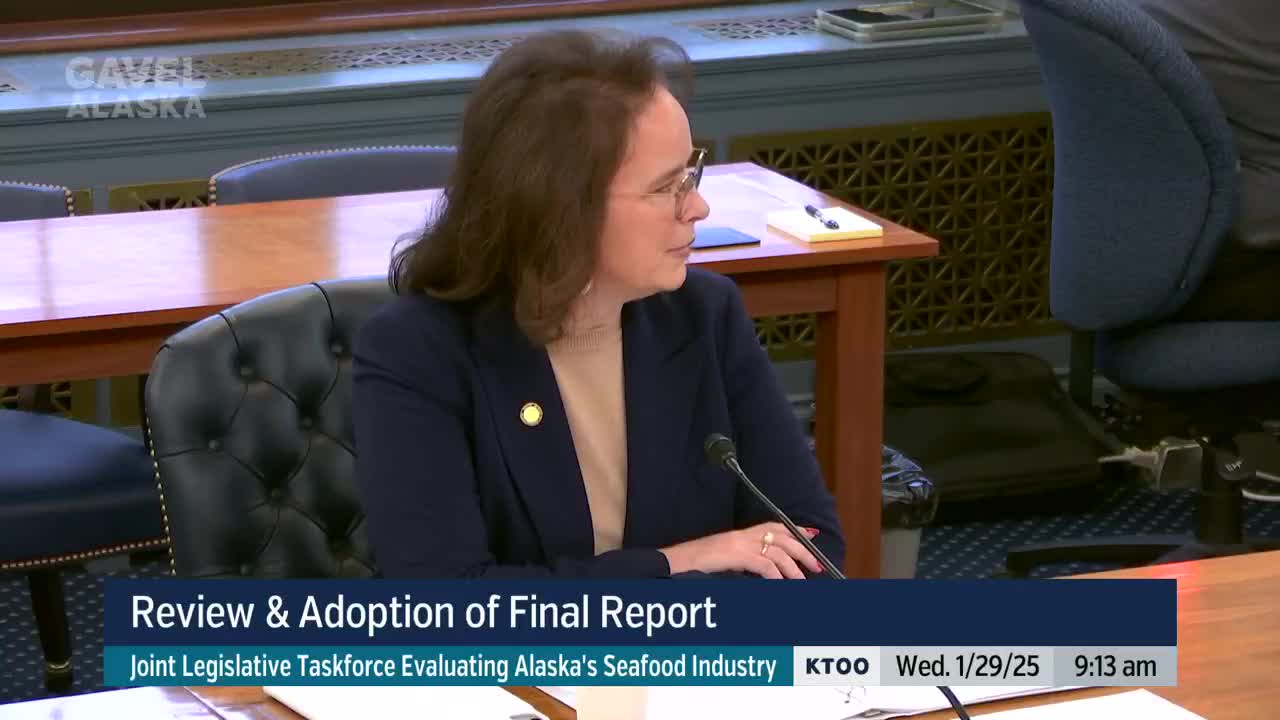
The bipartisan Alaska Legislative Seafood Task Force voted unanimously to adopt a final report outlining 29 near-, mid- and long-term recommendations aimed at stabilizing the seafood industry, including proposals on financing, tax credits, marketing and infrastructure.
Sen. Stevens, chair of the Alaska Legislative Seafood Task Force, moved to adopt the task force’s final report and its recommendations, and the panel approved the motion by unanimous voice vote.
The report, prepared by staffer Tim Lampkin and reviewed by task force members from both chambers, lists 29 action points divided into near-, mid- and long-term categories. Near-term priorities flagged for the 2025 session include examining finance and loan programs, adjusting tax-credit eligibility, supporting marketing through the Alaska Seafood Marketing Institute, exploring community cold storage options, and proposing measures to provide debt relief and insurance risk-pooling for fishery participants.
The report calls for immediate follow-up in several specific areas. Staff noted it will examine the statutory alignment between CFAB and the commercial fisheries revolving loan program and review loan terms that affect new entrants, vessels and smaller processors. It also recommends studying changes to fisheries product development tax credits, with a proposed fixed sunset included in the draft, and urges looking at revenue-sharing triggers for fishery business tax and landing tax allocations to protect impacted communities.
Task force members repeatedly emphasized the urgency. Senator Stedman said roughly 44,000 Alaskans are affected by the downturn and called it “probably the most significant downturn in the fisheries in a century.” Several members urged the group’s legislative allies—particularly the House Fisheries Committee and the Senate Resources Committee—to carry the proposals forward into bills and budget requests.
Tim Lampkin, staff to Sen. Stevens, explained that the report divides recommendations into what can be done during the current session, midterm work (2026–27), and longer-term goals that may require complex policy or budget work. Lampkin said some near-term items could be introduced as legislation, others would be handled through the budget process, and some would be started as bills to begin multi-year work.
Members discussed specific programmatic ideas from testimony the task force received: aligning CFAB interest rates and terms with the commercial fisheries revolving loan fund; exploring temporary adjustments to loan terms and borrower relief for unexpected market or harvest events; examining tax-credit incentives for processing and innovation; and pursuing federal advocacy on trade and disaster relief through resolutions to the congressional delegation.
Representative Stutes moved the final adoption “as will be amended,” and the motion passed by unanimous voice vote with no roll call. The task force asked staff to incorporate agreed amendments — including language suggested to prioritize near-term action on CFEC permit and buyback studies — and to circulate the final document for member signatures before transmission to the legislature.
The task force will not meet again unless members determine follow-up working groups are necessary; several members cautioned against creating a permanent new task force unless legislation and budgets require ongoing coordination. The task force recommended that the House Fisheries Committee and the Senate Resources Committee carry the work into the legislative process.
Votes at a glance: the one formal action recorded in the meeting was adoption of the task force final report (motion by Representative Stutes). The motion passed by unanimous voice vote; no roll-call counts were recorded in the transcript.
Ending: The task force adjourned after instructing staff to prepare the amended final report for distribution to committee chairs and the legislative process.