Get Full Government Meeting Transcripts, Videos, & Alerts Forever!
Get email alerts on the Department Of Law Civil Division topic
No spam. Unsubscribe anytime.
Department of Law outlines civil workload, staffing gains and document-management challenges
Summary
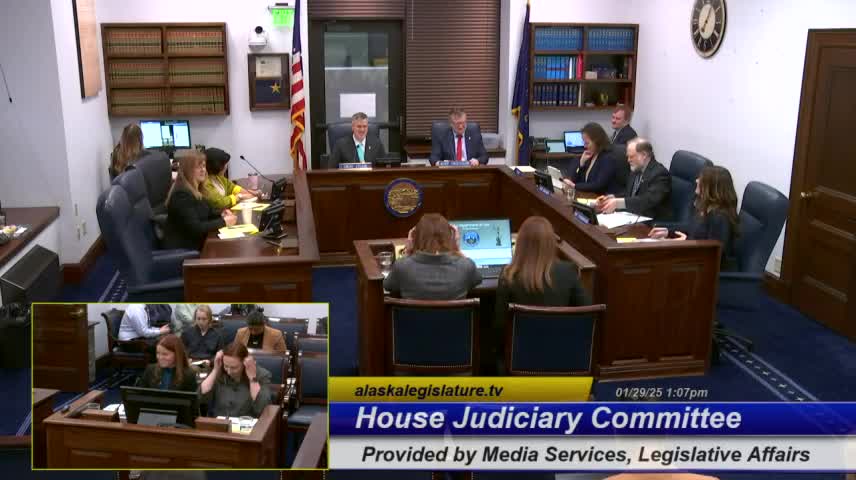
Deputy Attorney General Corey Mills briefed the House Judiciary Committee on the Department of Law’s civil division structure, priorities and staffing, noting improvements in attorney retention, a fellowship pipeline and large digital records demands that complicate litigation and public-records obligations.
Deputy Attorney General Corey Mills told the Alaska House Judiciary Committee on Jan. 29 that the Department of Law’s civil division provides legal advice and representation to the executive branch and has seen measurable staffing improvements while facing increasing digital workloads.
"The Department of Law upholds the rule of law, protects public safety, and provides high quality legal representation to executive branch agencies for the benefit of all Alaskans," Mills said, summarizing the department mission and its statutory basis in Alaska Statutes 44.20.020.
Mills said the civil division now has about 146 attorneys and roughly 250 total staff when paralegals and law office assistants are counted, and that attorney vacancies have fallen to about 6–7 percent from roughly 20 percent a few years ago. He credited recent pay adjustments and new recruitment and retention efforts, including a fellowship program the division uses as a hiring pipeline.
Mills outlined the civil division’s sections and primary clients: child protection and human services work that represents a large portion of hours; regulatory and consumer-protection work before the Regulatory Commission of Alaska; natural-resources and oil-and-gas representation; transportation and rights-of-way work; and transactional support to public corporations such as the Alaska Housing Finance Corporation. He said the child-protection caseload is the division’s largest single area of work and that the head of that section previously supervised an unsustainably large staff load.
Mills also described the department’s document-management and information burdens: the department’s information and project support unit reported roughly 10.5 million sent email messages and 58.4 million received messages across about 18,000 active mailboxes, using about 152 terabytes of storage. Mills said those volumes feed discovery and public-records requests and make compliance and cybersecurity more complicated.
On specific matters he highlighted litigation and regulatory roles: the department pursued long-running litigation over trails near Chicken, Alaska, that concluded with settlements recognizing many trails, and the office performs a gatekeeping role on administrative regulations to ensure compliance with the Administrative Procedure Act. Mills also noted the department’s consumer-protection unit enforces antitrust and consumer statutes and that the department appears before the Regulatory Commission of Alaska as a public advocate on rates and utilities.
Committee members asked about staffing distribution and particular requests. Representative Mina asked why the Alaska Railroad Corporation uses separate counsel; Mills replied that the legislature statutorily excluded the railroad from department representation. Representative Costello asked about rights-of-way work affecting elderly claimants; Mills described a long-running series of cases and a recent settlement that resolved much of that litigation but said additional work continues.
Mills said recruitment and retention work — internships, fellowships and professional development trainings — have helped retention and that the department has created a two-director civil structure to distribute workload. He also flagged a new tribal-liaison post placed with the opinions, appeals and ethics section to improve coordination with tribal governments.
Ending: Mills closed by handing the floor to the criminal-division director for the committee’s remaining questions.
Sources and attributions: Quotes and figures come from Deputy Attorney General Corey Mills’ presentation to the House Judiciary Committee, Jan. 29, 2025.