Get Full Government Meeting Transcripts, Videos, & Alerts Forever!
Get email alerts on the Pensions Retirement Funding topic
No spam. Unsubscribe anytime.
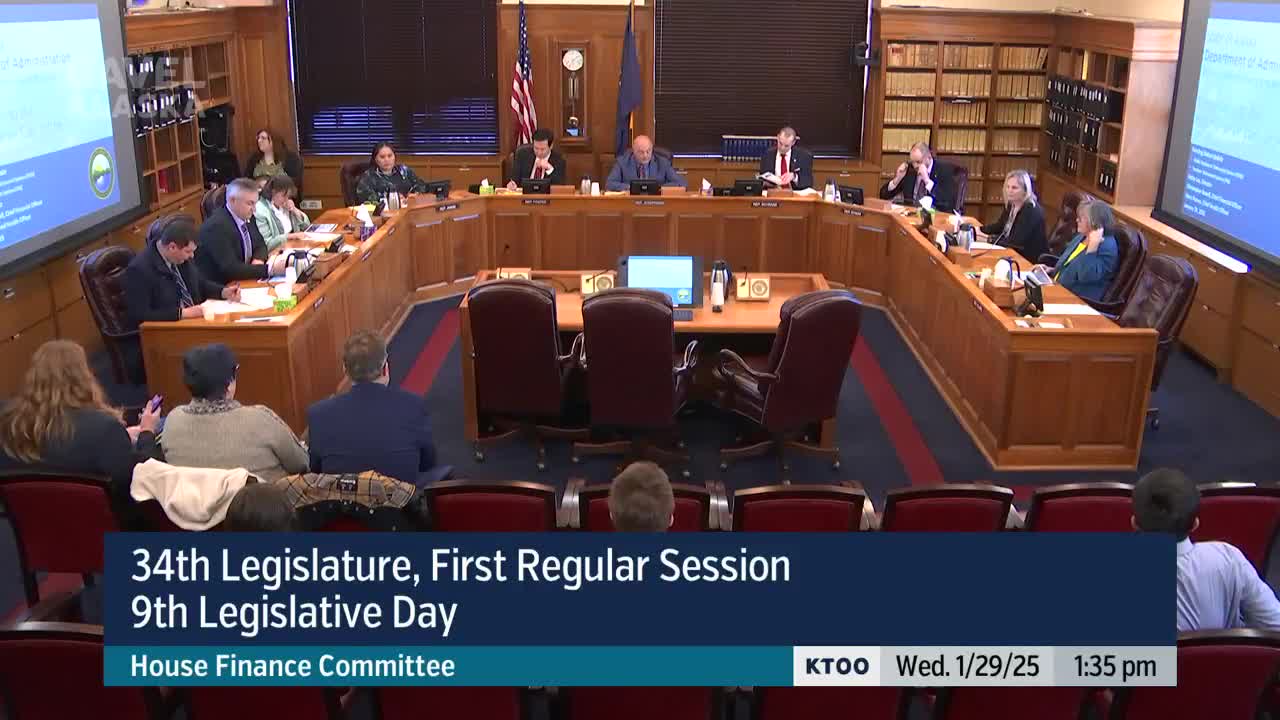
House Finance hears pension funding update: PERS pension ~68% funded; health trusts overfunded
Summary
On Wednesday, Jan. 29, 2025, the Alaska House Finance Committee received an update from the Division of Retirement and Benefits showing the Public Employee Retirement System (PERS) pension fund roughly 68 percent funded with about $5.5 billion unfunded, while the retirement systems' health trusts were materially overfunded.
Juneau — On Wednesday, Jan. 29, 2025, the Alaska House Finance Committee received an update from the Division of Retirement and Benefits on the funding status of the state’s retirement systems.
Christopher Novell, chief financial officer for the Division of Retirement and Benefits, said the draft 2024 actuarial valuation put the PERS pension liability at about $17 billion with actuarial assets of roughly $11.6 billion, leaving an unfunded liability of about $5.5 billion and a funded ratio reported in the presentation at about 68 percent. Novell emphasized the valuation was still in draft form and that the Alaska Retirement Management Board (ARM board) will review final figures in March.
The nut graf: the committee heard that pension liabilities remain materially underfunded while the systems’ retiree health trusts are materially overfunded, a split the division and the committee said is legally required to remain separate and cannot be offset one against the other. That divergence is driven in part by federal Medicare Part D subsidies (known in the presentation as the Employer Group Waiver Plan, or EGWIP) and by a large state infusion in 2015.
Most important details
- Funding levels and liabilities: Novell presented the draft 2024 figures showing PERS pension liabilities of about $17,000,000,000 and actuarial assets of about $11,600,000,000 (approximately $5,500,000,000 unfunded; ~68% funded). The presentation noted a similar pattern for TERS (teachers), with the pension fund underfunded and the TERS health trust overfunded.
- Health trusts and EGWIP: Kathy Lee, director of the Division of Retirement and Benefits, told the committee that a federal program — the Employer Group Waiver Plan (EGWIP) — has supplied substantial prescription-drug subsidies and related payments that have improved the health trusts’ funding. “The division has been a recipient of EGWIP funds for the last few years, and we get a considerable amount of discount from them,” Lee said. Division staff and the committee cited a projected total EGWIP subsidy near $100–102 million for 2024 as used in the division’s valuations.
- 2015 infusion and how it was allocated: Actuarial consultant David Kirschner (Gallagher) gave the committee a breakdown of the $3 billion state infusion enacted in 2015 under HB 119: $1 billion to PERS (all to the PERS pension trust) and $2 billion to TERS (about $1.7 billion to the TERS pension trust and about $300 million to the TERS health trust), figures Kirschner provided during Q&A.
- Assumptions and projections: The plans use a 7.25% assumed actuarial earnings rate (adopted in 2022). Kirschner told the committee that liabilities are sensitive to that assumption: “For every 100 basis point change in that assumption ... the liabilities change by about 11% or 12%,” he said. Using current assumptions, Kirschner said pension trusts are projected to reach 100% funded on the current path around fiscal year 2048, but he cautioned projections depend on future experience and assumptions.
- ARM board actions and contribution rates: The ARM board adopted a 0% normal cost rate for the health plans for the current valuation because the health trusts are overfunded; staff noted the board revisits rates annually. Committee members heard that employer contribution caps are set in statute (22% for PERS employers; 12.56% for TERS employers) and that additional state “on-behalf” contributions are required by Alaska statute. The presentation described the mechanics of employer/employee/defined-contribution and defined-benefit rates, including that tier 4 defined-contribution employees contribute 8% with employer matches (5% for PERS, 7% for TERS) and that the statutory employer caps mean the excess goes to amortize unfunded liabilities.
Committee discussion and outstanding questions
Committee members pressed staff and the actuary on several topics: how the EGWIP subsidy might change (Lee said EGWIP amounts are not guaranteed and can vary from year to year); whether excess health trust funds can be redirected to pension liabilities (Kirschner and Novell said the trust funds are legally segregated and cannot be moved to cover pension shortfalls); the potential effect of lower-than-assumed investment returns (Kirschner said lowering the assumption by 100 basis points would increase liabilities roughly 10–12%); and how the 2015 infusion was split between pension and health funds (Kirschner gave the breakdown noted above).
No committee motions or votes were taken; the session was a staff and consultant briefing. Members asked staff to provide follow-up information requested during the hearing, including sensitivity projections under alternative return assumptions and a list of participating employers.
Background and context
Committee members and staff noted that the defined-benefit tiers were closed to new hires in 2006 and that the membership is shifting toward defined-contribution tiers over time (the presentation showed active membership split roughly 22% in defined-benefit tiers and 78% in defined-contribution for PERS as of June 30, 2024). The division emphasized that pension and health funding must be tracked separately and that long-run funded-status projections depend heavily on investment returns, EGWIP subsidies and the ARM board’s adopted assumptions.
Ending
Co-chair Andy Josephson closed the hearing after questions and thanked Director Kathy Lee, CFO Christopher Novell and Chief Health Officer Steve Ramos for the presentation. The committee recessed and scheduled its next meeting for Jan. 30, 2025, when it will hear a fiscal overview from the Legislative Finance Division.