Get Full Government Meeting Transcripts, Videos, & Alerts Forever!
Get email alerts on the Carbon Storage topic
No spam. Unsubscribe anytime.
Alaska agencies set schedule to begin permitting carbon storage; EPA primacy application planned for May
Summary
The Department of Natural Resources told the Senate Resources Committee it has filed regulations to license underground carbon storage and will open applications Feb. 16; the Alaska Oil and Gas Conservation Commission said it will submit an EPA Class VI primacy application in May and expects EPA review to take 12–24 months.
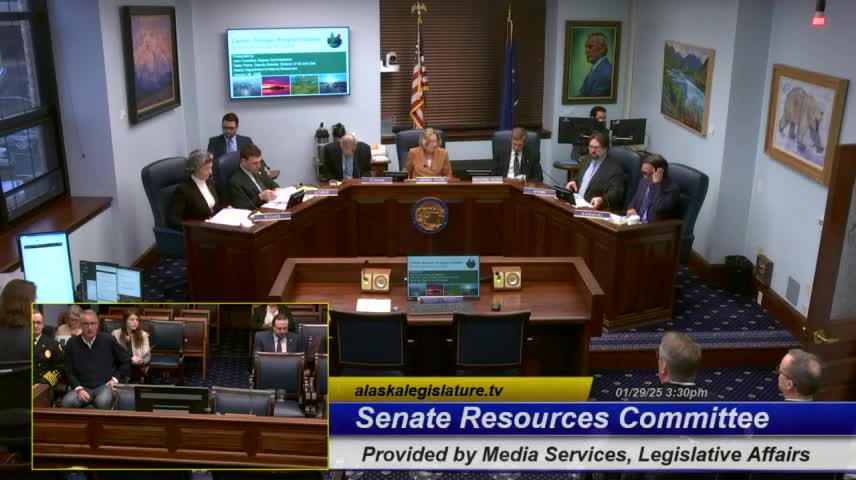
ANCHORAGE — The Alaska Department of Natural Resources and the Alaska Oil and Gas Conservation Commission updated the Senate Resources Committee Jan. 29 on state steps to implement carbon capture, utilization and storage (CCUS) after passage of HB 50.
DNR Deputy Director Haley Payne told the committee the department has completed a regulatory package and "filed those with the lieutenant governor, and they will take effect February 16th," positioning DNR to accept applications to license the state's subsurface for dedicated carbon storage. Payne said the department is also drafting model license and lease agreements and building an online technical database of public well and seismic data to help prospective applicants.
The update to the committee from the AOGCC focused on the agency's work to secure primacy from the U.S. Environmental Protection Agency to regulate Class VI underground injection (CO2 storage) wells within Alaska. Commissioner Gregory Wilson said the commission expects to submit its primacy application in May, after public comment on draft regulations, and that EPA's review of a primacy application typically takes 12 to 24 months.
Why it matters: HB 50 directed DNR to license the state's pore space for carbon storage and empowered AOGCC to regulate Class VI injection wells. If projects move forward, proponents have said CCUS could create new state revenue streams and attract private and international investment; both agencies told the committee they continue to see industry interest but that large projects would require several years to develop.
Key details from DNR - Regulatory status and start date: Payne said DNR completed its regulatory package and transmitted revisions to the lieutenant governor Jan. 17; the department will be "prepared to receive applications February 16th." - Fees and terms: Payne said the regulations set a $500 application fee and a $250 transfer-of-interest fee, matching existing oil-and-gas fee structures. DNR's exploration license is structured for a five-year characterization phase, with work commitments meant to prevent acreage warehousing. - Leasing, competition and public process: The rules include a best-interest finding process and provisions for competitive leasing and consideration of alternative uses (including natural gas storage). Payne said the rules mirror oil-and-gas practice where appropriate but also add provisions specific to long-term stewardship of storage sites. - Closure and monitoring: Payne emphasized that federal Class VI requirements include long post-injection monitoring periods. She said DNR's regulations and the Carbon Storage Closure Trust Fund give the state authority to monitor sites after injection ceases and to require abandonment and restoration plans; the transcript notes a default long-term monitoring expectation of 50 years under the EPA program.
Key details from AOGCC - Regulations and drafting approach: Commissioner Wilson said AOGCC elected to reproduce (rather than adopt by reference) the federal Class VI code in Alaska regulations (Title 20, Chapter 25, adding Article 6) to be more transparent for stakeholders. AOGCC created a regulatory "crosswalk" to align state rules with federal requirements. - Timeline and public process: AOGCC held scoping outreach in November 2024, received six formal comments and had good attendance at public meetings. Wilson said the commission expects to publish a final draft in February, complete state legal review in March, open a public comment period (about two months), and submit a primacy application to EPA in May. - Funding and staffing: The commission reported a state appropriation for fiscal 2025 of $388,000 for personnel, $500,000 for contractual services and $20,000 for commodities, with similar allocations projected through FY 2030. AOGCC also received an EPA Class VI grant of $1,930,000 (award date given as Nov. 18, 2024) for a five-year grant period. AOGCC described staff assigned to the effort (including a UIC program manager and a petroleum/carbon engineer) and said it will use contractors for specialized work such as plume modeling and cement/mechanical integrity review. - Outreach and polling: AOGCC has an outreach partnership with the University of Alaska (UAF) and reported community meetings in Fairbanks, Anchorage and Kenai, with a planned meeting in Utqiagvik. The commission said UAF conducted a statewide poll; full poll results were not provided during the hearing but were offered for follow-up.
Questions, concerns and next steps Committee members pressed agencies on public comment levels, staffing and the reliability of federal incentives (including the 45Q tax credit). Deputy Commissioner John Crother said the department "still sees significant" potential for large-scale projects and international interest, but that companies have not yet committed to a discrete schedule. AOGCC confirmed entities may seek a Class VI permit directly from EPA while state primacy is pending.
The committee did not take formal votes. Both agencies said they would return with updates after key milestones: DNR once applications begin to arrive and AOGCC as it advances the primacy application process.
Ending The committee paused further action but scheduled follow-up oversight. The agencies provided contact details and indicated they would supply public comment lists and poll results on request.