Get Full Government Meeting Transcripts, Videos, & Alerts Forever!
Get email alerts on the Staffing And Operations topic
No spam. Unsubscribe anytime.
Alaska Labor Department reports rising vacancies, warns of slower service turnaround
Summary
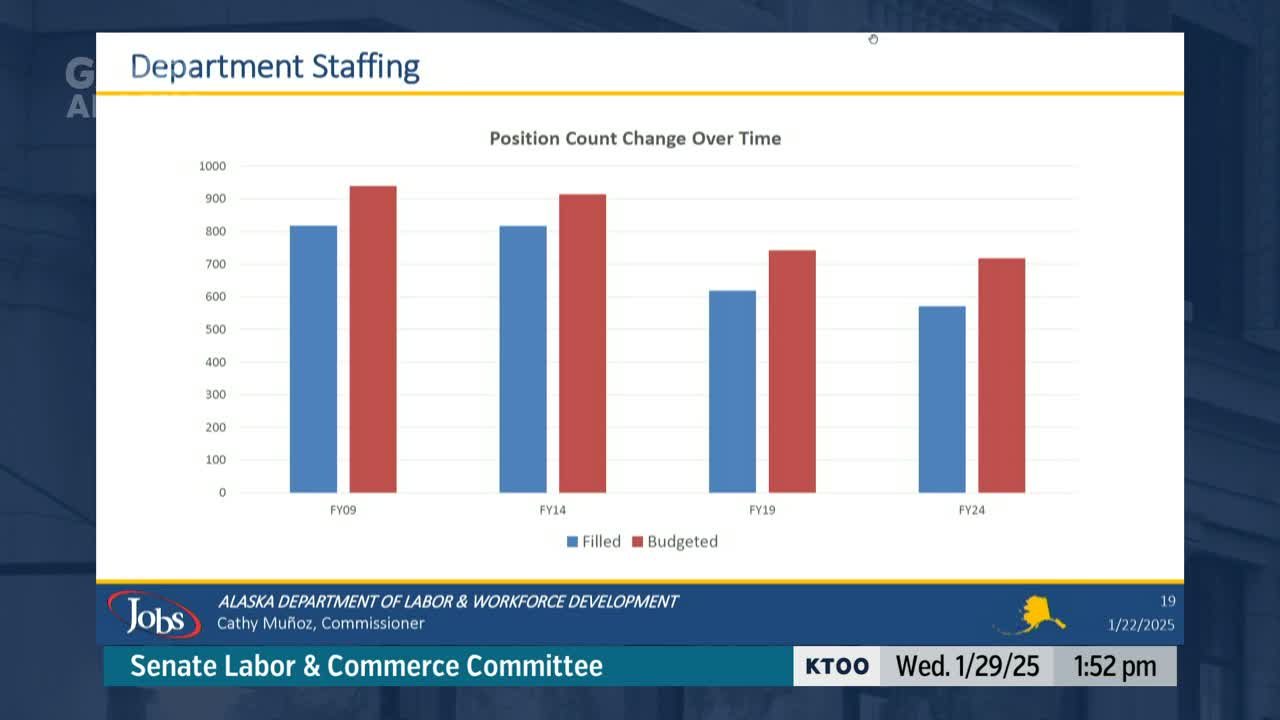
Department of Labor and Workforce Development officials told the Senate Labor and Commerce Committee that vacancies climbed to 22.2% at the end of December 2024, leaving 161 of 723 permanent positions empty and extending some customer service and program processing times.
Juneau — The Department of Labor and Workforce Development told the Senate Labor and Commerce Committee on Jan. 29 that long-term staffing losses and retirement eligibility have driven vacancy rates up and stretched some frontline services.
"We are at 22.2% vacancy here in our department," said Dan DeBartollo, the department's administrative services director. "Of that 723 total permanent positions, only 562 are filled and a 161 are vacant." He told senators the department's budgeted permanent positions fell from 939 about 15 years ago to 718 at the start of the last fiscal year, a net reduction of 221 positions.
The committee heard that the department's vacancy rate rose from about 17% in FY19 to roughly 20% at the end of FY24, and that the trend predates the pandemic. DeBartollo said part of the problem is a reduced applicant pool: national public-sector hiring data show applications have flattened while the number of open jobs has risen.
Why it matters: Senators pressed officials on service impacts. "What we find is we always prioritize emergent or priority services," DeBartollo said. He and other staff said divisions that protect worker safety remain prioritized, while divisions with large public-facing workloads — notably the Division of Employment and Training Services, which handles unemployment insurance and job center work — are experiencing longer turnaround times for constituents.
Commissioner Kathy Munoz, who opened the presentation, and Dan DeBartollo told the committee that the department is also contending with an older workforce: the department's average employee age is three to four years higher than the statewide average, and about 20% of currently filled positions are eligible for retirement within five years. DeBartollo warned that when experienced staff leave, institutional knowledge can be lost and rapid internal promotions can create gaps in expertise.
Senators asked about private-sector competition for workers and the practical effects for Alaskans. DeBartollo said reasons are mixed — private-sector hiring, retirements and demand for flexible schedules — and that the primary measurable impact for the public is longer wait times for application processing and responses from job centers.
What the department is doing: Officials stressed recruitment and retention efforts and an emphasis on workplace culture. DeBartollo described targeted strategies such as using long-term nonpermanent positions in small rural offices to avoid full closures when a single staff member is out for outreach or training. He also pointed to national vendor data from NeoGov showing a post‑pandemic divergence between available public-sector jobs and applicant volume.
Meeting context: The briefing followed an overview of the department's programs and was followed by an AWIB presentation on apprenticeship. Senators who participated in the staffing discussion included Senator Bjorkman (chair), Senator Grama Jackson, Senator Dunbar and Senator Young.
Ending: DeBartollo told the committee the department will continue prioritizing safety and emergent services and work to fill vacancies, while acknowledging that some service delays — especially in job‑center response times and application processing — are likely to persist until hiring improves.