Get Full Government Meeting Transcripts, Videos, & Alerts Forever!
Get email alerts on the Public Safety topic
No spam. Unsubscribe anytime.
Criminal division cites staffing shortfalls, rising evidence burdens and automation pilots as trials and caseloads shift
Summary
Criminal Division Director Angie Kemp told the House Law Finance Subcommittee that remote/rural workloads, growing evidence volumes and retirements are driving a request for new positions and investments in technology and internships to stabilize prosecution capacity.
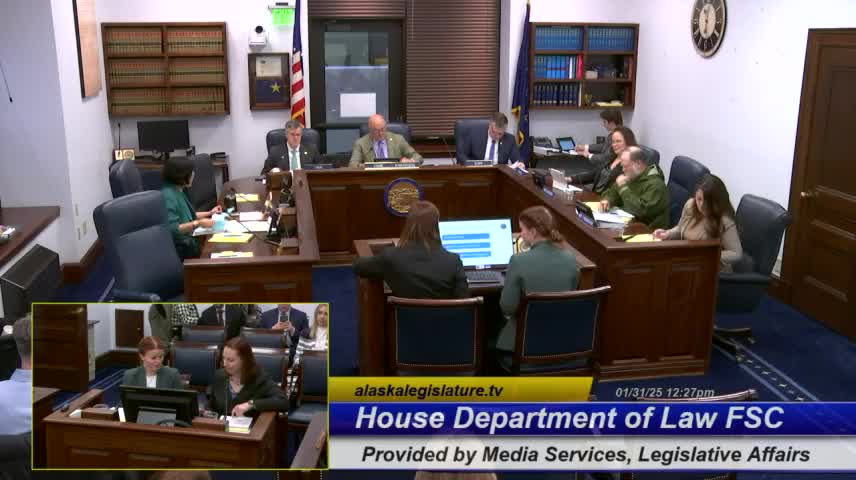
Criminal Division Director Angie Kemp told the House Law Finance Subcommittee on Jan. 24 that Alaska’s prosecutors face increasing workloads tied to larger evidence volumes, rural travel burdens and staffing gaps, and that the division is requesting targeted positions and exploring automation to improve efficiency.
Kemp outlined the division’s staffing and caseload picture and said the criminal division has 46 attorney, 52 paralegal and 78 support staff positions statewide and is recruiting for seven attorney, two paralegal and ten support positions at the time of the briefing.
Kemp said the criminal division operates offices in 13 communities from Utqiagvik in the north to Ketchikan in the south and highlighted specialty units including the Office of Special Prosecutions, a rural unit funded in part by federal grants and an appeals section. She identified specific district attorneys for locations such as Ketchikan (Alex Kamarczyk), Juneau (Whitney Bostick) and Kodiak (Will Vitkus), and named an Anchorage Office chief deputy, Jenna Gruenstein, who oversees the Office of Special Prosecutions.
Caseloads and trials: Kemp presented felony and misdemeanor filings and disposition charts showing a decline in filings and improvements in disposition rates since the COVID era; felony trial counts and conviction rates were cited as recovering. She said the division tried 49 felonies in the referenced year with an 82 percent conviction rate and noted that pre-COVID felony trials were higher (157 trials and roughly 81 percent conviction rate in a prior year).
Dillingham and rural workload: Representative Gray and Kemp discussed Dillingham’s open caseload, which Kemp cited as 339 open cases. Kemp and legislators discussed whether adding prosecutors in high-load rural offices could reduce per-prosecutor caseloads; Kemp confirmed the division is requesting additional positions to address caseload pressure.
Requested positions: Kemp said the criminal-division budget request for caseload reductions seeks five new positions: three attorney positions and two support staff positions. She said a fuller presentation of requested positions would follow in a separate division budget hearing to be scheduled.
Evidence volume and technology: Kemp and other speakers stressed that modern prosecutions include far larger volumes of digital evidence — body-worn camera footage, in-car video, cell-phone extractions and terabytes of data — which increases pretrial workload, discovery review and motion practice. Kemp said the division is piloting automation to move evidence between law-enforcement systems and the department’s digital evidence system. She described today’s automation pilot as a program that transfers evidence without manual handling and said it had reached a milestone during the meeting.
On artificial intelligence, Deputy Attorney General Corey Mills said the department is piloting closed-system tools such as Microsoft Copilot to test internal uses; Kemp said the division focuses first on automation for repeatable tasks rather than generative AI for evidentiary judgments.
Interns, retention and health resources: Kemp and Mills credited paid internships — funded by a legislative appropriation last year — with increasing the number of 2L applicants and creating hiring pipelines. Kemp also fielded legislators’ questions about prosecutor wellness programs (intent language from earlier budgets) and said the division continues to identify supports, though a detailed update was requested for a future meeting.
Dismissals and public perception: Legislators pressed the division on high court-system dismissal rates in some jurisdictions and asked for comparative data across states and agencies. Kemp explained dismissal statistics are affected by many factors including whether charges are filed by law enforcement or by prosecutors, grand jury outcomes, witnesses who fail to appear and negotiated global resolutions that resolve multiple cases with plea agreements. Kemp offered to provide additional comparative context and said the criminal division would cooperate with the committee to clarify how reporting categories are calculated.
Ending: Kemp and Mills said they would return with a more detailed criminal-division budget presentation in the coming weeks and provide requested follow-up data on dismissals, caseload targets and wellness efforts.