Get Full Government Meeting Transcripts, Videos, & Alerts Forever!
Get email alerts on the State Budget topic
No spam. Unsubscribe anytime.
Department of Law tells House subcommittee its budget is ‘people powered’ as vacancies, retirements and interagency billing rise
Summary
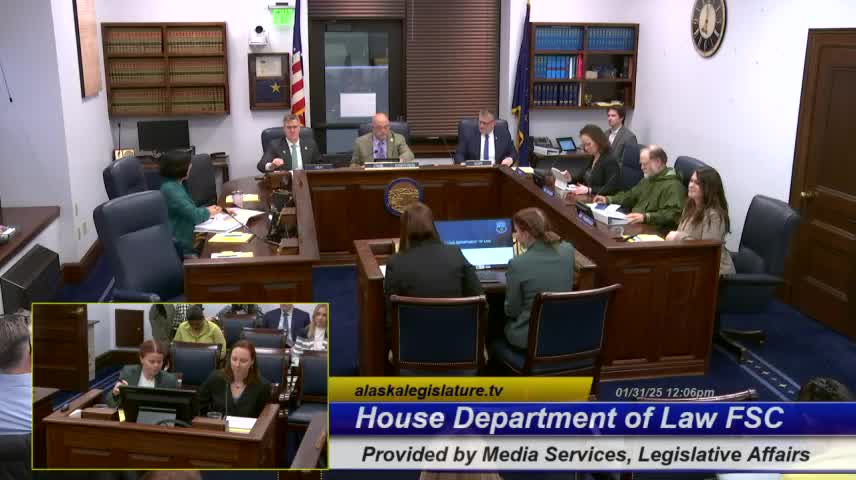
Deputy Attorney General Corey Mills and administrative staff briefed the House Law Finance Subcommittee on Jan. 24 on the Department of Law’s $133 million budget proposal, stressing personnel costs, rising interagency receipts and an upcoming civil-division budget deep dive.
Deputy Attorney General Corey Mills told the House Law Finance Subcommittee on Jan. 24 that the Department of Law’s operations and budget are driven chiefly by personnel costs and legal services billed to other agencies.
“The mission of the Department of Law … is really met through people power,” Mills said, describing a proposed operating budget of about $133,000,000 and asking members to focus on the undesignated general fund portion that underwrites staff salaries and core services.
Why it matters: Most of the department’s spending pays salaries for attorneys, paralegals and support staff who provide legal advice, litigation and regulatory screening for executive-branch agencies. The shape of the budget affects the state’s ability to defend lawsuits, advise boards and commissions and staff child-protection and other high-priority matters.
Mills told members the department’s budget bars two funding types on the slide he showed: the blue portion, undesignated general fund that the department controls directly, and a gray portion made up of interagency receipts — money billed to other state agencies for legal services. He said increases in the budget reflect salary adjustments, additions of positions over recent years and higher legal-services billing rates charged to client agencies.
On constituencies and workloads, Mills said the Department of Family and Community Services accounts for a large share of legal time on the civil side but noted some of that work is billed to that department rather than paid from undesignated funds. “Even though they look like the majority of the agency we serve, that is accurate, from a budgetary perspective, you probably have to cut that in half,” Mills said.
Vacancies, retirements and succession planning: Mills gave the subcommittee a current staffing snapshot. The civil side is actively recruiting for nine attorney positions, three law-office assistant positions and one paralegal. He said law-office assistant retention has improved after establishing clearer promotional tracks that can move staff into paralegal roles.
The department also received retirement-projection data showing more than 30 employees will be eligible to retire within one to five years across retirement tiers. Mills said the department is preparing through cross-training and succession planning to avoid losing institutional knowledge.
Reorganization of budget components: Mills explained that the department reduced its internal budget components from 15 to eight last year to increase flexibility and administrative efficiency. The new components include a deputy attorney general component; legal and support services (paralegals and law office assistants); civil defense litigation; health, safety and welfare; labor; business and corporations; resource development and infrastructure; government services; and special litigation and appeals.
Work types and preventive advice: Mills summarized how attorneys log time across categories such as courtroom representation, legal advice, legislation and regulation work, and consumer- and child-protection matters. He described preventive legal counsel as an important cost saver, quoting a former attorney general: “an ounce of prevention is worth a pound of cure.”
Internship pipeline and recruitment: Both Mills and Criminal Division Director Angie Kemp (speaking later in the meeting) highlighted a bipartisan initiative to pay interns, which Mills said had produced a notable rise in 2L applicants. Mills said the civil side has increased applications roughly 20 percent and has filled multiple internships; the goal is to create a pipeline from paid internships to full-time state positions.
Capital request for case-management system: The department told the subcommittee it has an outstanding capital request for a modern case-management system. Mills said the current system is aging and costly to maintain and that a new system could reduce email traffic, improve workflows and multiply staff productivity if funded.
Questions from legislators: Representatives asked about which agencies most frequently use Department of Law services, how interagency billing is allocated between client agencies and the department, and whether the conversion from 15 to eight budget components removed work (it did not, Mills said; it reorganized it to improve flexibility). Representative Mina and Representative Meade pressed for more detail on interagency recipients and amounts; Mills offered to provide a deeper civil-division presentation in the committee’s next meeting.
Ending: Mills closed by inviting members to submit specific follow-up questions and said the committee would examine civil-division budget requests in detail at the next House Law Finance Subcommittee meeting scheduled Feb. 7.