Get Full Government Meeting Transcripts, Videos, & Alerts Forever!
Get email alerts on the Public Safety topic
No spam. Unsubscribe anytime.
Alaska Department of Public Safety briefs House committee on staffing, rural policing and drug interdiction priorities
Summary
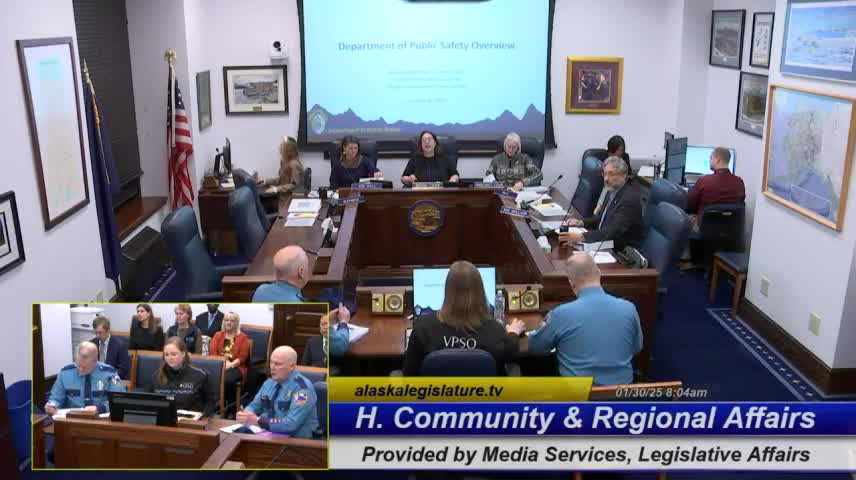
On Jan. 30, 2025, Commissioner James Cockrell of the Alaska Department of Public Safety told the House Community & Regional Affairs Committee that the department is focused on filling trooper vacancies, expanding rural investigative capacity and continuing drug‑interdiction work across the state.
On Jan. 30, 2025, Commissioner James Cockrell of the Alaska Department of Public Safety told the House Community & Regional Affairs Committee that the department is focused on filling trooper vacancies, expanding rural investigative capacity and continuing drug‑interdiction work across the state.
Cockrell said the department has shifted resources to rural regions, cited recent hires for a Bethel pilot on crimes against children and described a reduced budget request after several years of larger increases. "People cannot prosper if they don't feel safe in their communities," he said, explaining the department's emphasis on placing investigators and troopers in remote communities.
The department highlighted several operational priorities that underlie its budget request and staffing plans. Cockrell described targeted deployments of criminal investigators to rural hubs including Dillingham, Bethel, Nome and Kotzebue, and said the department has placed a detachment commander in Bethel to reflect the region's needs. He told lawmakers the department has filled three long‑term non‑permanent positions for the Bethel crimes‑against‑children pilot and emphasized that these investigators free uniformed troopers to do patrol work in villages.
Cockrell reported shrinking trooper vacancy levels compared with 2024 but did not provide a single definitive figure. He said the department’s most recent academy class included about 22 troopers and that vacancies have dropped from “over 70” a year earlier to a lower level this year; he also stated the department currently has "about 56" trooper vacancies. He stressed continued emphasis on recruitment, retention and wellness programs, including on‑staff counselors and peer support for critical incidents.
On geographic coverage, Cockrell explained that some urban areas are the responsibility of municipal police and described prior transfers of coverage. He told members the department is again asking to restore a three‑post presence on the Tok highway corridor (referred to in testimony as the "Tolkaiton region") because of high call volume, vehicle traffic and drug pipeline activity along that route.
Cockrell also described organizational changes the department is making to better serve victims. The department has created an integrated victim assistance division with a new director to centralize victim‑centric services and take administrative burden off troopers. He said the department has closed a backlog of sexual assault evidence kits and established barcoding and tracking for kits; he reported the current processing time for those kits is "around 130 days."
Lawmakers asked about how the department measures performance. Cockrell pointed to published resources — including the department’s use‑of‑force data, annual Uniform Crime Report and other annual reports on drug seizures, felony statistics and the VPSO program — and said some metrics are available on the department website. He also told the committee the department compiles daily reports of significant incidents and that commissioner notifications alert leadership to deaths, major seizures and plane or boat incidents.
Cockrell repeatedly framed rural enforcement needs against the scale and speed of violent incidents: he cited a recent trooper shooting on the Kenai Peninsula and referenced a separate Fairbanks‑region incident in which two troopers were killed, noting how quickly violent events can unfold. He told the committee that those and other incidents inform equipment and staffing needs.
The committee did not take formal action during the presentation. Representative Neli Jimmie will chair the department of public safety budget subcommittee in the next hour, the committee noted at adjournment.
Looking ahead, Cockrell said the department will continue to press recruitment and to place investigative resources where they believe they will have the greatest effect in rural Alaska.