Get Full Government Meeting Transcripts, Videos, & Alerts Forever!
Get email alerts on the Department Of Public Safety Budget topic
No spam. Unsubscribe anytime.
House finance subcommittee reviews DPS FY26 operating budget, focuses on rural trooper housing, Talkeetna post and forensic capacity
Summary
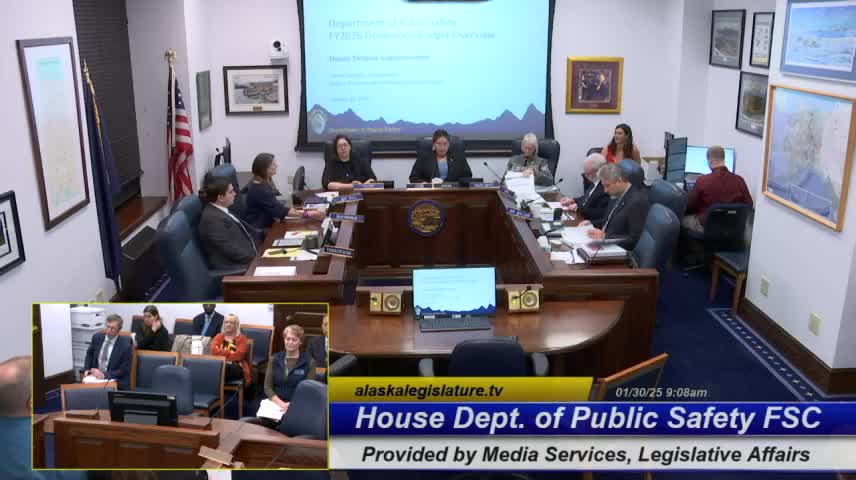
The House Finance subcommittee on the Department of Public Safety met Jan. 30, 2025, to review the department's FY26 operating budget request focusing on recruitment, rural trooper housing, reopening the Talkeetna post and expanded forensic capacity.
The House Finance subcommittee on the Department of Public Safety met Jan. 30, 2025, in Room 124 to review the Department of Public Safety's FY26 operating budget request and discuss specific initiatives aimed at strengthening rural public safety, forensic response and fisheries enforcement.
The department emphasized recruitment and retention, expanding rural trooper housing, reopening a Talkeetna post, and boosting forensic and wildlife-enforcement capacity as the priorities underpinning the FY26 request. "Our key objectives, with this budget are to address, recruitment, retention, rural public safety, looking to establish our North, Parks Highway post," Administrative Services Director Diana Thornton said during the presentation.
Why it matters: the operating budget shapes staffing and service levels for Alaska State Troopers, Alaska Wildlife Troopers and related public-safety functions across widely separated communities. Committee members questioned the scope and timing of new housing and facility leases, changes in how maintenance-and-operations expenses are reported, and whether the department has sufficient in-state forensic capacity for DNA work.
Budget overview and drivers
Diana Thornton, administrative services director for the Department of Public Safety (DPS), told the subcommittee the department's FY26 request reflects statutory compensation increases for state employees and program increments. Thornton said the budget presentation details roughly $9 million in new activities the department is seeking for FY26 on top of statutory compensation cost increases and that unrestricted general funds for the department show about a $20 million increase compared with the prior year. "The request that we have on this budget really only, consists of just over $9,000,000," Thornton said; she said the statutory compensation increases account for a substantial portion of the larger general-fund change.
Thornton also described the department's structure and major appropriations, saying the Alaska State Troopers and Wildlife Troopers component is the largest, and citing a component figure of about $216,000,000 for that appropriation and $59,000,000 for statewide support during the presentation.
Maintenance-and-operations reporting
Thornton explained a statutory reporting change that moved some routine costs (utilities, leases and like items) into separate maintenance-and-operations (M&O) components to improve transparency. State Fire Marshal Lloyd McConnell confirmed that structural fire protection is the fire marshal's responsibility and referred wildland- and forestry-related fire response questions to the Department of Natural Resources' Forestry division.
Rural trooper housing and office space
Committee members pressed DPS for details about funds allocated last year for trooper housing and how those dollars are being used. Thornton and Deputy Commissioner Leon Morgan said the department obtained federal Housing and Urban Development funds to support housing projects and is pursuing a mix of new construction, leases and purchases in several communities. Morgan said work is under way for housing in Dillingham and Saint Mary's and that the department is pursuing additional properties; he also said the department is leasing new-construction housing in Bethel and Nome and has obtained some former federal housing units.
On those housing efforts, Morgan said Bethel's new construction is occupied and Nome's new construction is about 50% occupied while other acquisitions remain in process. The department said it is also securing additional office lease space in Bethel to support an increased trooper presence.
Talkeetna post reopening
The department requested a roughly $1.4 million increment in the Alaska State Troopers component to reopen a Talkeetna post, including funding for one sergeant, three troopers and a criminal justice technician plus initial move-in and operating expenses. Committee members asked whether the operating ask for FY26 is prorated because DPS expects roughly a six-month delay before the post is fully staffed and operating; Thornton said the FY26 request includes full annual personnel costs but that some lease and start-up costs were prorated for FY26 and the department expects to adjust FY27 budget lines to reflect full annual lease costs.
Thornton estimated annual lease costs for the Talkeetna post in the range of about $80,000–$90,000, and said the FY26 figure includes a prorated lease and one-time move-in costs. "We anticipated it'd be about 6 months before we could get the... post stood up," Thornton said. She said the department does not expect FY27 costs to simply double the FY26 request and that payroll would be the primary ongoing increase if the positions remain on staff.
Dispatch contracts and overtime
Thornton identified a negotiated-contract increase of about $123,000 for primary 911 dispatch contracts (with the Kenai and Mat-Su areas) and said the department adjusted overtime calculations to reflect actual usage. Deputy Commissioner Morgan told the committee the overtime increment reflects a recalculation that brings trooper overtime budgeting to about five hours per week on average and is intended to better match historical usage.
Forensics and crime-scene capacity
DPS requested $65,000 for a specially equipped transit van for crime-scene forensic technicians so those technicians can transport climate-controlled evidence and equipment on-scene rather than using ad hoc vehicles and duffel bags. Morgan said the state's large rural geography requires aircraft support for remote responses but added that road-system areas with high caseloads benefit from a dedicated van: "we can't fly a crime scene van to every location of the state. But to those areas that are on the road system that do see a large amount of felony crime... having a crime scene van response capability is... critically important." The department said the van would be added where it is most needed; Fairbanks was cited as the current location for the existing van, and DPS said it is adding vans incrementally to other locations.
DPS also requested approximately $50,000 to send about 70 cases of unidentified human remains to out-of-state private laboratories for SNP-based genetic genealogy testing. Deputy Commissioner Morgan said the specialized SNP capture testing used for genetic genealogy is performed by a small set of private labs nationally and that, to his knowledge, equivalent SNP testing capacity is not currently available in Alaska. Colonel Brian Barlow, director of the Alaska Wildlife Troopers, and Deputy Commissioner Morgan said DPS would use an RFP process and prefer in-state capacity if it exists.
Wildlife troopers and commercial-fisheries enforcement
Colonel Brian Barlow, director of the Alaska Wildlife Troopers, told the committee the wildlife troopers carry out continuous, proactive commercial-fishing enforcement and said the division adjusts patrol plans when it receives specific complaints (he cited "Area M" as an example). "The Alaska Wildlife Troopers are out on the waters, if you will, conducting proactive commercial fishing enforcement efforts continuously," Barlow said. He offered to provide a more detailed, year‑in‑review snapshot of commercial-fisheries enforcement activity for members who requested it.
Other increments and one-time items
Thornton described a $1,000,000+ request to add three nonpermanent state trooper investigative positions in Kotzebue, and a one-time increment (about $270,000) for vehicles and workstations to support those investigators. She also noted recurring equipment funding requests (uniforms, ballistic vests and other consumable law‑enforcement gear) that the department asked be made permanent in the base budget.
What the committee asked for and next steps
Members sought clarification on how past housing dollars were spent, whether forensic testing can be built in-state over time, the exact composition of the Talkeetna cost line and whether M&O reporting changes materially change service levels. DPS said it will follow up with more detailed cost breakdowns and that Colonel Barlow will provide a focused summary of fisheries enforcement activity. The subcommittee chair said scheduling for future meetings will be announced to members' offices.
Ending
The subcommittee closed after roughly 53 minutes of discussion. Committee members said they expect follow-up materials from DPS on housing expenditures, fisheries enforcement data and forensic-testing options, and they indicated future subcommittee meetings will continue to examine the FY26 operating request.