Get Full Government Meeting Transcripts, Videos, & Alerts Forever!
Get email alerts on the Stip Project Delivery topic
No spam. Unsubscribe anytime.
DOT tells committee lack of shovel-ready STIP projects and MPO boundary questions limited Alaska’s August redistribution award
Summary
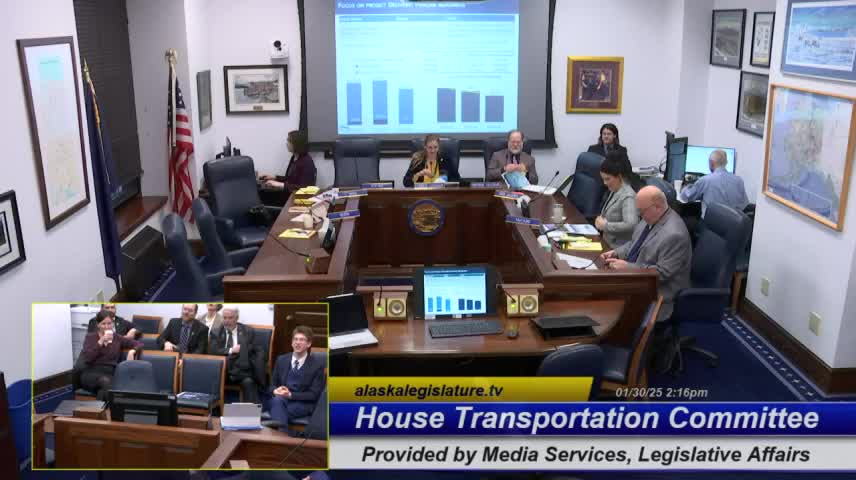
Deputy Commissioner Catherine Keith and program director Don Panone briefed the House Transportation Committee on Jan. 30 about project-delivery constraints, metropolitan planning organization boundary disputes and why Alaska received a smaller August redistribution award than it sought.
Deputy Commissioner Catherine Keith and Dom (Don) Panone, director of program management and administration for the Alaska Department of Transportation and Public Facilities, told the House Transportation Committee on Jan. 30 that two factors — project-delivery readiness and unresolved metropolitan planning organization (MPO) boundary and operating-agreement issues — limited the state’s ability to secure additional August redistribution (year-end contract-authority) funding from Federal Highways.
Keith summarized agency corrective actions after federal planning findings, including updated GIS boundary work and renewed consultation with Metropolitan Planning Organizations, the Alaska Railroad and federal partners. She cautioned that some MPO boundary adjustments remain unresolved and that governor approval is required for final metropolitan-area boundary designations.
Why it matters: The August redistribution (sometimes called the August “plus-up”) allocates additional federal contract authority to states that can demonstrate they can obligate (commit) and deliver projects rapidly late in a federal fiscal year. The department sought $71,400,000 in August redistribution but received $19,200,000, and DOT&PF officials said the delta reflects federal concerns about whether the state could reliably deliver the full package in the applicable time frame.
Numbers and explanation: Director Panone said the department applied for about $71.4 million and received $19.2 million; Deputy Commissioner Keith added that the funds were not “lost” but rather remained available as carried-over authority tied to specific fund sources. Keith said some fund sources are restricted by program type (for example National Highway System funding) and cannot be flexibly applied to every project the committee mentioned.
Cooper Landing Bypass and pipeline balance: Committee members asked whether a major multi-year project such as the Cooper Landing Bypass had consumed available National Highway System funds. Keith said that a large portion of available National Highway Performance Program funding is limited and that a very large project would have absorbed several years’ worth of that category — in turn reducing opportunities for smaller Alaska-based contractors if the department had concentrated the bulk of its allocation on a single multi-year award. She noted the department has obligated substantial funding to the bridge portion and staged the remaining work to balance contractor capacity and statewide project distribution.
MPO boundaries and operating-agreement timing: Committee members pressed the department about timing and process. Keith said boundary recommendations must be processed through census-derived urban-area updates, reviewed by DOT&PF and the attorney general’s office and then transmitted to the governor for final approval. She said some MPO technical committees have postponed operating-agreement discussions and that the department’s stewardship-and-oversight responsibilities require updated documentation. “These are, you know, very regulated processes,” she said, adding the department hopes to complete boundary conversations and adopt updated boundaries by the end of 2026.
Advanced construction and obligations: Panone described advanced construction as a tool to authorize projects now and convert them to federal funds later; he said the advanced construction balance represents authorized projects that will be converted to federal obligation when funds are available. He also displayed historical obligation and contractor-payment trends, noting a recent pattern of fewer new contract awards while contractor payments rose as multi-year projects reached active construction phases.
August-redistribution mechanics and the federal review: Keith and Panone told the committee the federal office requires a documented plan showing projects can be delivered with “certainty” within the award window; where federal and state estimates or schedules diverge, the federal office will reduce awarded authority. Panone said Alaska has historically used August redistribution successfully in many years, but acknowledges that matching the right projects to the right fund sources and proving execution certainty is essential to capture full awards.
Committee reaction and next steps: Representatives on the committee, including Representative Louise Stutes and Representative Sam McCabe, pushed for clearer public explanations of August-redistribution outcomes and asked for specific financial plans and project lists. Keith said DOT&PF will continue to coordinate with FHWA and MPO partners and pursue an August-redistribution plan for the coming year; she also highlighted the department’s new project-management office metrics intended to forecast delivery and better align project readiness with available fund types.
Ending: The committee thanked DOT&PF for the briefing and sought follow-up materials on the department’s obligations, advanced-construction balances and the specific documentation submitted to FHWA for the August-redistribution request.