Get Full Government Meeting Transcripts, Videos, & Alerts Forever!
Senate committee hears Alaska-centered options to cut rural electricity costs and scale renewables
Summary
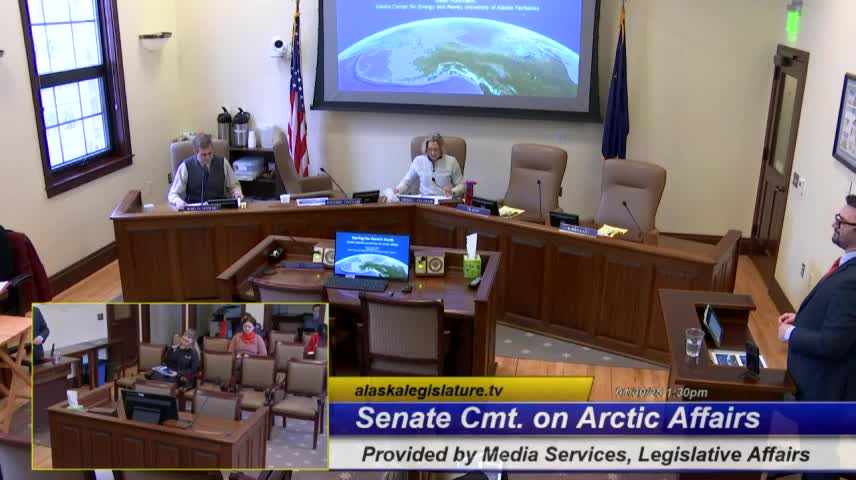
At a Jan. 30 meeting of the Senate Special Committee on Arctic Affairs, Gwen Holdman of the Alaska Center for Energy and Power reviewed Arctic energy systems, Alaska’s relatively low subsidies for remote power, the state’s renewables progress, and barriers such as limited transmission and geothermal risk.
Senate members heard a wide-ranging briefing Jan. 30, 2025, on energy challenges and options for Alaska and other Arctic jurisdictions from Gwen Holdman, chief scientist at the Alaska Center for Energy and Power at the University of Alaska Fairbanks.
Holdman framed the issue as a question of differing electric systems across northern regions, telling the Senate Special Committee on Arctic Affairs that “we call it the electric north” to describe places that sit beyond continuous continental grids and rely on regional grids, small distribution networks or isolated diesel systems.
The presentation matters because Alaskans outside the Railbelt face some of the highest delivered electricity costs in the Arctic while state subsidies are modest. Holdman told the committee that Alaska’s Power Cost Equalization (PCE) program covers roughly one‑third of kilowatt‑hours sold in rural areas but equates to “about 15% of the actual cost, all in” for generation in those communities, a lower subsidy level than in many other Arctic jurisdictions. The imbalance, she said, contributes to high household energy burdens in parts of Alaska.
Holdman gave specific figures and comparisons. She said hydro accounts for about 20% of Alaska’s statewide generation but is unevenly distributed across the state. She told members that Fairbanks households now spend roughly 10% of household income on energy on average, and cited Kuskokwim‑area…
Already have an account? Log in
Subscribe to keep reading
Unlock the rest of this article — and every article on Citizen Portal.
- Unlimited articles
- AI-powered breakdowns of topics, speakers, decisions, and budgets
- Instant alerts when your location has a new meeting
- Follow topics and more locations
- 1,000 AI Insights / month, plus AI Chat