Get Full Government Meeting Transcripts, Videos, & Alerts Forever!
Get email alerts on the Arctic Energy topic
No spam. Unsubscribe anytime.
Senate committee hears Alaska-centered options to cut rural electricity costs and scale renewables
Summary
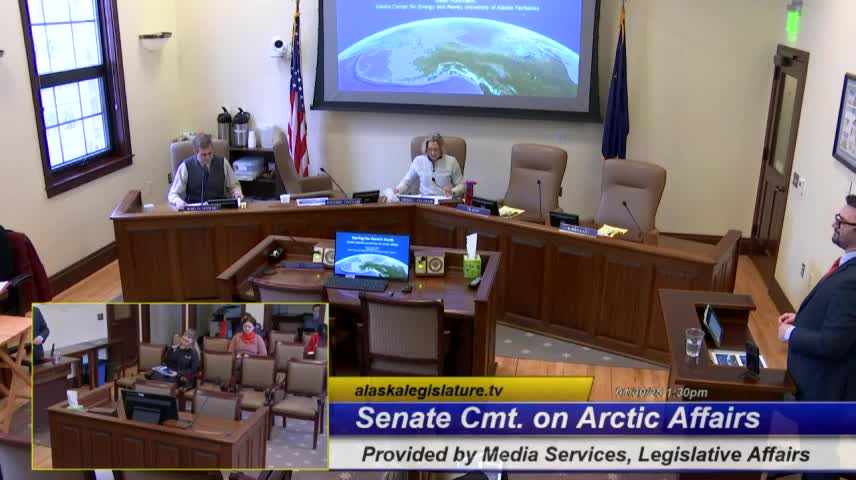
At a Jan. 30 meeting of the Senate Special Committee on Arctic Affairs, Gwen Holdman of the Alaska Center for Energy and Power reviewed Arctic energy systems, Alaska’s relatively low subsidies for remote power, the state’s renewables progress, and barriers such as limited transmission and geothermal risk.
Senate members heard a wide-ranging briefing Jan. 30, 2025, on energy challenges and options for Alaska and other Arctic jurisdictions from Gwen Holdman, chief scientist at the Alaska Center for Energy and Power at the University of Alaska Fairbanks.
Holdman framed the issue as a question of differing electric systems across northern regions, telling the Senate Special Committee on Arctic Affairs that “we call it the electric north” to describe places that sit beyond continuous continental grids and rely on regional grids, small distribution networks or isolated diesel systems.
The presentation matters because Alaskans outside the Railbelt face some of the highest delivered electricity costs in the Arctic while state subsidies are modest. Holdman told the committee that Alaska’s Power Cost Equalization (PCE) program covers roughly one‑third of kilowatt‑hours sold in rural areas but equates to “about 15% of the actual cost, all in” for generation in those communities, a lower subsidy level than in many other Arctic jurisdictions. The imbalance, she said, contributes to high household energy burdens in parts of Alaska.
Holdman gave specific figures and comparisons. She said hydro accounts for about 20% of Alaska’s statewide generation but is unevenly distributed across the state. She told members that Fairbanks households now spend roughly 10% of household income on energy on average, and cited Kuskokwim‑area averages near 16%, both numbers she described as well above U.S. norms. She said Greenland uses a unified or “postage‑stamp” retail electricity rate of about $0.24 per kilowatt‑hour for customers statewide and that other Arctic nations direct subsidies differently — for example, Greenland subsidizes commercial loads while some Canadian northern residents pay as little as $0.06 per kWh because of federal territorial subsidies from Ottawa.
To illustrate pathways for lower costs and higher renewable shares, Holdman reviewed foreign examples and Alaska projects. She highlighted Iceland’s large‑scale geothermal and hydro build‑out, Norway’s use of stranded wind to produce green hydrogen and ammonia, and Greenland’s use of waste‑to‑heat district heating. She credited Alaska programs and local utility experimentation with substantial renewable deployment in remote communities, noting Kodiak as a long‑running example of island renewables and Alaska Village Electric Cooperative (AVEC) as pursuing larger wind projects and shared resources among multiple villages.
On financing and program design, Holdman said Alaska’s Renewable Energy Fund (launched after the 2008 fuel‑price spike) helped projects move from pilots to mainstream deployment. She also told senators that wind projects in AVEC communities have produced measured savings to consumers and to the PCE endowment, and that, in a limited sample, wind projects yielded roughly $5–6 million in cumulative savings to the PCE program.
Committee members asked about geothermal and project risk. Holdman described geothermal exploration as high‑cost and high‑risk and said successful programs abroad used drilling backstop or drilling‑fund mechanisms to reduce early risk. She pointed to a previous Alaska geothermal drilling effort at King Salmon that expended tens of millions of dollars and did not encounter sufficiently productive formations; she said that outcome illustrated the need for pre‑drilling resource characterization and structured public‑fund participation rather than open guarantees. (At the hearing she referenced a project cost “about $30,000,000” as an example of a costly unsuccessful well.)
On system architecture, Holdman argued that Alaska’s many small, locally governed utilities — more than 100 statewide, with an average customer base around 2,500 — enable innovation but limit opportunities to build projects at scale. She and committee members discussed the Railbelt transmission backbone and a unified transmission or “postage‑stamp” transmission rate. Holdman cautioned that a unified transmission rate affects only the transmission portion of bills and could raise costs in places that currently benefit from moving power across the grid; she said Fairbanks might not see a net reduction unless broader system upgrades and a second major transmission line are completed.
The committee also discussed advanced or small modular nuclear reactors as a potential long‑term option for Railbelt reliability and scale. Holdman said she has worked on nuclear options and that advanced reactors “are coming” and could be part of long‑term planning, while acknowledging they bring complex deployment questions.
Holdman described the Arctic Remote Energy Network Academy — a training and peer‑exchange program that brings operators and leaders from Arctic communities together to learn microgrid and renewable integration techniques — and noted ongoing town halls and polling her center has done on public perception of energy technologies, including nuclear and carbon capture.
Committee members pressed for policy levers. Holdman recommended focusing on physical transmission infrastructure that would allow larger, lower‑cost projects to be built and exported across the Railbelt, and on incentive structures that favor collaboration (“carrots instead of sticks”) among utilities. She also urged careful, milestone‑based lease and procurement terms for very large projects to avoid companies holding leases without development progress.
The meeting concluded with the committee noting a future appearance by Cordova Electric Association and scheduling a Feb. 6 presentation by the Arctic Domain Awareness Center at the University of Alaska Anchorage. No formal committee votes or motions were recorded at the hearing.