Get Full Government Meeting Transcripts, Videos, & Alerts Forever!
Get email alerts on the Aviation Rural topic
No spam. Unsubscribe anytime.
DOT official: Alaska's rural airports running a large shortfall amid workforce, weather and equipment strains
Summary
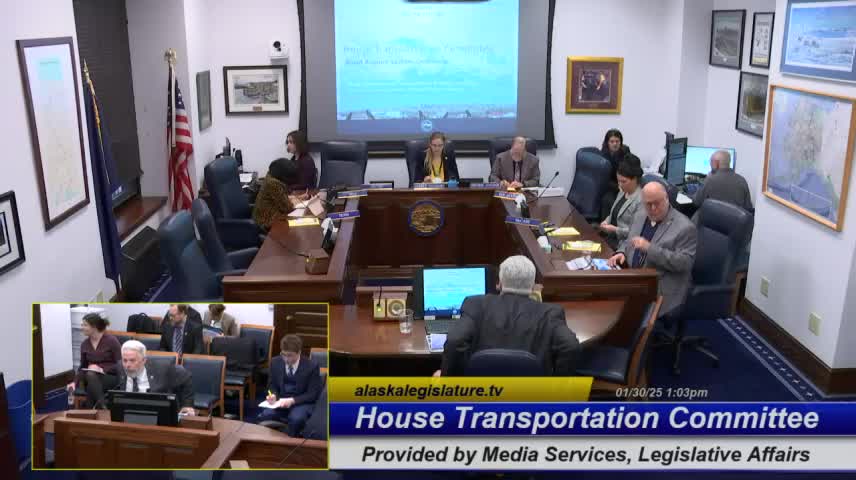
Troy LaRue, division operations manager for Statewide Aviation at the Alaska Department of Transportation and Public Facilities, told the House Transportation Committee on Jan. 30 that Alaska’s rural airport network faces an operating shortfall, workforce shortages, rising equipment costs and changing weather-technology needs.
Troy LaRue, division operations manager for Statewide Aviation at the Alaska Department of Transportation and Public Facilities, told the House Transportation Committee on Jan. 30 that Alaska’s rural airport network faces an ongoing operating shortfall, workforce shortages, rising equipment costs and changing weather-technology needs.
LaRue said the rural aviation system carries “just under $50,000,000” in operating costs while generating about “$11,800,000 in revenue,” and stressed aviation’s role for remote communities: “82% of our communities live off the road system and are dependent on aviation. So without aviation, they're not gonna get their milk, they're not gonna get their medicine.”
Why it matters: Many Alaskan communities depend on routine air service for basic supplies, medical transport and mail. Committee members pressed LaRue on reliability, equipment and staffing, and on how federal programs and rule changes affect project eligibility and construction timing.
LaRue described three sets of near-term pressures. First, maintenance and winter operations: some gravel runways — for example at community fields such as Big Lake — cannot be treated the same way as paved Part 139 airports that receive sand and chemical de-icing to meet required friction coefficients. “At Big Lake, they're a much smaller aircraft. You're working on a gravel airfield,” he said, noting local highway maintenance crews sometimes split time between roads and airport duties and occasionally list an airport as “closed or unattended” while clearing highways.
Second, staffing and training: LaRue said airport workers in rural Alaska often “have to wear about 7 to 10 hats” including operations, equipment operation, security, airfield inspection, aircraft firefighting and emergency medical duties. He told the committee the department’s recent collective-bargaining settlement improved recruitment and that new remote video training and peer exchanges have helped, but that he could not provide a current vacancy rate on the spot and offered to supply that figure as a follow-up.
Third, equipment and capital funding: LaRue said graders, aircraft rescue and firefighting vehicles and aggregate have risen sharply in price (he cited a 22% rise in grader costs over 10 years and a 61% rise for aircraft-firefighting trucks). He said DOT&PF has a near-term equipment funding program of about $7.7 million this year with a longer-term need LaRue described as “$67,000,000 we would definitely spend it on equipment if we could afford to do that.” He noted long lead times and stricter Buy America enforcement have constrained procurement.
Federal funding and program rules: LaRue explained how Alaska’s airport funding is a mix of federal Airport Improvement Program (AIP) dollars (including cargo and passenger entitlements), state apportionment based on land mass and population, and an Alaska supplemental apportionment that predates the 1982 AIP program. He said the state is currently receiving a 5% match through 2026 (historically 6.25% except for Essential Air Service airports) and that Alaska benefits from the federal Essential Air Service (EAS) program for small communities.
On EAS: LaRue summarized the federal subsidy program and its role for the state: “We have over 60 essential air service routes that are worth over $40,000,000. So those are seat subsidies that help Alaskans get to their location.” Committee members asked him to clarify that the subsidy keeps seat fares affordable in many isolated communities.
Regulatory friction and the AIP handbook: LaRue told the committee that the FAA’s AIP handbook (adopted in 2014) had effectively turned advisory guidance into binding eligibility rules after federal funds were used on an airport. He said DOT&PF and Alaska’s congressional delegation pushed to get Alaska-specific consideration in the latest FAA reauthorization and that FAA has agreed to open and revise the AIP handbook over the next three years: “Maybe Alaska needs to have their own AIP handbook,” LaRue said, referring to ongoing discussions with FAA to reflect Alaska’s unique access, construction season and rural logistics.
Weather systems and NOTAM/dashboard work: The department is building dashboards to improve pilots’ access to airport status and automated weather system information. LaRue said AWOS/ASOS instrumentation can cost about $2,000,000 to install in Alaska but noted lower-cost approved alternatives are emerging (he cited an example approved at “about a $100,000”): “We don't really wanna build a $2,000,000 weather systems anymore.” He said Alaska is testing newer approved weather units and that the FAA and National Weather Service are working to expand acceptable aviation weather sources.
Unmanned aircraft and Smart grant work: LaRue described a U.S. DOT Smart Grant project (stage one) that funded Alaska Rural Remote Operations Work Plan (ARROW) pilots and drone-dock deployments. He said the first-stage grant allowed the department to teach 11 underserved communities around Bethel to operate drones and mapping tools and led to a second-phase award of about $12.4 million. He said drone “docks” can be warmed and ready to fly and can livestream footage to state offices to speed emergency assessment after storms.
Other issues raised by committee members included low-lead avgas timing and an HJR 29 resolution referenced by Representative Mina seeking federal relief on an EPA Avgas ruling, vandalism to runway lights (LaRue said reported vandalism might now be roughly half of earlier levels), and the Don Young Alaska Safety Initiative, which the FAA reports to Congress on annually and which aims to reduce fatal accidents in Alaska.
Next steps and follow-ups: LaRue said the department will expand dashboards over the coming year, provide a vacancy-rate update to the committee and continue working with FAA on AIP-handbook issues and cold-weather construction-start solutions. He also described multiple upcoming rural projects (terminals, generators and snow-removal-equipment buildings) that DOT&PF plans to advertise and program through federal grant cycles.
Ending: Committee members thanked LaRue for the briefing and pressed for follow-up data on vacancy rates, vandalism statistics and the progress of weather-technology pilots. LaRue and committee members also signaled ongoing work with FAA and federal delegations to adapt funding and program rules to Alaska’s unique rural-construction calendar and operating needs.