Get Full Government Meeting Transcripts, Videos, & Alerts Forever!
Get email alerts on the State Salary Study topic
No spam. Unsubscribe anytime.
Alaska officials say statewide salary study delayed to incorporate recent pay increases and additional comparators
Summary
Department of Administration officials told the House State Affairs Committee on Jan. 30 that a contractor draft returned in June omitted recently negotiated and legislated pay changes; the state expects to release an updated study at the end of March to inform future budget and bargaining decisions.
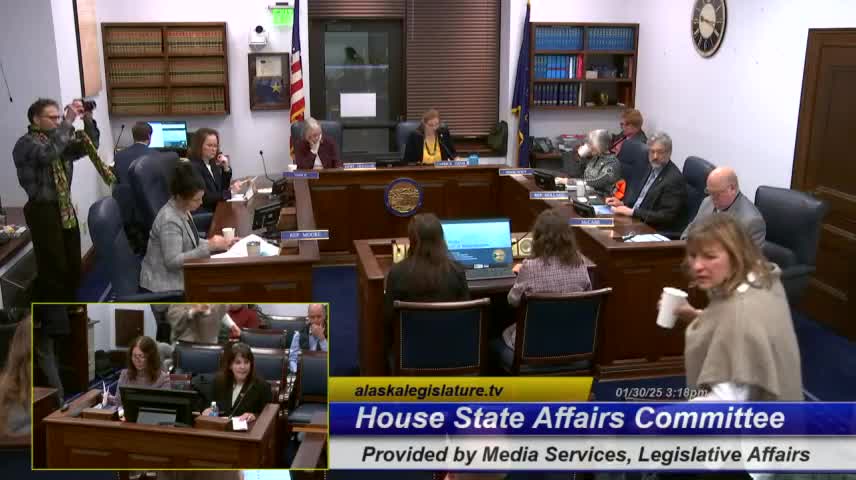
The House State Affairs Committee heard on Jan. 30 that the Department of Administration has pushed back completion of a statewide salary study so the contractor can incorporate recent legislation and collective-bargaining increases.
"It was determined that excluding these factors from the study would result in flaws in the data and assumptions, and would substantially diminish the studies usefulness for decision making," said Paula Grama, Commissioner of the Department of Administration, explaining why the department asked the contractor for additional work.
The study, funded by a $1,000,000 legislative appropriation in 2023, is intended to compare state pay across 404 benchmark job classes to peer jurisdictions and market data. Kate Sheehan, director of the Division of Personnel and Labor Relations, told the committee the contractor’s initial draft — received in June — did not include some post‑draft changes that the department judged material, and that the contractor has been asked to gather more data and expand the jurisdictional pool. Sheehan said the department expects to release the revised study at the end of March.
Why it matters: committee members and the Alaska State Employees Association argued the timing is critical because bargaining units must submit economic terms to the legislature around the 60th day of session (roughly March 21). Heidi Bridal, executive director of the Alaska State Employees Association, said her union represents about 8,000 of the state’s nearly 12,000 employees and that receiving the study after bargaining deadlines would limit its usefulness to members.
Key numbers and scope: the department said it requested comparisons for 404 benchmark job classes. Officials told lawmakers the state had made roughly $25,000,000 in targeted salary increases for about 1,200 positions and that collective‑bargaining increases affecting nearly 12,000 employees exceeded $100,000,000; the department combined those figures when asking the contractor to rework certain comparisons (the department described the combined adjustment as about $125,000,000). The legislature originally appropriated $1,000,000 for the study; the department entered a contract for $800,000 and later executed at least two amendments, including one amendment that added $80,000 for 100 staff hours, according to committee materials.
Committee questions and department responses: lawmakers pressed whether the contractor followed the original RFP and contract; Sheehan said the contractor was performing under the RFP but that the department requested additional work after receiving the first draft. Committee members asked which peer jurisdictions were included and whether the study accounts for Alaska’s geographic pay differentials (for example, Juneau vs. Anchorage vs. North Slope). Sheehan said the contractor was asked to account for geographic differentials and to expand outreach to five to ten additional jurisdictions because some comparators had not responded to voluntary surveys.
Contractor name and documents: the contractor is referred to in committee materials and testimony alternately as "Seagull" and "Siegel." Committee members asked about redactions in a contract amendment and the legal basis for withholding draft materials; Sheehan said the June draft was being treated as privileged and that the department would follow up with the Department of Law about redaction and privilege questions.
On incentives and bonuses: lawmakers asked whether hiring and retention bonuses had been included. Sheehan said those payments — frequently implemented through letters of agreement that vary by position, department and fiscal year — were not requested for inclusion because they would skew benchmark comparisons. She said letters of agreement are subject to different legal review and typically are handled on a fiscal‑year basis.
Timing and next steps: Sheehan and Grama told the committee they expect the contractor to deliver a revised report by the end of March and that department staff are meeting regularly with the contractor to monitor progress. The department said it would post the final report on the Division of Personnel and Labor Relations section of the Department of Administration website once it is finalized and would make staff available to help interpret the results for legislators and the public.
What the committee asked for: lawmakers requested additional details on the contract amendments, the list of comparator jurisdictions, the methods the contractor used to obtain data and the legal justification for any redactions in contract materials. Committee members also asked for vacancy‑rate breakdowns and historical comparisons before and after the use of hiring/retention bonuses.
The meeting closed with the committee chair confirming that members would receive follow‑up material, and with the department agreeing to provide additional documentation about the contract amendments and the privilege/redaction rationale if Department of Law allowed.