Get Full Government Meeting Transcripts, Videos, & Alerts Forever!
Get email alerts on the Department Overview topic
No spam. Unsubscribe anytime.
Alaska lawmakers hear overview of new Department of Family and Community Services; officials cite capacity, foster recruitment and complex‑care efforts
Summary
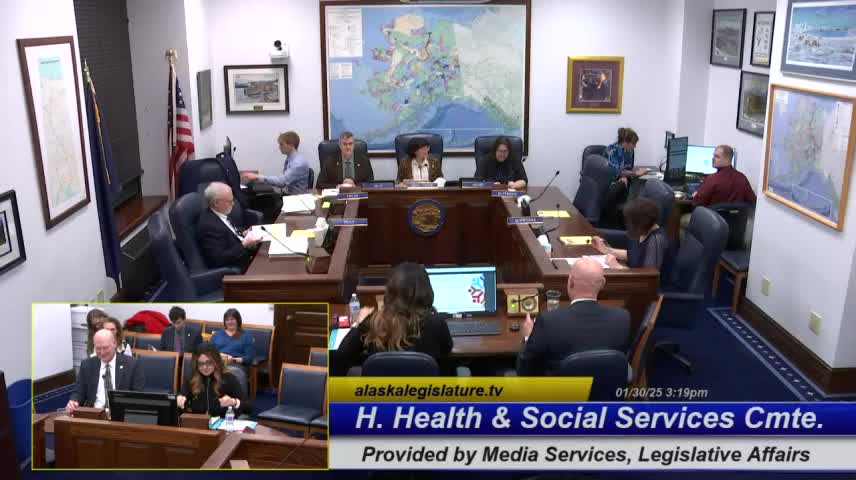
For the record, Kim Koval: "I've been the commissioner since the creation of the department in July 1, 2022 when the large department reorganized into 2 smaller departments." Commissioner Koval and deputy commissioner Clinton Lasley gave the House Health and Social Services Committee a detailed overview of the Department of Family and Community Services (DFCS) on Jan. 30, 2025, covering the Alaska Pioneer Homes, Alaska Psychiatric Institute (API), the Division of Juvenile Justice (DJJ) and the Office of Children's Services (OCS).
For the record, Kim Koval: "I've been the commissioner since the creation of the department in July 1, 2022 when the large department reorganized into 2 smaller departments." Commissioner Koval and deputy commissioner Clinton Lasley gave the House Health and Social Services Committee a detailed overview of the Department of Family and Community Services (DFCS) on Jan. 30, 2025, covering the Alaska Pioneer Homes, Alaska Psychiatric Institute (API), the Division of Juvenile Justice (DJJ) and the Office of Children's Services (OCS).
Nut graf: The presentation aimed to explain how the 2022 split of the former Department of Health and Social Services has focused services for vulnerable Alaskans and to outline capacity, workforce and capital needs that could affect service delivery across the state.
DFCS leaders told lawmakers that the Pioneer Homes system has a total licensed capacity of 506 beds and a fiscal 2025 component budget of about $112,000,000. Commissioner Koval said Pioneer Homes serve residents from independent to advanced dementia care and noted that "61% of our residents in the Pioneer Homes have a diagnosed dementia related disease." DFCS reported Pioneer Homes occupancy at about 86% (roughly 435 residents at the end of December) and said some beds are offline for restoration work such as flooring and painting.
Deputy Commissioner Clinton Lasley explained part of the Pioneer Homes’ apparent per‑resident cost is a budget structure that includes payment assistance funds. Lasley said the state maintains an assistance component that is drawn down "if in the event that the elders need them," and that roughly $38,000,000 appears within the component as part of that structure.
On the Alaska Psychiatric Institute, Koval and staff said API has five inpatient units and 80 beds total. "Capacity is 80 beds. And, as of, today, we are at 74, admitted patients. Yesterday was 76," Koval said, adding that the patient census fluctuates; DFCS reported a wait list of about 10 for API and said any daily total above about 70 is effectively full because of shared/dual‑bed rooms and clinical placement constraints.
DJJ and community supervision: Deputy Commissioner Lasley said DJJ operates six secure facilities and 13 probation offices across the state, with about 400 positions (PCNs) and a roughly $67,000,000 budget. Lasley said only about one third of youth DJJ serves are in secure facilities at any given time and that the division supervises roughly 530 youth on probation statewide.
Complex care coordination: DFCS described a small coordinated health and complex care unit that now houses designated evaluation and stabilization liaisons and other staff who monitor individuals with complex needs who rotate through DFCS systems. Lasley said the unit "has multiple functions" and described regular meetings with the Department of Health and cross‑agency work to reduce repeated system cycling. DFCS said the unit has six staff and that a standing complex care committee meets to drive system‑level improvements.
Foster family recruitment and emergency placements: DFCS officials told the committee that foster family counts fell after the pandemic. Koval reported historical and recent licensing numbers: "Prior to 2020, we had 1456 licensed non child specific foster homes. In 2022, at the reorganization, we had 1143. And today, we have 920." DFCS said 348 applicants have applied since the start of the current fiscal year (July 1, 2024) and cautioned not all applicants will complete licensing. The department pointed to expanded outreach, a new placement and support unit in OCS, a new respite program and a 30% average base‑rate increase approved for fiscal 2025 as measures to improve recruitment and retention.
On emergency placement stipends, OCS Director Kim Graham told the committee: "We did have, in the beginning of this fiscal year, we did notice there's a little bit of a misalignment with our policy and our regulation." Graham said DFCS paused a regulatory change, continues to pay emergency homes at the existing rate and will pursue regulation updates to align policy and practice.
Workforce and operations: DFCS said the department employs about 1,900 positions and has focused on staff engagement and recruitment. Officials said a new talent acquisition team reduced average recruitment time from about 45 days to about 10 days in a phased approach. DFCS reported OCS turnover has fallen from roughly 52% to 37% in recent years.
Capital projects and facilities: DFCS discussed several renovation needs and projects: a Palmer Pioneer Home roof replacement estimated at about $5,000,000 (DFCS said the U.S. Department of Veterans Affairs is expected to cover roughly 60–65% of that cost), renovation work at the Fairbanks Pioneer Home and the Fairbanks Youth Facility, and a 32‑bed unit at McLaughlin Youth Center that DFCS plans to renovate using funds reallocated from a larger Fairbanks scope.
Security and service delivery: Committee members asked about contracted private security at OCS offices. Deputy Commissioner Lasley said DFCS engaged contracted security at multiple offices after staff received threats and to provide backup coverage and redundancy; he said DFCS has not completed a formal cost‑benefit analysis of in‑house versus contracted security and cited liability, staffing bench and continuity as factors in choosing contractors.
Quotes and committee responses: Chair Mina opened the meeting and members asked detailed operational questions about capacity, wait lists and program pilots. Representative Grama, Representative Prox, Representative Fields and others probed foster recruitment, emergency stipends and outcomes from the department’s coordinated care work. DFCS leaders repeatedly described collaboration with the Department of Health, tribal partners and community providers as central to future pilots and system redesign.
Ending: DFCS officials asked for continued legislative engagement on funding, licensing and regulatory changes. The committee did not take formal action; the department said it would follow up with additional data and updates on pilot outcomes and regulation revisions.