Get Full Government Meeting Transcripts, Videos, & Alerts Forever!
Get email alerts on the Elections topic
No spam. Unsubscribe anytime.
Senate committee hears wide-ranging election reform bill; supporters back ballot curing and removing witness signature
Summary
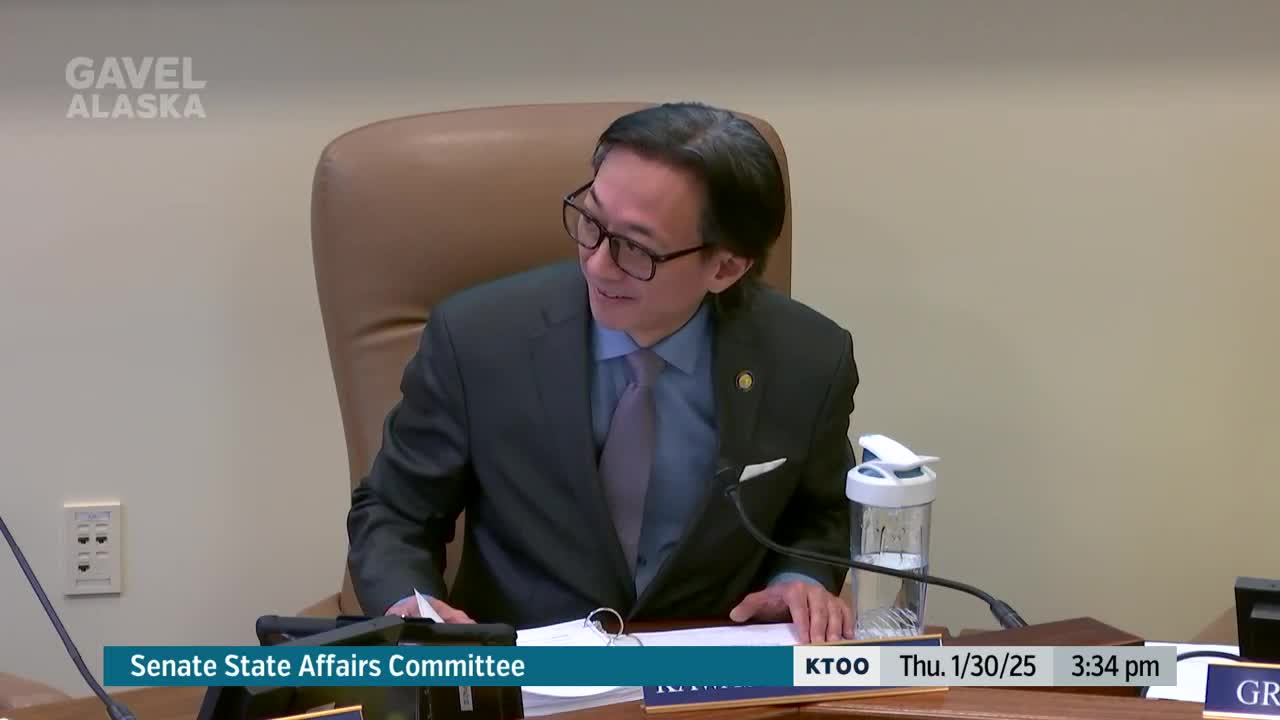
Senate State Affairs Committee Chair Senator Gary Kawasaki convened a Jan. 30 hearing in Juneau on Senate Bill 64, a Rules Committee‑sponsored, bipartisan package of election changes presented by Senator Chris Wilikowski and his staffer David Dunsmore.
Senate State Affairs Committee Chair Senator Gary Kawasaki convened a Jan. 30 hearing in Juneau on Senate Bill 64, a Rules Committee-sponsored, bipartisan package of election changes presented by Senator Chris Wilikowski and his staffer David Dunsmore. The bill, described by its sponsors as a comprehensive election reform package, would amend Alaska’s voter-registration rules, add ballot‑curing procedures, eliminate the witness‑signature requirement for absentee ballots and add multiple transparency and cybersecurity measures.
The bill matters because it touches basic procedures that affect how Alaskans register and cast ballots, and it contains measures aimed at both increasing access and tightening administrative processes. Supporters in the hearing and public testimony stressed rural access, ballot cure protections and removal of administrative barriers; some legislators raised questions about timelines, costs and security tradeoffs.
David Dunsmore, staff to Senator Wilikowski, summarized the bill in the committee: “Senate Bill 64 is a comprehensive election reform package that will help clean up Alaska’s voter rolls, remove barriers to voting, allow for faster and more transparent reporting of election results, ban the use of undisclosed deepfakes in Alaskan elections, and contain several other provisions to modernize Alaska’s election laws.” He told the panel the measure draws from bills introduced by Republican, Democratic and independent legislators and includes long‑discussed items such as ballot curing and expanded drop‑box rules.
Sponsors cited voter‑roll hygiene as a core objective. Dunsmore repeated the statistic cited in committee materials that Alaska’s voter registration list was estimated at roughly 106% of the adult population in a 2022 estimate and said the bill would streamline the process of removing voters who have clearly left the state. The bill would expand the triggers that prompt the division of elections to send maintenance notices, add a statutory cancellation procedure for voters who wish to remove themselves from the rolls, and permit a single forwardable notice in place of the current two‑step non‑forwardable/forwardable mailing sequence.
A central access change is repeal of the absentee witness‑signature requirement. Dunsmore told the committee the division “does not verify whether the witness meets the statutory requirement” and that envelopes do not collect witness name or birthdate in a way that would allow verification. He said the requirement has had a disparate effect in rural areas and for military voters: in a 2022 all‑mail special primary, about 1.7% of ballots statewide were rejected for a missing witness signature and in some districts the rate exceeded 10%.
The bill would establish a ballot‑curing process in statute. Dunsmore described a notice and cure procedure modeled on the practices in at least 24 other states whereby the division would notify a voter whose absentee ballot appears defective, allow at least 24 hours for a cure submission and accept documentation or a signed attestation confirming the voter cast the ballot. He said the division would contact voters by phone or email when that information is on file.
The bill also contains transparency and security provisions: preliminary ranked‑choice tabulations with unofficial results, clearer online reporting of which ballots are included in preliminary totals, expanded observer rules, a requirement that the division adopt cybersecurity regulations and a criminal/civil disclosure regime aimed at undisclosed synthetic media used to influence elections. Dunsmore said the package would also codify a settlement in ACLU of Alaska v. State of Alaska on campaign signs along state roads and remove an unfulfilled statutory requirement that the Alaska Public Offices Commission maintain an office in every Senate district, replacing it with a requirement to post filings online.
Public testimony was largely supportive of the bill’s access measures. Jan Carolyn Hardy, who identified herself as state president of a retiree organization, told the committee the proposal’s voter‑roll cleanup and removal of the witness requirement were important: “The target is voter cleanup is very good try a very good hygiene for us to have a clean, voting system,” she said. Michael Garvey, policy director for the ACLU of Alaska, urged passage specifically for the ballot‑curing provision, noting a court decision last week made clear the legislature must act to establish notice‑and‑cure in statute.
Speakers representing rural and Native organizations emphasized postal and logistical barriers in remote Alaska. Michelle Spark, director of Get Out the Native Vote (affiliated with the Cook Inlet Tribal Council), recommended that tribal IDs be accepted as voter identification and warned that eliminating permanent fund dividend (PFD) automatic registration could reduce registration of harder‑to‑reach voters. Kendra Kloster with the Alaska Federation of Natives said prepaid return postage and ballot curing were especially important for villages with limited postal service.
Opponents or skeptics raised practical and security questions. Randy Ruderick, citing the witness requirement, said retaining witness signatures preserves election integrity in his view and questioned early scanning and pre‑election counting procedures. Senator Mike Shower, speaking from the floor as a legislator, said he was working with sponsors and other senators to seek additional security measures such as watermarking or tracking and emphasized a desire to balance access and fraud prevention.
The committee did not take a vote. Chair Kawasaki kept public testimony open on SB 64 (and related bills) and scheduled continuation of hearings for Feb. 4. Committee members asked staff and division officials for fiscal and implementation details to inform future markup.
Next steps: The committee will accept additional written testimony and will revisit SB 64 during follow‑up hearings; sponsors said they hoped to complete work so measures could take effect for the 2026 cycle if enacted in this session.