Get Full Government Meeting Transcripts, Videos, & Alerts Forever!
Get email alerts on the Senior Disability Services topic
No spam. Unsubscribe anytime.
Subcommittee hears Senior & Disability Services updates: No Wrong Door, PulseLight data link, InterRAI funding reversal
Summary
Department officials described a $300,000 No Wrong Door coordinated access request, deployment of a PulseLight data tool to better detect assisted-living incidents, and reversal of a multiyear InterRAI assessment appropriation that will affect FY26 accounting.
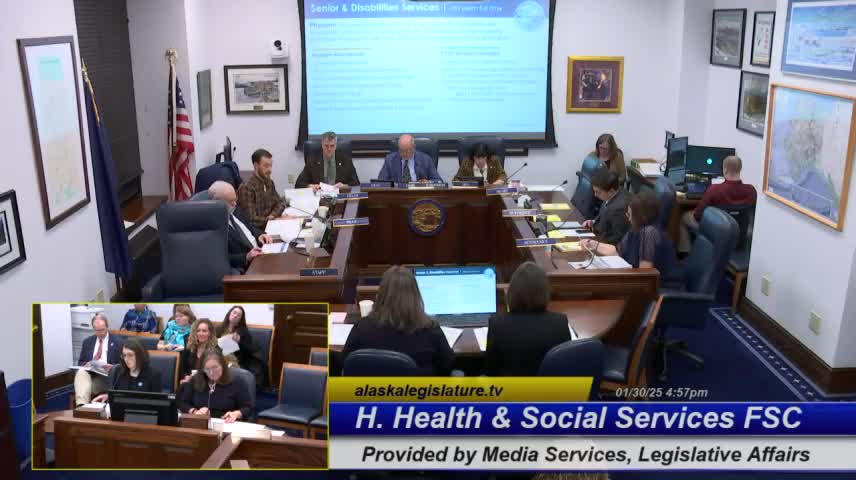
The House Finance Department of Health subcommittee received several operational updates for the Division of Senior and Disability Services on Thursday, including investments in coordinated access and a new data linkage to identify systemic issues.
Deputy Commissioner Emily Ritchie explained the department’s InterRAI assessment tool (referred to in testimony as “inter eye”), an evidence‑based assessment intended to improve person‑directed care and budget allocation for home‑and‑community‑based waiver services. Halloran and Ritchie told the committee that a multiyear appropriation for InterRAI will reverse for FY26 and that the remaining balance will carry forward per the appropriation’s terms.
Ritchie described a $300,000 MTAR (coordinated access) request to support a No Wrong Door approach that trains a network of providers to connect people to home‑ and community‑based services without requiring individuals to repeat their story. The subcommittee heard that the No Wrong Door project is intended to improve access and navigation for long‑term‑services and supports.
The division has also implemented a new system called PulseLight to connect reporting systems (Harmony) with Medicaid claims adjudication to identify patterns that may not surface through incident reporting alone. Ritchie said PulseLight can surface system‑level patterns — for example, multiple residents at a facility experiencing falls shown in claims data even when critical incidents were not reported — enabling earlier intervention.
The division also described recent organizational changes including establishment of a multidisciplinary team to support screeners and staff training. The Senior and Disability Services FY26 budget was presented as just under $73,000,000, a small decrease primarily tied to the reversal of multiyear and one‑time items.
Committee members asked for followup on restoring infant learning program funding and on responses to an ombudsman report; the department said it would provide more detail in division hearings.