Get Full Government Meeting Transcripts, Videos, & Alerts Forever!
Get email alerts on the Reeds Act Reading topic
No spam. Unsubscribe anytime.
State reports early reading gains under REEDS Act but third‑grade proficiency still lagging, DEED says
Summary
DEED officials told the House Finance Education Subcommittee that early reading interventions reduced kindergarten and first‑grade reading deficits in the agency's first year of implementation, while third‑grade improvements were smaller; the Alaska Reading Academy facility did not open for in‑person tutoring as planned.
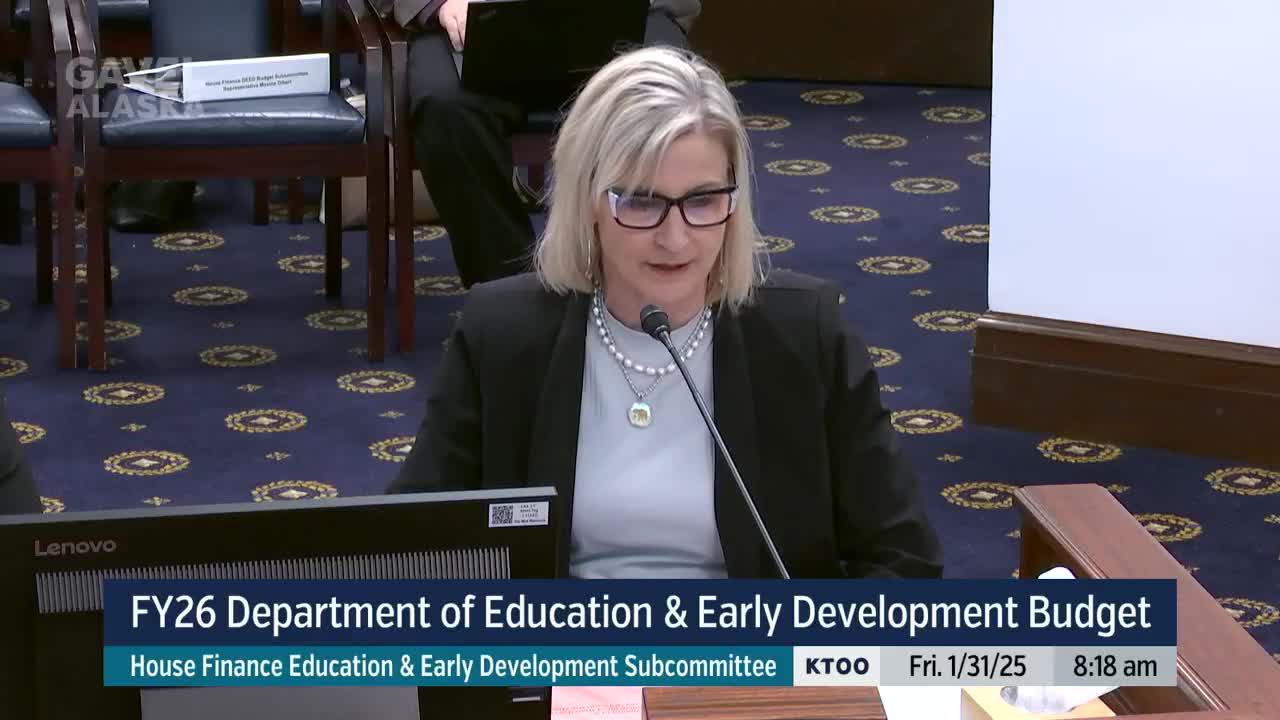
Department of Education and Early Development officials told the House Finance Education Subcommittee on Jan. 31 that the REEDS Act and related programs produced measurable early gains but that third‑grade proficiency remains a work in progress.
“REEDS Act…all students should be on grade level by 3rd grade,” Commissioner Dina Bishop told the committee while describing the statute’s accountability features. Bishop said the law prescribes assessments and interventions and that the first year of statewide screening showed marked reductions in students classified as “well below” grade level.
Bishop said kindergarten showed the largest improvement, with students in the lowest category reduced by roughly 20 percent. On first grade she said, “at the end of the year, over 61% of our 1st graders had the skills and were assessed on the skills, the independent skills necessary to start 1st grade in a better place.” She added that second‑grade results also improved and that DEED outpaced national means in some grades.
By contrast, Bishop said, third‑grade reading improved less: “Once you get to 3rd grade, you are having more comprehension. The stakes get higher for you, and we did not, even with all of our efforts, move 3rd grade that much,” she said.
Bishop also updated the committee on the Alaska Reading Academy, a tutoring initiative established as part of recent reading investments. She said the facility never opened for in‑person tutoring this year and that much of the initial work shifted to remote tutoring and district‑run summer programs.
“The facility was never operated. It was planned to, to be built out,” Bishop said. She told lawmakers that the department redirected some purchased equipment and funds to districts for summer intervention and tutoring after in‑person plans were delayed by building inspections and weather.
The REEDS Act also requires district reading improvement plans and parent notification. Bishop said district reading coaches and participating districts received program support in the first year and that the department will continue oversight and programmatic work in subcommittee meetings scheduled later in the session.
Lawmakers asked for geographic breakdowns of reading gains and for clarification on which districts participated in the statewide screener; Bishop said two districts did not participate in the DIBELS‑8 screener this year and that DEED will provide more detailed, district‑level data on request. She said the department will continue to present REEDS Act program details in regular committee meetings.