Get Full Government Meeting Transcripts, Videos, & Alerts Forever!
Get email alerts on the Medicaid Redeterminations topic
No spam. Unsubscribe anytime.
Alaska health subcommittee hears redetermination update as Medicaid budget eyed for FY26
Summary
Deputy Commissioner Emily Ritchie told the House Finance subcommittee the Department of Health has about 17,000 Medicaid redeterminations left and expects to finish them by March 31; department staff also outlined FY26 Medicaid projections and budget drivers.
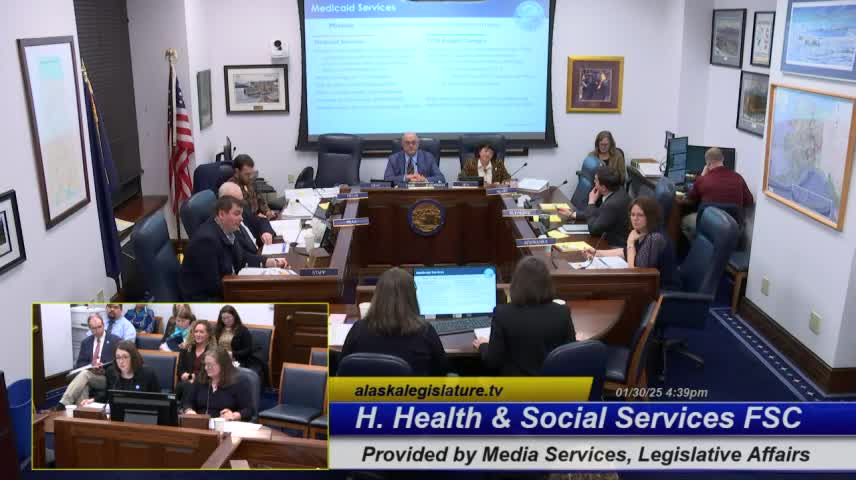
The Alaska House Finance Department of Health subcommittee was updated Thursday on Medicaid redeterminations and early FY26 Medicaid budget projections.
Deputy Commissioner Emily Ritchie, Department of Health, told the subcommittee that the department “finished implementing the initial determination for all Medicaid recipients in September of this year” and that “there's about 17,000 left, and we will finish up with those by the end of March, March 31st.” The committee heard that enrollment figures are still changing: “the last enrollment number I had was in December and there was 246,000 Medicaid enrollees in the program which is about 6,000, 6 to 7,000 less than when we started in March of 2023,” Ritchie said.
Why it matters: redeterminations, reinstatements and ongoing “churn” will affect near‑term enrollment counts and therefore budget projections and state‑federal match calculations. Ritchie told the panel that many disenrollments are procedural and that individuals have a 180‑day window to be reinstated; she warned the subcommittee that “it's going to be, probably at least another 6 to 9 months before we really know what the effect of redetermination was on the overall Medicaid enrollment.”
On budget totals, Assistant Commissioner Pam Halloran and Department staff presented high‑level figures. The department said the FY26 Department of Health budget is “just over $3,500,000,000,” a change the department described as primarily reflecting the end of multiyear and COVID appropriations. The department also told members that the Medicaid appropriation for FY26 is roughly $3.0 billion (presented as “just under $3,000,000,000”), and that a reversal of a multiyear appropriation for the InterRAI assessment tool accounts for a portion of a small change between FY25 and FY26.
The department has delivered Medicaid projections to the Legislature per legislative intent; Halloran told the committee the next Medicaid projections will be delivered on Feb. 19 and will reflect rate changes and other updates.
Committee members pressed the department for context on who is being disenrolled and why. Representative Prox asked whether procedural errors or income changes drove disenrollments; Ritchie said both occur and that procedural reasons—such as the failure to return required forms—account for a substantial share of removals, especially late in the review process. Representative Fields noted health and budget effects of churn and applauded the department’s efforts to reduce it, saying that short‑term savings can lead to higher downstream acute costs.
The department emphasized uncertainty in short‑term enrollment effects and highlighted that while overall enrollee counts may drop, utilization patterns show a concentration of costs: Ritchie said “about 67% of the cost of the Medicaid program accrued to about 10% of the population with those really acute needs,” and the department reported an increase in members with higher acuity.
The subcommittee did not take formal action on Medicaid policy at the meeting; staff and department officials said additional data and the February projection will inform later deliberations.