Get Full Government Meeting Transcripts, Videos, & Alerts Forever!
Get email alerts on the Education Omnibus topic
No spam. Unsubscribe anytime.
Dunleavy outlines omnibus education bill: charter expansion, reading incentives, transportation and teacher pay proposals
Summary
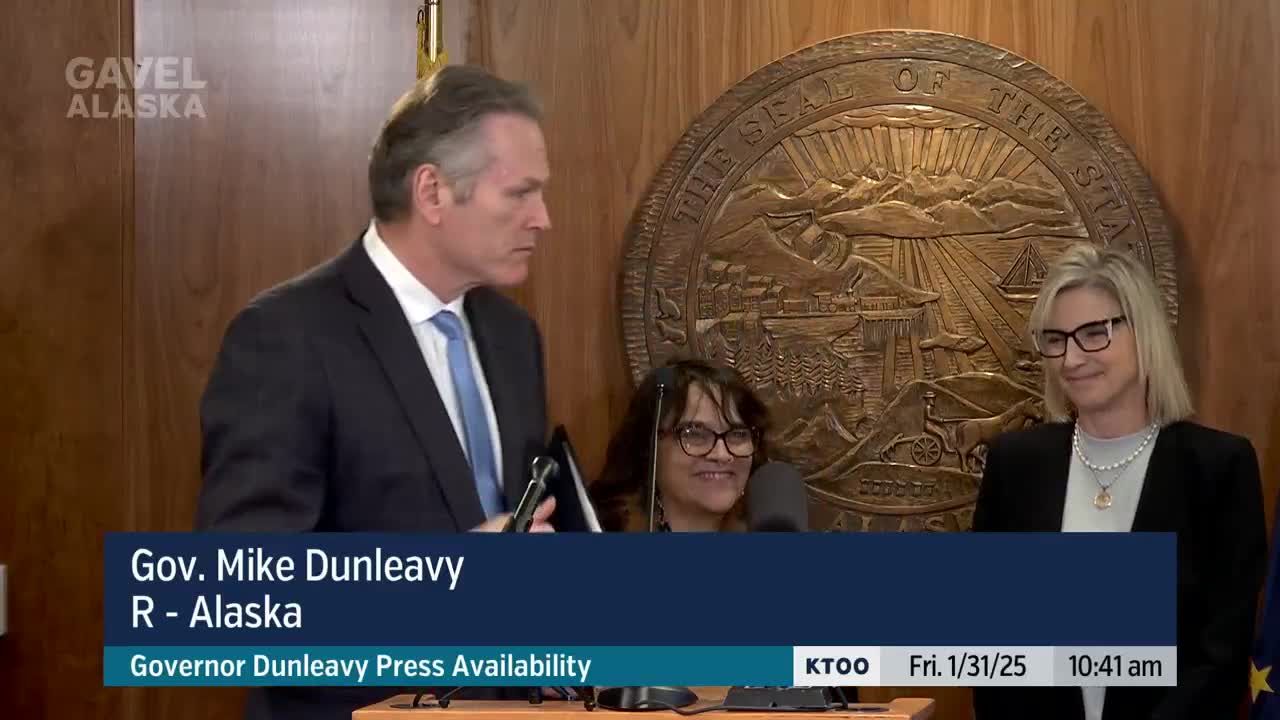
Governor Mike Dunleavy and Alaska education officials presented an omnibus education package that pairs targeted funding changes with new policy measures intended to boost reading outcomes, expand public charter access and increase supports for rural and correspondence students.
Governor Mike Dunleavy and Alaska education officials presented an omnibus education package that pairs targeted funding changes with new policy measures intended to boost reading outcomes, expand public charter access and increase supports for rural and correspondence students.
Dina Bishop, commissioner of the Department of Education and Early Development, framed the proposal in the context of Alaska's recent National Assessment of Educational Progress (NAEP) results. "The 2024 NAEP results should serve as a wake up call," Bishop said, noting Alaska ranked near the bottom of NAEP reading and math comparisons she cited during the briefing.
Officials described principal components of the omnibus bill as follows (figures and program descriptions as stated at the briefing):
- Reading incentive: schools would receive $450 for each student in grades K–6 who meets grade-level reading standards or demonstrates growth toward those standards, and the bill also provides incentives for demonstrated growth below the proficiency threshold.
- Charter authorization and enrollment flexibility: the proposal would expand which public entities can authorize charter schools to include the state Department of Education, municipalities and the University of Alaska, in addition to local school districts; officials said the change is aimed at accommodating students on charter wait lists.
- Transportation and boarding funding: the bill would increase transportation funding by 20% and raise boarding-school per-pupil funding by 50% to support residential and remote programs.
- Correspondence programs: funding for correspondence students would move from an average daily membership allocation of 90% to full (100%) funding, officials said, so those students would access special education, gifted and career education resources on an equal basis.
- Career and technical education: the package includes additional CTE funding, with officials citing a $32,000,000 adjustment targeted to expand access statewide.
- Teacher recruitment and retention incentives: depending on remoteness, teachers would receive $5,000, $10,000 or $15,000 annually for a three-year period, the administration said.
Lacey Sanders, director of the Office of Management and Budget, described the proposed dollar amounts and the administration's recent investments: "We've invested close to $500,000,000 in education" over the last three years through one-time funding, she said, and the proposed omnibus bill would add approximately $117,000,000 in 2026 and increase up to $181,000,000 in later years as the package phases in.
Speakers also cited a national study of charter outcomes and said Alaska charter systems performed well in that research. Dunleavy and Bishop said the administration wants to combine policy changes with funding — not treat money and policy as separate choices — and repeatedly framed the package as a response to student-performance data.
During question-and-answer, officials were asked about local control, the basis for expanded authorizers and the effect of moving to statewide open enrollment for public schools. Dunleavy said expanded authorizers would remain public entities and described the state Department of Education as a legitimate public authorizer; Bishop added that allowing students to apply to any public school across the state (subject to capacity) is an explicit goal of the bill.
The briefing included no committee votes or enactments; officials said the bills were newly introduced and would advance through the legislative process. The administration urged the Legislature to pair policy changes with sustained funding and said some components would require statutory changes.