Get Full Government Meeting Transcripts, Videos, & Alerts Forever!
Get email alerts on the Tribal Education Compacting topic
No spam. Unsubscribe anytime.
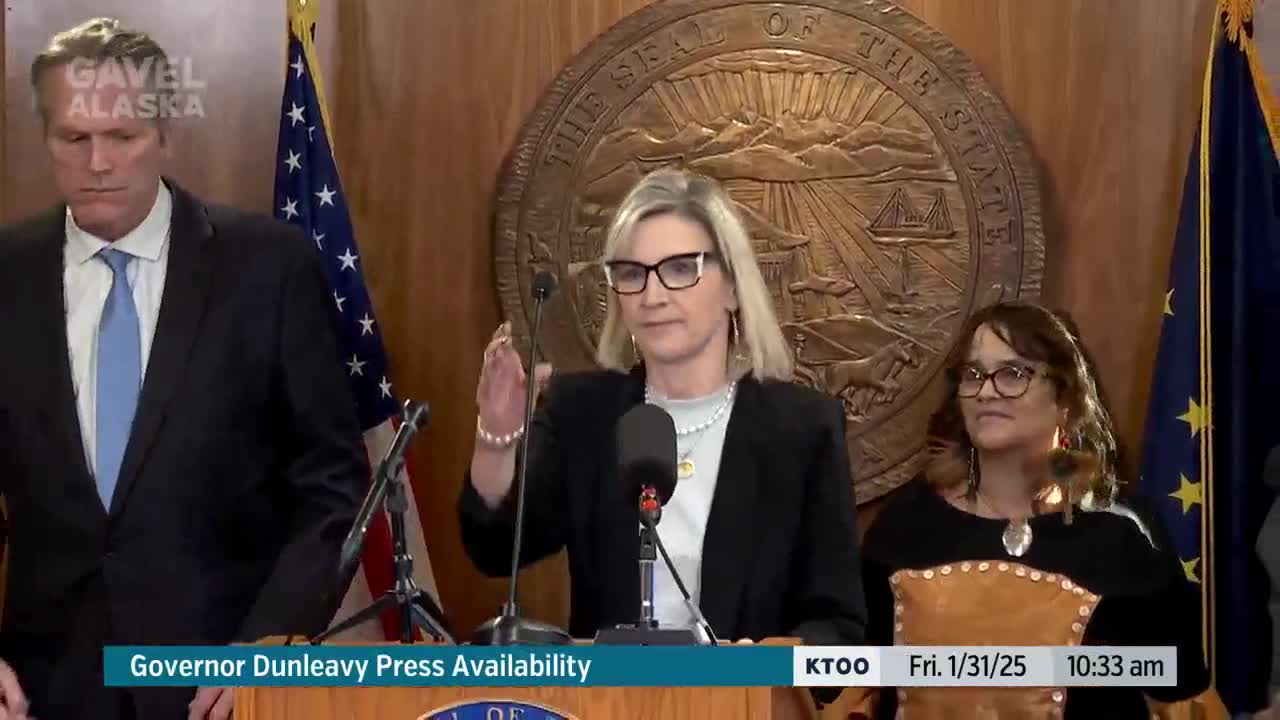
Dunleavy, education officials unveil bills to allow tribally controlled public schools
Summary
Governor Mike Dunleavy and Education Commissioner Dina Bishop introduced legislation to enable tribally controlled public schools through tribal compacting, citing a multi-year development process and a pending House tribal affairs hearing on related legislation.
Governor Mike Dunleavy and Alaska Department of Education leaders announced legislation to create tribally controlled public schools under a tribal-education compacting framework, naming Senate Bill 66 and House Bill 509 as vehicles for the proposal and noting a House tribal affairs committee hearing on House Bill 59 next week.
Dina Bishop, commissioner of the Department of Education and Early Development, said the compacting effort grew from a 2017 state board of education directive and a pilot that allowed collaboration with up to five tribes to develop a model for tribal public schools. "That bill allowed the state board of education to collaborate with up to 5 tribes to develop a outline legislation for a tribal education public school," Bishop said.
The presentation framed the proposal as an expansion of public-school options rather than a separate private system. Sonya Scan, identified as education and training director and lead compacting negotiator for the Ketchikan Indian Community, described the proposal as a mechanism to let tribes design public schools suited to local communities. "This would be a tribally controlled public school. So it's open to everyone and how each tribe in each community does their school will be focused on what works for their communities," Scan said.
Dr. Joel Isaac, introduced by Bishop as a lead on the compacting project and identified in the remarks as cultural preservation and language director for the Coneitsee Indian Tribe, and other tribal partners were credited with developing the approach. Bishop said the compacting concept was modeled in part on tribal health compacting and has been in development for multiple years.
Bishop and Dunleavy traced the policy path to the state board's 2017 work and subsequent reports that led to draft legislation. Bishop said next week the House tribal affairs committee would hold the first hearing on House Bill 59, which will feature presentations from tribal partners. No committee votes or legislative outcomes were reported at the press event.
Officials said the compacting model is intended to unite state and tribal leadership to provide more public-school options while preserving tribal authority over curriculum and language. Speaker comments repeatedly emphasized that the proposed tribally controlled schools would be public and open to all students in the state.
The announcement included no formal vote or final legislative action at the press conference; staff said the bills were newly introduced and would move through the Legislature according to regular committee processes.