Get Full Government Meeting Transcripts, Videos, & Alerts Forever!
Get email alerts on the Budget topic
No spam. Unsubscribe anytime.
Labor department says TVEP reauthorization drove jump in training dollars, seeks language change to speed payouts
Summary
Department of Labor and Workforce Development officials told the House Finance subcommittee that a recent reauthorization of the Training and Vocational Education Program increased designated general fund (DGF) training dollars and that placing TVEP language in the budget would allow faster distribution to training providers.
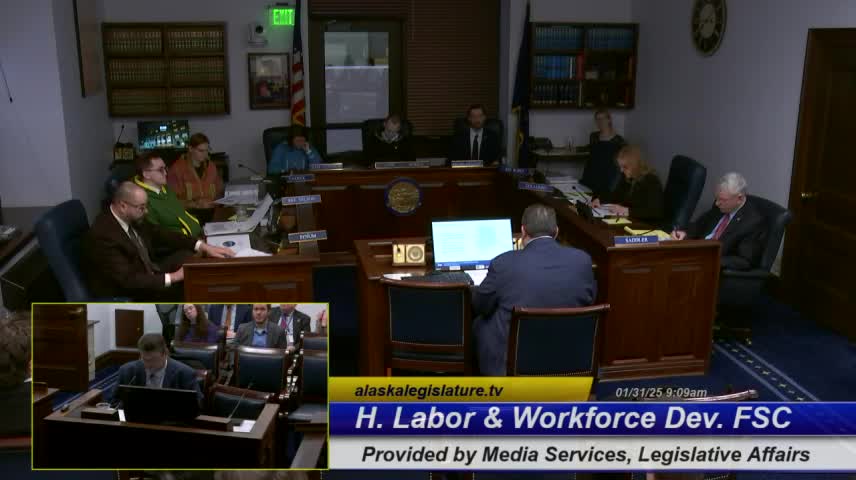
Dan DiBartolo, administrative services director for the Alaska Department of Labor and Workforce Development, told the House Finance Department of Labor and Workforce Development Subcommittee on Jan. 31 that recent changes to the Training and Vocational Education Program have increased training dollars available to grant recipients.
DiBartolo said the department’s 10-year budget look-back shows a jump in DGF that “is largely explained” by a TVEP reauthorization and related changes to the percentage of revenue the program can retain. He told committee members the change made more training funds available this year.
The department asked the Legislature to move TVEP language into the budget’s language section so officials can authorize additional trainee dollars quickly if actuarial revenue projections change. “Currently, in the numbers section, we can’t just say, ‘hey, more revenue is here,’” DiBartolo said. Placing the authority in the language section would allow the department to work with the Office of Management and Budget to distribute additional funds without a supplemental appropriation, he said.
Why it matters: TVEP and related designated general fund changes affect which training providers receive funds and how quickly money can be distributed. The department said the change would let it move money to providers faster when UI-trust revenues increase.
Budget trends and recent history: DiBartolo traced the department’s reductions in Unrestricted General Fund (UGF) across FY 2015–FY 2018, and noted one-time multiyear allocations in FY 2023–FY 2024 that temporarily raised UGF. He also said the department’s reliance on DGF-derived tuition and TVEP revenue has increased AVTEC’s revenue volatility because enrollment affects available funds.
Related items mentioned to the committee included a $240,000 training partnership request with the Department of Transportation that did not move forward and several earlier program reductions (youth grants, oil and gas training and others) during the FY 2015–FY 2018 period. DiBartolo said some recent fund increases were finite multiyear allocations and that the department expects those to expire.
What the department will return with: DiBartolo said the subcommittee will receive a more detailed presentation next Wednesday on three items tied to late changes last year—workers’ compensation, mechanical inspection and the Alaska Safety Advisory Program—to cover fiscal notes and divisional impacts.
Ending: The department characterized the TVEP language change as an administrative fix to speed distribution of trainee dollars rather than a request for new funds. The subcommittee scheduled follow-up briefings to review the worker-protection items and other FY 2026 proposals.