Get Full Government Meeting Transcripts, Videos, & Alerts Forever!
Get email alerts on the Civil Legal Aid Funding topic
No spam. Unsubscribe anytime.
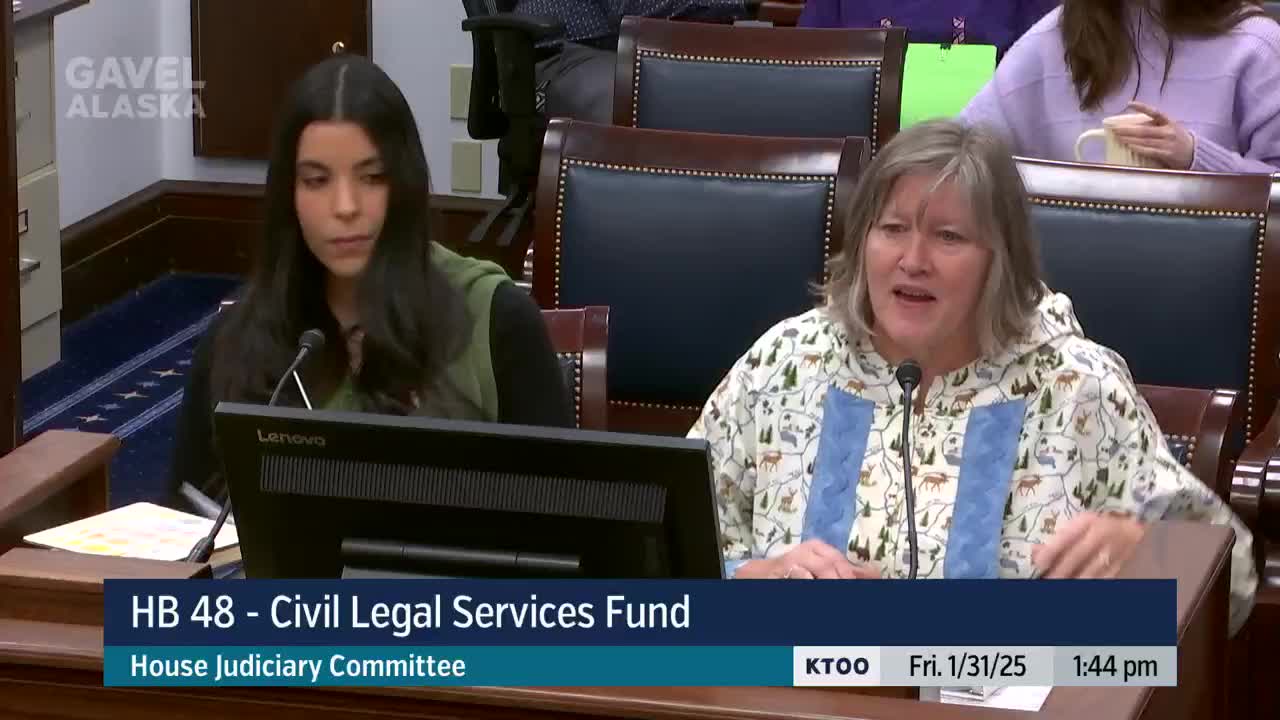
House Judiciary Committee hears bill to raise civil legal services fund cap to 25% of court filing fees
Summary
A House Judiciary Committee hearing on Jan. 31 reviewed House Bill 48, which would amend the civil legal services fund cap from 10% to 25% of court filing fees and set out fiscal projections and scheduling for further action.
ANCHORAGE — The Alaska House Judiciary Committee on Jan. 31 heard testimony on House Bill 48, a proposal from Rep. Sarah Hannon to amend state law to allow the legislature to appropriate up to 25% of court filing fees to the civil legal services fund that supports Alaska Legal Services (ALSA), the committee chair said at the start of the hearing.
Rep. Sarah Hannon, sponsor of HB 48, told the committee the bill "is a very straightforward piece of legislation" that "changes what is currently a 10% to 25%" in the statute establishing the civil legal services fund. The bill would amend the statutory cap in AS 37.05.590 to permit an appropriation of up to 25% of the prior fiscal year's court filing fees to the fund.
Why it matters: Alaska Legal Services (ALSA) provides free civil legal aid to low-income Alaskans, including domestic violence survivors, seniors and veterans, and ALSA and the bill's backers said the extra funding would allow the nonprofit to serve more clients and reduce court strain. Maggie Hamm, executive director of Alaska Legal Services, said: "Passing HB 48 would help promote the core American value of fairness and equal access to our justice system and help to protect more vulnerable Alaskans." Hamm told the panel ALSA provided direct representation in more than 6,210 cases in state fiscal year 2024 across 204 communities and that the organization turns away roughly one person or family for every household it serves.
Fiscal picture and projections: Committee members pressed for clarity on the fiscal note. Division of Community and Regional Affairs director Sandra Mueller said the fiscal materials needed a correction on one line and explained the numbers used in the fiscal estimate. The fiscal note uses FY24 filing-fee collections as its baseline: those filing fees were reported as roughly $3,125,000 for the most recent year. Under that projection, 10% equals about $312,000 and 25% equals about $781,000; the fiscal note shows the governor's FY26 request includes $312,600 and the bill would add an incremental $468,900 to reach a 25% cap in out years, for a total projected ongoing amount of about $781,500 if fully appropriated.
Legal and procedural limits: Committee members asked whether the statutory cap change is necessary given a state supreme court decision referenced in the hearing. Legislative Counsel Daniel Wayne told the panel, "I think the statute would need to change in order to go over 10%." Alaska Court System General Counsel Nancy Mead explained the mechanics: "All of the court's filing fees go to the general fund," she said, and HB 48 would authorize a transfer from the general fund into the civil legal services fund; the court system does not control transfers after revenues are deposited to the general fund.
Program context and capacity: Hamm and sponsor Hannon described how ALSA uses a mix of federal, state, local, tribal, foundation and private funds, and volunteer and community-justice-worker models to stretch limited resources. Hamm told the committee ALSA's annual budget is about $10.3 million and that the current amount coming from the statutory filing-fee share is roughly $296,400 in the current year; she said the organization estimates every additional $100,000 would allow ALSA to serve roughly 182 more Alaskans. Hamm added that about one-third of ALSA's clients are older than 60 and noted many services are resolved without formal court filings.
Eligibility and demand: The bill does not change ALSA's client eligibility, which is set in statute at 125% of the most recent federal poverty guidelines. Committee members discussed whether that threshold should be adjusted and the administrative trade-offs of changing eligibility; Hannon and Hamm said expanding eligibility without a commensurate funding increase would enlarge the unmet need. Hamm said some grants allow higher income thresholds for targeted populations (for example, certain senior programs) and that ALSA's accounting and case management systems already track multiple funding sources and differential eligibility rules.
Committee questions and technical clarifications: Members raised multiple technical questions about the fiscal note and the underlying data. Mueller acknowledged an earlier error in the fiscal note’s labeling of federal receipts and clarified that the anticipated transfers would come from the general fund to Alaska Legal Services. Committee staff and witnesses said additional fact sheets and breakdowns of case types would be provided to the committee record after the hearing.
Next steps: Chair Rep. Gray set an amendment deadline of Thursday, Feb. 6, and scheduled public testimony on HB 48 for Friday, Feb. 7, and warned members to coordinate amendments with committee aide Nate Graham. The committee took no final vote on HB 48 at the Jan. 31 hearing and adjourned after testimony and questions.