
Englewood council retreat focuses on finishing strategic plan, lead-service funding, infrastructure and safety communications
Get AI-powered insights, summaries, and transcripts
Subscribe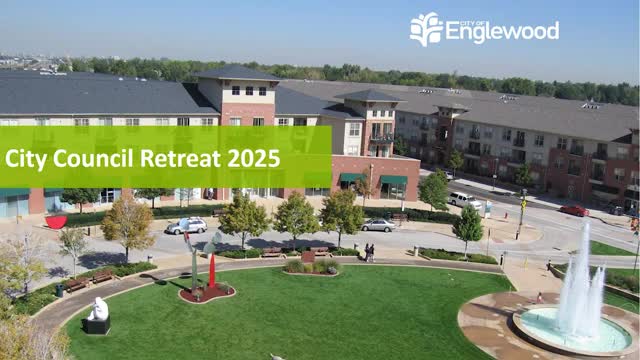
Summary
At a Jan. 2025 retreat, Englewood City leaders and staff reviewed progress on the city's strategic plan, heard project updates on stormwater repairs, lead-service-line replacements and transportation projects, and debated how to improve residents'sense of safety and the city's external communications.
Englewood City Council and staff used a daylong retreat in 2025 to refine the city's strategic plan, review progress on capital and program work and direct staff on several policy and communication priorities.
The meeting centered on three near-term priorities: finish and update the existing strategic plan for 2025, continue major infrastructure work already under way (stormwater repairs and a federally funded lead service-line replacement program) and sharpen public safety and communications work after survey results showed a drop in residents' sense of safety.
The retreat was led by an outside facilitator, who opened with governance principles and a caution about requests to staff: "everything you say is urgent and important," he said, urging council members to use explicit timeframes when asking staff to act. That framing guided later discussions about what council expects staff to deliver during this year and what items should be elevated for budget or regional coordination.
Infrastructure and utilities
Public works staff reviewed several high‑cost active projects. Victor, a Public Works staff member who presented stormwater work, said the city successfully recovered federal reimbursement for recent repairs after a sinkhole and related damage: "over $850,000 were recovered and returned to the stormwater fund," he said. Public Works also reported that the long-running lead service‑line replacement program started in July and has completed roughly 500 household replacements so far. Presenters stressed the work is funded primarily with grants: the project brought in roughly $10 million in federal and grant funding, which staff said covers homeowner-side replacements.
Staff clarified how costs are split under the state and federal rules: grant dollars cover the homeowner side of the service from the curb to the house (what presenters described as ensuring "no cost to residents" for that portion), while the city will finance and repay the portion of the service from the curb to the water main via a previously authorized fee. Presenters estimated a $5 monthly charge tied to debt service would generate about $660,000 a year toward roughly $1.8 million in annual debt service for the project.
Transportation and public works projects
The council heard progress reports on Dartmouth Bridge work, the South Bengal flood‑reduction tunnel and other corridor projects funded through regional grants. Staff said the South Bengal tunnel breakthrough is complete and that the project is on track for substantial completion in early 2025 quarters. On Dartmouth Bridge, staff explained construction sequencing and utility coordination (including work by Xcel) has delayed final paving timelines.
Council members pressed staff about traffic calming and pedestrian safety. Council expressed clear interest in a city traffic‑calming program; staff replied the program will be launched with consultant support and that the city's newly approved traffic engineer position this past year is starting to address the backlog of pedestrian and safety projects. Staff said federal grant processes and staffing capacity have contributed to delays on some transportation deliverables.
Public safety, technology and perceptions of safety
Police and public safety staff briefed the council on technology, community outreach and facility improvements. Presenters flagged two parallel streams: investments in operational technology (drones, mobile cameras and evidence workflows) and work to improve employees'sense of safety at city facilities. One presenter described the prospect of "drones as a first responder" for quick situational awareness once FAA operational constraints are resolved.
Council members raised the city's community survey results showing a drop in residents' feelings of safety (the retreat packet compared the 2024 figure with prior years). Council member Russell said directly: "the community overall does not feel safe," and urged polished outreach and policy steps that better align residents'perceptions with the city's investments. Staff agreed to add a focused goal to the strategic plan to address resident perceptions of safety alongside the operational policing and response metrics already tracked.
Strategic plan and governance
Presenters reviewed the 2020 strategic plan's structure and work completed in 2024. The council spent much of the afternoon proposing wording changes and relocations of specific goal statements. The retreat's working method combined quick votes and wordsmithing: several goals were reworded (for example, replacing aspirational shorthand with explicit language about life‑cycle cost analysis for infrastructure and adding targets for tracking performance metrics); others were flagged for study‑session follow up rather than immediate removal.
Sustainability, community programs and economic development
Sustainability staff highlighted the new "at‑your‑door" hazardous‑waste and electronics pickup service (a pickup program contracted for a limited number of households that staff said increased access for residents) and the Sustainable Business Partnership launched with Sheridan and Littleton to provide free technical assistance to local businesses. The city also funded six grassroots sustainability grants in 2024 and is planning a draft tree‑protection ordinance to come before the council in the coming months.
On economic development, staff described the recent transfer of the City Center ground lease to a developer group; staff said initial meetings are planned with the new ground‑lease holder and that the council will see a redevelopment briefing and options for next steps.
What council directed and next steps
The retreat produced several near‑term directions for staff: finish and close out the current plan year, include life‑cycle cost analysis and targets when new infrastructure projects are proposed, begin a traffic‑calming implementation program (with consultant support and the traffic engineering position), continue the lead‑service replacement work under the existing grant plan while keeping residents informed about the fee structure, and prepare a focused study session on public communications and the city's strategy to improve residents'sense of safety.
The council also asked staff to return to a later study session with refined language and budget impacts for several items (traffic calming, community events strategy, and options for addressing vacancy and commercial blight in business districts). The city will monitor performance metrics quarterly and present progress toward targets in advance of the FY2026 budget discussions.
The retreat was largely procedural and advisory: no formal legislative actions or votes were taken. Council members asked for additional follow‑up briefings and a short list of specific measurable deliverables staff will pursue in the coming months. The next formal step is a follow‑up study session scheduled as part of the regular council calendar, at which staff will present refined wording and budget implications.
Ending
Council members said the retreat clarified expectations for staff and set priorities for the next year's strategic work, while staff noted the additional workload created by several new implementation requests. Presenters and council members agreed to return to a formal study session to finalize language and budget priorities before the FY2026 budget process.