
House Education hears superintendents' research-backed recommendations on district consolidation, school and class size
Get AI-powered insights, summaries, and transcripts
Subscribe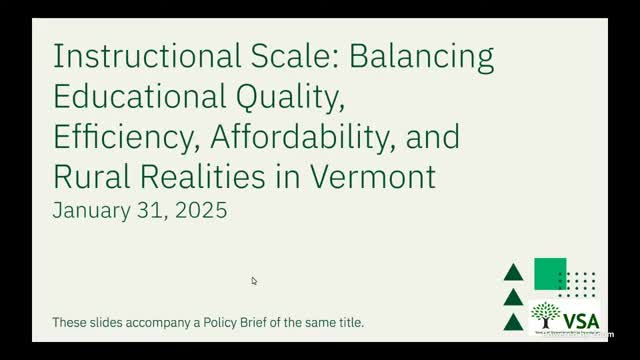
Summary
The House Education Committee heard a presentation from the Vermont Superintendents Association and Maple Run School District leaders outlining research and practical recommendations on district consolidation, school size, and class-size policy, including suggested minimums and cautions about implementation costs and local geography.
Chelsea Myers, executive director of the Vermont Superintendents Association, told the House Education Committee on a January 2025 meeting day that research on district consolidation and school size is mixed and must be paired with implementation plans that account for local geography, facilities and staffing.
Myers said policymakers should “balance quality and efficiency” and recommended the Agency of Education work with districts toward district sizes of about 2,000 to 4,000 students, while setting minimum school-size thresholds and clearer staffing reporting. The presentation stressed that governance changes alone do not guarantee improved instructional quality and urged careful sequencing of governance, delivery and funding changes.
The recommendations respond to recent state proposals that would consolidate districts. Myers cited several research findings and state studies, including a Vermont prototypical district size of about 3,900 students from the Vermont Adequacy Study (the PICUS report), research finding potential diseconomies of scale above roughly 10,000–15,000 students, and a 2024 Education Commission of the States note that transition costs can offset consolidation savings.
Bill Kimball, superintendent of the Maple Run School District, gave practical context from district experience and said larger unified governance can make some services quicker to approve. “Having 1 board to do that with, really made it about a 2 meeting decision,” Kimball said, describing how a single board enabled his district to launch a middle-level alternative program and reduce costs compared with contracting out services.
Key recommendations Myers and presenters outlined: - Set a target district size range of about 2,000–4,000 students in district quality standards and ask the Agency of Education to support movement toward that size over a reasonable timeline. - Reconfigure supervisory unions into unified school districts where appropriate and require newly formed districts to designate up to three public or approved independent high schools to serve students from merged nonoperating grades when needed (reference in statutory language cited in the presenters' paper). - Adopt minimum school sizes — the presenters suggested a 300-student minimum for elementary schools and a 600-student minimum for secondary schools as policy goals, while acknowledging infrastructure limits in many communities. - Clarify and require consistent staffing reporting by the Agency of Education to enable informed staffing- and funding-policy decisions. - Consider class-size guidance or minimums as a policy lever, with recommended minimum average class-size targets developed by local superintendents: kindergarten about 12 students; grades 1–5 about 15; grades 6–12 about 18 (presenters described these as minimums, not maximums, and said exceptions would be necessary for CTE and specialized instruction).
Presenters cautioned the committee that consolidation does not automatically yield savings or improved outcomes. Myers pointed to research showing a U-shaped cost curve where very small districts are inefficient, mid-range districts are most efficient, and very large districts can face diseconomies of scale and higher transportation and transition costs. The Education Commission of the States, the presenters said, has noted transition costs for new facilities, transportation and integration can offset expected savings.
Myers and Kimball emphasized implementation details and local constraints. Myers said Vermont’s complex mix of operating configurations, physical capacity and long bus times in remote areas can limit the feasibility of reconfiguration and that geographic necessity needs clearer definition. Kimball described operational trade-offs and said boards struggle with class-size decisions in budget seasons; he described Maple Run’s administrative overhead at about 4% and said centralization can allow schools to hire full-time specialists rather than fractional positions shared across buildings.
The presenters urged caution about adopting a foundation funding formula without aligning staffing rules and delivery mechanisms with Vermont’s declared education vision and the Education Quality Standards. Myers closed by asking legislators not to change the funding mechanism without changing delivery: “Please do not change the funding mechanism without changing some of the other delivery mechanisms,” she said.
Committee members asked for more data and clarified that many of the presenters’ figures are policy proposals that require further analysis, local facility reviews and definitions of geographic necessity. No formal votes or motions were recorded during this presentation; presenters asked for follow-up work and acknowledged further discussions would be needed to translate recommendations into statute or regulatory changes.
The presentation and discussion will inform continuing committee consideration of district consolidation proposals, district quality standards and staffing and funding discussions during the 2025 legislative session.