Get Full Government Meeting Transcripts, Videos, & Alerts Forever!
Get email alerts on the Federal Funding Omb Pause topic
No spam. Unsubscribe anytime.
Cuellar says OMB pause threatened federal aid to Laredo-area programs; judge temporarily blocked freeze
Summary
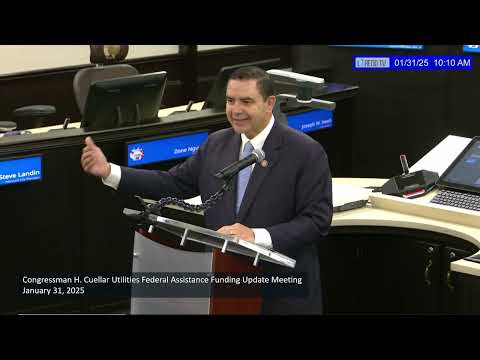
U.S. Rep. Henry Cuellar said an Office of Management and Budget memorandum and related executive orders issued in the new administration briefly threatened to halt federal obligations for thousands of programs that support Laredo and nearby counties, but a judge temporarily blocked the freeze.
U.S. Rep. Henry Cuellar said an Office of Management and Budget (OMB) memorandum and related executive orders issued in the new administration briefly threatened to halt federal obligations for thousands of programs that support Laredo and nearby counties, but a judge temporarily blocked the freeze.
"It would have affected over 26,100 individual programs," Cuellar said during a public briefing at Laredo City Hall. He outlined a timeline in which several executive orders were issued on Jan. 20, followed by an OMB memorandum on Jan. 27 that, he said, asked agencies to pause obligations and disbursements except for certain direct payments. Cuellar said OMB issued clarifications Jan. 28 and a judge blocked the freeze the same day.
The congressman listed types of programs that would have been affected, including WIC, SNAP, the Low Income Home Energy Assistance Program, Title I education grants, childcare block grants, Head Start, FEMA public-assistance and disaster programs, Small Business Administration disaster loans, firefighters staffing grants (SAFER), and Community Development Block Grants. "Head Start would have been just devastating," he said.
Cuellar described the legal backdrop in which he and appropriations staff view the pause: he cited Congress's constitutional power of the purse and the Impoundment Control Act of 1974 as constraints on unilateral presidential withholding of appropriations, and he referenced the Supreme Court case Train v. City of New York in explaining why such a freeze would face legal challenge.
Appropriations staff on the call said they were working directly with federal agencies to identify which programs could be affected. "There's still a lot of unknown at this moment, but we are working around the clock to figure out what programs will be affected," said Ryan, an appropriations staff member on the briefing.
Local officials and nonprofit leaders asked about specific programs. Cuellar said Pell Grants and other federal student-aid programs should continue; he said earmarks generally "should be fine" unless they fall under one of the executive-order categories (he identified ending DEI programs among the targeted items). He said the House majority's current appropriations language had zeroed out the migrant assistance earmark on the House side, while the Senate had previously included money for the program.
On immigration enforcement and local authority, Cuellar said there was currently no federal directive requiring local police or sheriffs to enforce immigration law and that such cooperation remained voluntary. "A lot of them don't think it's their job to enforce immigration law," he said, adding that historically some programs used biometric information from jails and that such tools could be used again.
Cuellar addressed a widely circulated personnel memo to federal employees and described uncertainty about its consequences. He said some agencies have asked employees to return to in‑office work and that a deadline mentioned in the memo had raised concerns; he said House Democrats were preparing follow-up discussions and that his office would seek further clarity.
He told the meeting he would follow up with local officials and staff where answers were not immediately available and invited attendees to contact his office for details. Cuellar also noted a planned local announcement of a separate congressional earmark for colonias and water-line work in Webb County and Laredo; he said about $20 million had been directed to the city and county for water infrastructure and that more details would be released later.
Cuellar repeatedly emphasized that the situation was evolving: "It's only week two," he said of the new administration, and he urged local leaders to contact members of Congress and appropriations staff to explain program priorities.
The briefing included questions from reporters and local officials representing school districts, community-action agencies, health clinics and county economic development. Appropriations staff pledged to deliver follow-up information about agency implementation of the OMB guidance and about any programs later identified as at risk.