Get Full Government Meeting Transcripts, Videos, & Alerts Forever!
Get email alerts on the Pensions Liquidity topic
No spam. Unsubscribe anytime.
State retirement systems $31 billion in assets; officials say asset mix and liquidity increased to meet $1.5 billion annual payouts
Summary
Department of Revenue and ARM Board staff told the House Finance Committee that the combined PERS and TERS systems stood at about $31 billion at June 30, 2024, that net withdrawals were roughly $1.5 billion in FY24, and that Treasury has increased fixed‑income allocations to support liquidity needs.
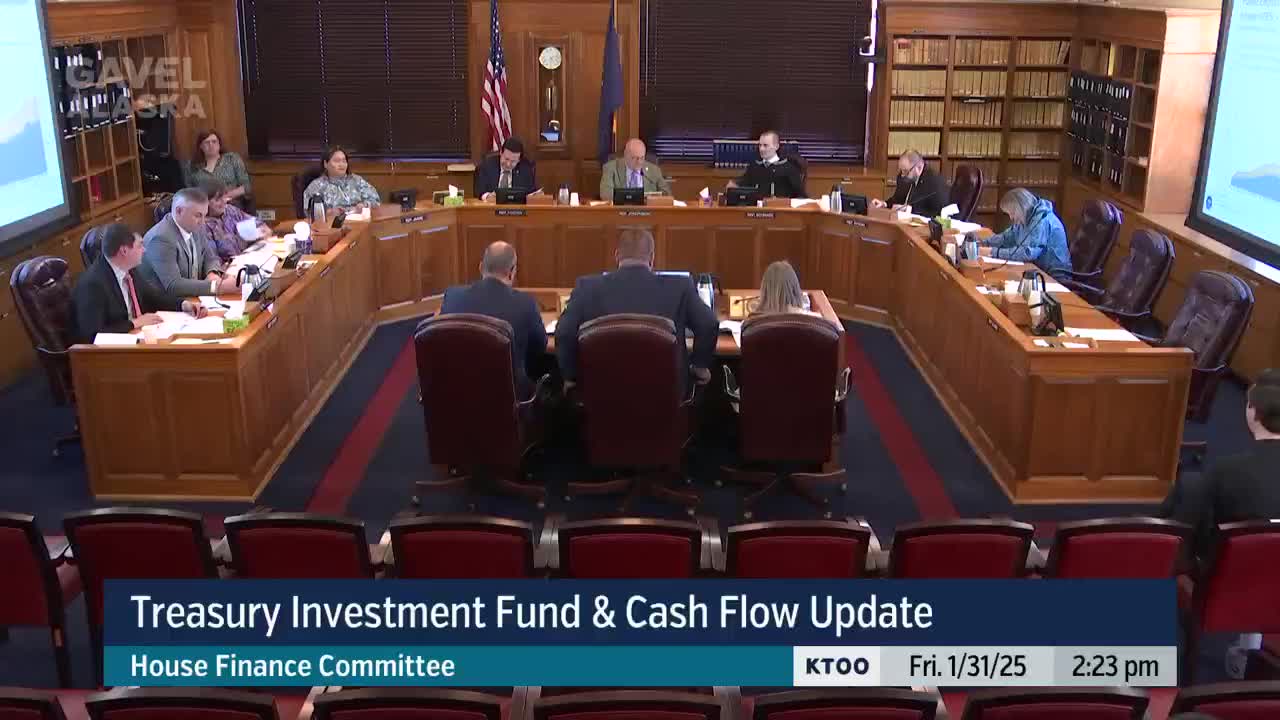
Juneau — Department of Revenue and Alaska Retirement Management Board staff told the House Finance Committee on Jan. 31 that the combined defined benefit retirement systems held about $31 billion at June 30, 2024, and that fiscal year 2024 recorded approximately $1.5 billion in net withdrawals (benefit payments exceeding new contributions).
Chief Investment Officer Zach Hanna and Treasury staff described adjustments to the retirement systems’ asset allocations to ensure benefit payments are available when due. “We certainly do need a higher proportion of liquid assets than you would need if you didn't have that cash outflow profile,” Hanna told lawmakers while describing changes in fixed‑income allocations.
Why it matters: Defined benefit plans carry hard‑dollar payout obligations to retirees; those payments do not adjust in proportion to asset values. Large or sustained market downdrafts could increase unfunded liabilities and would require policy responses, including higher employer contributions or other remedies.
Key details - System size and outflows: PERS and TERS combined were reported at around $31 billion with net withdrawals of roughly $1.5 billion for fiscal 2024 (the staff described those withdrawals as a recurring feature of closed defined‑benefit systems). - Asset allocation changes: Hanna said allocations have shifted toward more fixed income in recent asset allocations — from about 19% two years ago to about 23% last year — explicitly to meet liquidity needs while taking advantage of higher rates. - Current mix: Staff reported a long‑horizon asset allocation of roughly 43% public equities, 23% fixed income and 34% alternatives (private equity, private debt, real assets). - Expected long‑term returns and liabilities: Treasury cited a 10‑year return of approximately 7.9% (10‑year periodic calculation) and noted the actuarial assumed rate of return is 7.25%; staff said excess returns added value to the systems over the past decade but warned that prolonged poor markets would enlarge unfunded liabilities.
Committee concerns and modeling Lawmakers asked how many years of flat or poor returns the systems could withstand before the state would need to backfill liabilities. Hanna said modeling indicates the current liquidity posture is likely sufficient for multi‑year scenarios typical in actuarial stress testing but acknowledged that a significantly deeper or longer market decline would require state decisions on funding and amortization schedules.
Quotes from staff - Zach Hanna: “We certainly do need a higher proportion of liquid assets than you would need, if you didn't have that cash outflow profile.”
Bottom line Treasury and ARM Board staff told the committee they have increased fixed‑income allocations and modeled stress scenarios to preserve liquidity for benefit payments. Officials said current positioning is intended to meet near‑term payout obligations while preserving long‑term return objectives, and they committed to provide additional modeling details to the committee on prolonged low‑return scenarios.